


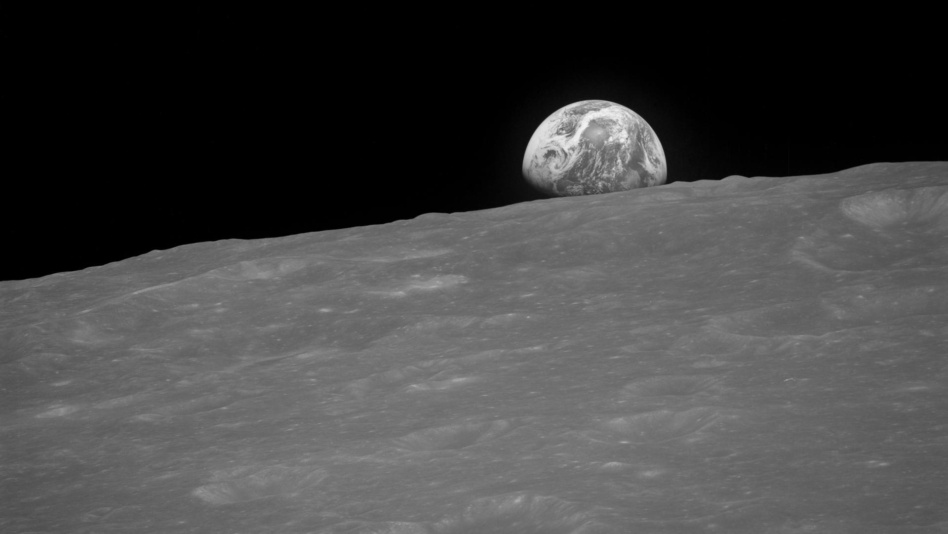
Once engineers solve the technical problems that stand in the way of a thriving lunar economy, it’s up to policymakers to set industry up for success on the Moon’s surface.
In the Moonshot Mechanics series this year, we’ve looked at the technical hurdles to a long-term lunar presence, including communications, rovers, human health, Earth return, and PNT. Today, we’re taking a more terrestrial look at the state of the lunar policy, and the open policy questions that could face industry when they arrive on the Moon’s surface.
Whose land is it anyways: If you want to mine on Earth, you must first buy the land containing the mine. This first step, while simple on Earth, is much harder on the Moon because companies’ property rights on lunar turf are unclear. Some legal experts say you can’t just claim the area where you set up shop.
“To operate at scale, you really have to think about how that’s going to work when you don’t have property rights on the Moon,” Clayton Swope, a senior fellow at CSIS, told Payload. “From a policy standpoint, that is a big question mark to me.”
Keep out: In a similar vein, there’s also no clear standard for safety zones on the Moon—despite all Artemis Accords signatories agreeing to them in principle. While nations who have signed on to the accords agree to protect certain lunar operations by keeping away, there are no details about what operations are covered, and how the duration and distance required differs among different missions.
That’s why Thomas González Roberts is studying this problem in his lab at the Georgia Institute of Technology.
“We’re modeling mining behavior, so rovers that start in one place and move to different high-value [latitudes and longitudes] to search for popular resources,” said González Roberts, an assistant professor in both the Sam Nunn School of International Affairs and the Daniel Guggenheim School of Aerospace Engineering. “I study how international organizations balance efficiency and equitability, which comes from this idea that states are willing to give up some efficiency…in the name of equitability.”
While the Artemis Accords seem like a good place to work out the details, since all the signatories have already agreed on the basics, González Roberts said that would leave out a key mover on the Moon: China. Instead, González Roberts hopes the conversion can begin at the United Nations Committee on the Peaceful Uses of Outer Space (COPUOS) —specifically, the body’s scientific and technical subcommittee.
“All space treaties came from the legal subcommittee,” he said. “But I want to take a different approach and see if I can get on the same page with Russia and China on the science and tech side, regarding how much space do you need to do things that all actors want to do on the surface of the Moon.”
Buy in: Others, however, said that the policy piece is the easiest piece to solve in the puzzle that is a long-term lunar economy. Casey Dreier, the chief of space policy at the Planetary Society, said the Artemis program surviving the proposed 2026 budget cuts to NASA—and the attempted pivot to Mars—shows that the program has staying power.
“Once you hit a tipping point in human space programs, they last decades,” he said, pointing to the space-shuttle and ISS programs. “We’re hitting the point in Artemis where the investment is so great, the momentum will carry it through any level of disruption absent something catastrophic.”
“The lunar presence…might be less expansive than we all had hoped, but it will be something, and that’s not to be dismissed,” he continued.
Sustaining Life on the Moon is Harder Than it Looks
Artemis requires scientists and researchers to find long-term solutions to the problems space creates for human health, replacing the short-term fixes that once sufficed.
Closing the Loop on Lunar Exploration: Material Return
Industry is working every day to establish a long-term, sustainable human presence on the lunar surface. But the challenge of creating a complete, end-to-end cislunar economy doesn’t end with touchdown—or even with setting up shop permanently on the surface. To close the loop, material from the Moon also has to make its way back to Earth.
Orion: The Spaceship That Will Carry Astronauts Back to the Moon
When four astronauts climb into NASA’s Orion spacecraft for the Artemis II mission, they will be doing something no one has done in more than half a century: leaving Earth for a journey to the Moon. Behind this historic flight is a spacecraft designed and built with one unmistakable priority—safeguarding its crew every step of the way.

International Competition is Driving the Moon Race
In the 21st century space race, the contest to reach the Moon feels less like the Cold War and more like Wacky Races.

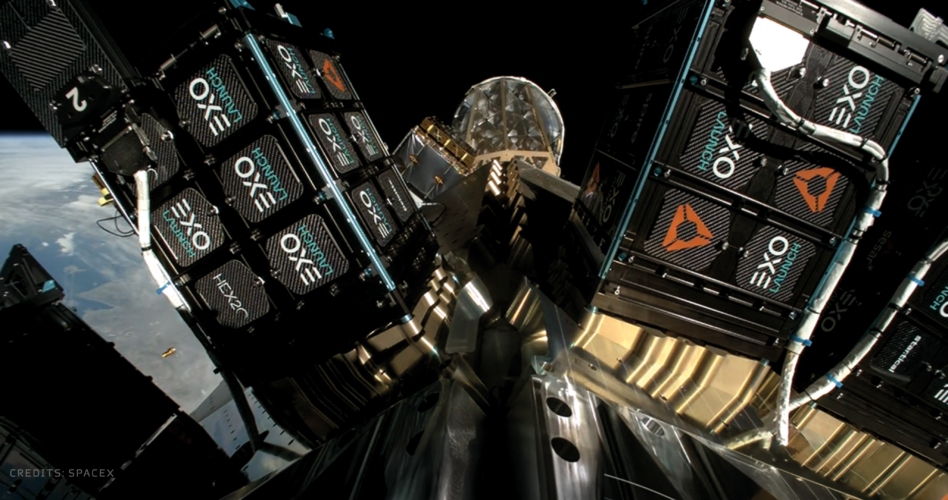
SpaceX is ready to bring customers on a sunset cruise.
In a new class of rideshare mission, scheduled for early next year, SpaceX will bring customer satellites to a unique sun-synchronous orbit over the Earth’s terminator—an orbit that allows satellites to scrutinize our planet at the moment of dawn and dusk.
Naturally, launch integrator Exolaunch is filling up the manifest. The German company, which has integrated sats on all of SpaceX’s Transporter and Bandwagon rideshare flights to date, will deploy 22 satellites on the Twilight mission. The payloads include six microsats, one ESA-funded tech demonstration, and over a dozen cubesats.
Keep reading