


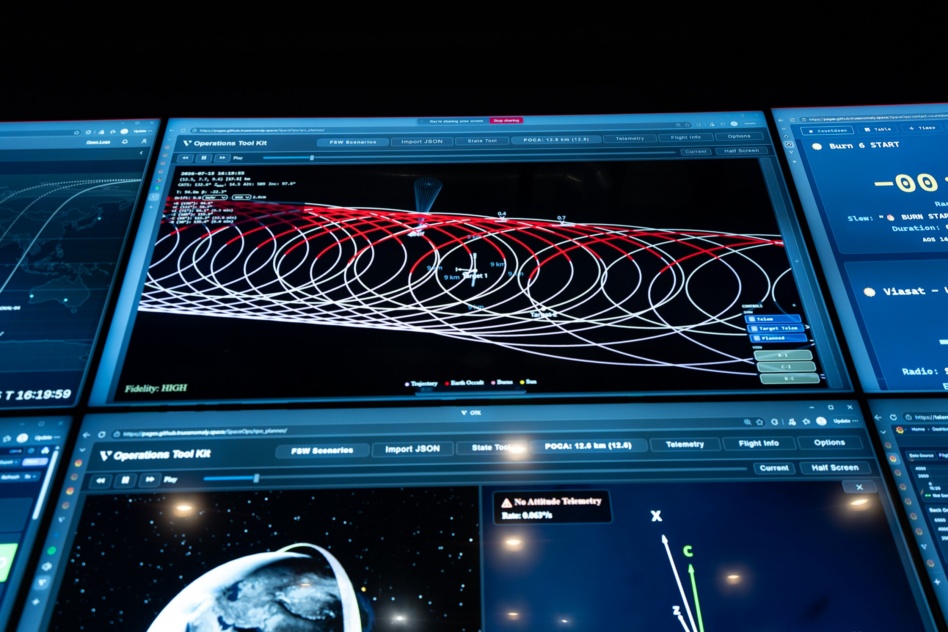
Hundreds of kilometers above the Earth’s surface, the Jackal stalked its prey.
Last week, True Anomaly said it had become the first company to execute an in-space pursuit of an evading target as part of a Space Force’s tactical responsive space mission—VICTUS HAZE.
For this sortie, True Anomaly’s Jackal spacecraft was tasked with tracking and imaging Puma, a Rocket Lab-built sat acting as the target—all while Puma was actively trying to shake Jackal off its tail.
“We understood that Jackal was capable for this next phase in the mission,” True Anomaly COO Sarah Walter told Payload. “The mission objective was different because in this case, the target was not going to cooperate.”
Mission accomplished: Most military exercises test the system rather than the people running it. This mission was designed to do the opposite. It was an escalation from True Anomaly’s first VICTUS HAZE objective in July, in which the spacecraft found and characterized a non-evasive Puma in an unknown orbit.
On July 14, SSC tasked the team with pursuit. As Jackal approached, Puma broke away, and Jackal had to track the movement, replan, and re-engage.
According to Walter, the sortie involved:
- Producing a validated mission plan within 30 minutes of tasking, then executing a 23-minute ingress and burn sequence to close in on Puma;
- Using Jackal’s ‘Multi-Object Detection and Tracking’ algorithm to generate target orbit estimates from Jackal’s own onboard measurements;
- Closing to ~10 km of Puma, within the target guidance of 10 to 20 km;
- Spiraling and circling back around Puma to image it, giving Jackal two opportunities to capture multi-aspect imagery.
In the loop: Even though Jackal achieved its mission objectives, the mission had a few surprises—such as higher than normal thermal temperatures at the beginning of the exercise.
Walter said the team was able to quickly adapt due to the relationship between the operators and Mosaic—True Anomaly’s mission-command-and-control software.
“I would equate the relationship between the operators and Mosaic to a Formula One race car driver to their car,” Walter said. “This is the engine that is built to execute on all of the mission objectives, and the operators are the brains, the judgments, and the mission-setters.”
Next steps: While this phase of VICTUS HAZE is complete, Walter noted that Jackal has “barely made a scratch in the fuel and the capability that we have left.”
“The team’s performance throughout VICTUS HAZE has been exemplary and we are looking forward to conducting more first-of-a-kind missions in the coming months, with more autonomy, more maneuvering, innovative tactics, techniques and enhanced tracking modes,” True Anomaly CEO Even Rogers told Payload over email. “This is what our Autonomous Orbital Vehicle, Jackal, and our BMC2 software platform, Mosaic, were designed to do.”
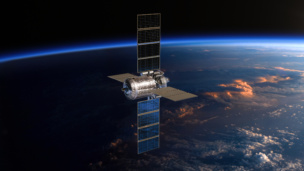
Exclusive: DoD Taps Orbital Operations for Cryogenic Spacecraft Demo
The Long Beach, CA, startup has won up to $35M from the DoD under a prototype Other Transaction Agreement to fly a full-scale, in-orbit demo of Astraeus—its cryogenic-maneuvering vehicle.
Inside Starburst’s First Flight, and Portal’s New Bothell Office
“I feel like 80% success now,” CEO Jeff Thurnburg said. “But honestly, to get this far this fast, I’m tempted to call it 100%.”
Exclusive: EraDrive Lands $13M DoD Award For Autonomy Module
EraDrive won a $13M DoD award, under which the Space Force will buy an undisclosed number of the company’s Era-Node vision-based autonomy modules.
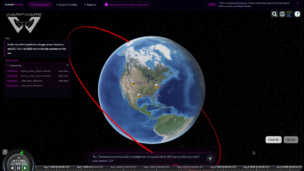
WarpWare Closes Pre-Seed to Bring Agentic Tools to Flight Software
CO-based WarpWare closed its $1.2M pre-seed round today to expand what it calls an AI-enabled engineering platform for space missions.


Blue Origin landed a $11.7M modification to its existing contract with AFRL to study how its launch technologies can be used to complete point-to-point cargo delivery missions for the DoD—bringing the total contract value to ~$13M.
The contract is part of the DoD’s expanding efforts to use space for military logistics, which includes both rocket-based cargo resupply efforts—through the Rocket Experimentation for Global Agile Logistics (REGAL) program—as well as efforts to explore storing cargo on orbit for fast reentry-based supply missions.
Send it: The REGAL program was established in 2021 as one of four “Vanguard” technology programs highlighted by AFRL as necessary for the next-generation of warfare. REGAL is intended to give the US military new capabilities for resupplying troops anywhere in the world in under an hour.
Keep reading