


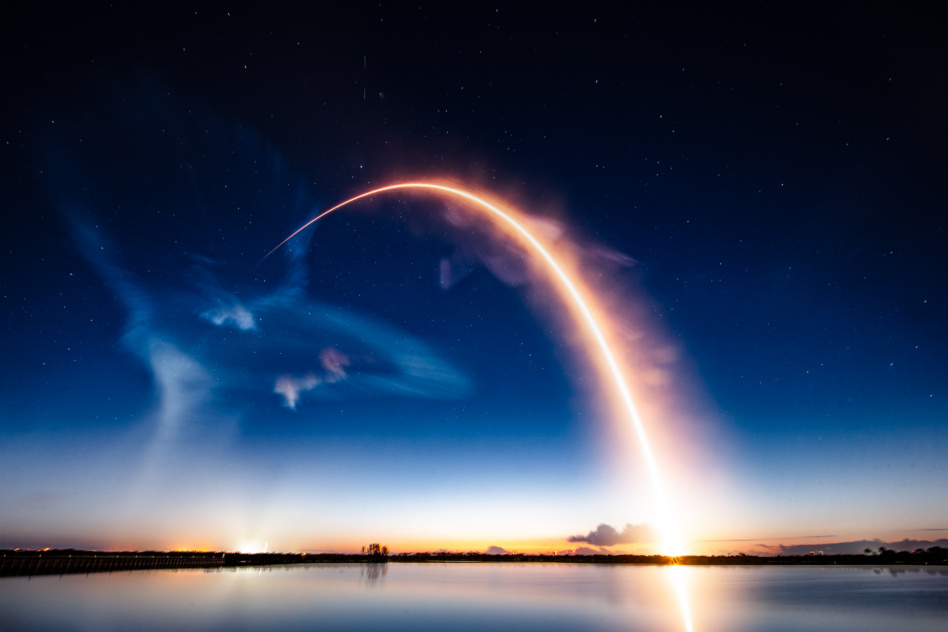
SpaceX ($SPCX) is set to go public today in what is gearing up to be the largest IPO in history. But after the public markets initiate their newest whale, what happens to the rest of the space industry still reliant on private capital?
Payload spoke with nine VC firms invested in space startups to see how they expect the IPO to impact venture capital markets. Their response was overwhelmingly bullish.
“This is space’s Netscape moment,” Space Capital founder and CEO Chad Anderson told Payload via email. “Before Netscape went public, the internet existed, but Wall Street didn’t take it seriously…The IPO changed the perception overnight and opened the floodgates for internet investment. SpaceX does the same thing for space.”
Grab an umbrella: Anderson wasn’t alone in making the connection between Netscape and SpaceX, with multiple VCs calling today the real beginning of the second space age—and that’s good news for the rest of the industry.
“More than simply attracting additional venture capital, [the IPO] would further establish space as a mainstream investment category,” Seraphim Space CEO Mark Boggett told Payload via email. “We would expect a listing to increase interest from a broader range of investors, including generalist venture capital firms.”
After 24 years as a private company—granted, one with a robust secondary market—SpaceX going public is expected to free up a lot of capital from VC firms that can then reinvest into the rest of the industry.
“[The IPO] will recycle wealth back to founders, angels, funds, and operators who understand these markets, while also forcing allocators to revisit how they think about investing in the physical world,” Van Espahbodi, partner at Generational Partners, told Payload via email.
Founder stampede: The IPO is more than just a big moment for capital allocation, however, as it stands to launch “the largest founder-generating event in the history of industrial tech,” according to Espahbodi. VC investors, many of whom have backed portfolio companies founded by SpaceX alumni, are expecting the IPO to arm a new wave of SpaceX employees with fresh capital to launch new ventures of their own.
“The IPO will…mint thousands of millionaires, many of whom are brilliant engineers and ambitious operators with the SpaceX mentality,” said Type One Ventures Principal Daniil Chen.
SpaceX alumni also have the chance to become investors themselves.
Bulent Altan, an early SpaceX employee and Founder of Alpine Space Ventures, told Payload that more than 20 early-SpaceXers contributed to Alpine’s first fund as limited partners. That’s a trend he expects to continue as the VC raises future funds and SpaceX employees come into new wealth.
“The many brilliant engineers working at SpaceX will suddenly find themselves with a lot of liquidity. They’re very likely to use that to invest in what they know best: space companies,” said NewSpace Capital CEO Bogdan Gogulan.
These new founders and investors are entering a market that’s increasingly comfortable betting on hardware and deeptech, and—with the DoD signaling huge contracts for space activities—there exists more revenue potential than ever to justify larger fundraises.
“The budget on the DoD side for space activities is growing extremely quickly,” Industrious Ventures Partner Taylor Sargent told Payload. “It used to be hard to convince investors to look at the [space] sector. Now it’s hard to even get allocation into these great companies. It’s just a complete 180 from how it was even just three years ago.”
The finer details: Despite their broad agreement that the IPO is good for the industry, VC investors shared widely different feelings on what impact SpaceX—with roughly $75B in fresh capital, and detailed plans to enter multiple subsectors of the space economy—could have on the competitive landscape.
Some investors, like Shield Capital Partner Mike Brown, said VC firms could avoid backing companies in direct competition with SpaceX, meaning potentially tighter capital access ahead for companies building launch and satcom capabilities.
“I think that it puts a chill on [the market],” Brown said. “We’re not investing in the main areas where SpaceX is dominant…You’d have to be pretty bold to think you’re going to compete and do better than SpaceX.”
Other VCs, however, see these markets as contested opportunities, and signaled their intention to continue backing SpaceX’s competition, with the understanding that demand will remain bigger than any one company can satisfy.
“Investors will pause before backing potential competitors in those opportunity areas against such well-funded competition,” Voyager Ventures Partner Matthew Blain told Payload via email. “But we expect increasing competition across their two, core revenue generating products today—rideshare launch and satellite internet.”
Even if SpaceX maintains its dominance in many of these subsectors of the space economy, the majority of the VCs Payload spoke with remained bullish about the future.
“We don’t believe the long-term space industry is one where a single company captures 90% or more of the value,” Altan said. “If the industry grows by a factor of 10, 100, or more from here, and SpaceX leads the way into that future, there is no doubt that is good for the sector as a whole.”

Seraphim Space Investment Trust Doubled its Value in 2026
Seraphim’s major holdings—ICEYE, ALL.SPACE, D-Orbit, HawkEye 360, and Xona Space Systems, which together represent more than 75% of the firm’s portfolio—all had a great year, and that success has trickled upwards.

BlackSky Renews HEO Deal, Adds Gen-3 Imagery for Space Domain Awareness
BlackSky Technology inked a seven-figure deal to extend its partnership with Australian non-Earth imaging (NEI) provider HEO for another year.
Balerion Surpasses $200M Goal for Fund II
Dallas-based Balerion Space Ventures has surpassed its $200M target for its second fund, the firm announced Thursday.

Exclusive: Kapta Space Raises $24M Series A to Build Moving Target Radar Payload
Seattle-based Kapta Space announced a $24M Series A to build next-gen radar payloads designed to track moving targets.

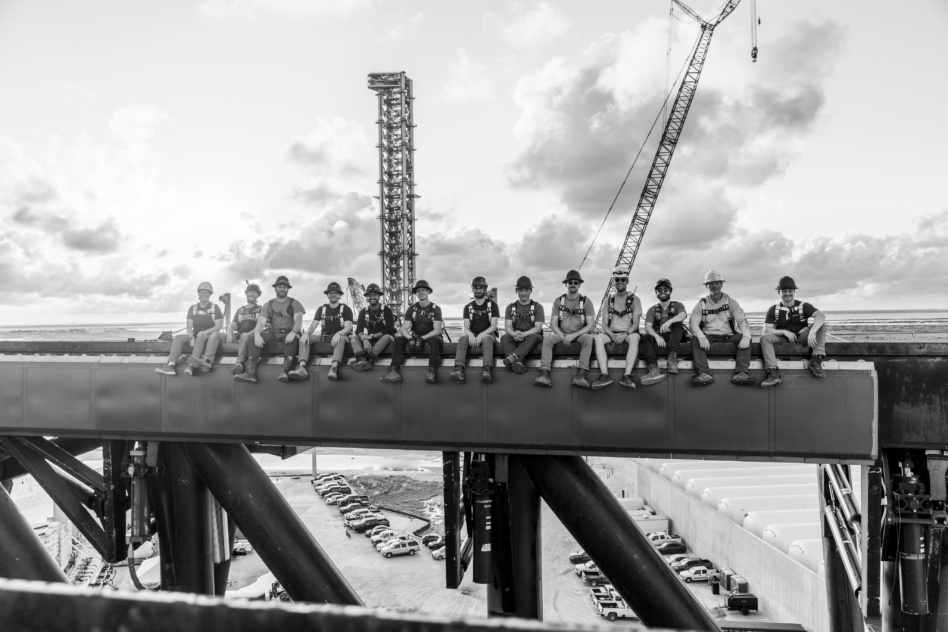
The largest IPO in history is here, and capital is expected to flow into the space industry at record volume. Whether that capital builds an economy that fully operates—or one that just accumulates hardware—is a choice we are about to make.
The big picture: SpaceX is expected to price at a valuation between $1.75T and $2T, with a raise of up to $80B. This capital will not stay entirely within SpaceX, but will flow down through its supply chain and into even newer technologies.
The question is not whether capital is coming. It is, as space pivots beyond exploration to a sector that creates huge economic value. The question is whether we use it to keep building an economy of assets—or to finally build one that fully operates.
Keep reading