



Xona Space Systems is working to build an alternative to GPS in LEO, and it’s just secured an additional $19M to make that goal a reality.
Future Ventures and Seraphim Space led the funding round, which also included participation from new investors NGP Capital, Industrious Ventures, Murata Electronics, Space Capital, and Aloniq.
“Waiting for GPS to fail, or for hostile powers to spoof it, is not an option for our security or commercial industries,” Rob Desborough, general partner at Seraphim Space, said in a release. “Xona and the pioneering team are executing on building the GPS the modern era needs and we’re delighted to continue to support their transformative vision.”
Ready to fail: If we were to rank space technologies by their importance to daily life here on Earth, large global navigation satellite systems (GNSS) like GPS and its counterparts would probably take the #1 spot. But these government-run systems, consisting of very large, mostly very old satellites in MEO, are also potentially vulnerable sitting ducks should conflict come to the space domain.
The legacy systems were also built for a time that required less precision in positioning, navigation and timing. Modern applications such as autonomous driving—and other autonomous systems—call for modern solutions, including centimeter-level precision.
Xona’s solution: By using a larger fleet of position, navigation, and timing (PNT) satellites in LEO, Xona aims to vastly increase the accuracy of satellite navigation services for autonomous applications. Its planned 258-bird Pulsar constellation is aiming to be the first commercial GNSS to hit the US market.
With this funding round, Xona plans to begin beta operations on Pulsar. The company has contracted Aerospacelab to build its first commercial satellite, but there’s no word yet on when it will be delivered.
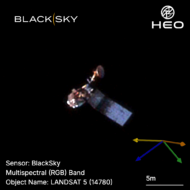
BlackSky Renews HEO Deal, Adds Gen-3 Imagery for Space Domain Awareness
BlackSky Technology inked a seven-figure deal to extend its partnership with Australian non-Earth imaging (NEI) provider HEO for another year.

Balerion Surpasses $200M Goal for Fund II
Dallas-based Balerion Space Ventures has surpassed its $200M target for its second fund, the firm announced Thursday.

Exclusive: Kapta Space Raises $24M Series A to Build Moving Target Radar Payload
Seattle-based Kapta Space announced a $24M Series A to build next-gen radar payloads designed to track moving targets.

Nebex Partners with Thrusters Unlimited to Unlock $700M for Mexico’s Space Ecosystem
The capital will fund EO, telecoms and other strategic capabilities, according to Nebex.


Pixxel and Enabled Intelligence are announcing a new partnership under which the data labeling startup will annotate the space company’s hyperspectral imagery.
The two companies are working together to make hyperspectral imagery more accessible by annotating and labeling the pictures, which can then be used to train AI and machine learning models.
Meet Enabled Intelligence: Enabled Intelligence, which was founded four years ago to do data labeling, annotating, and analysis, already works with the NGA, NRO, DoD, and Space Force, among other agencies.
Keep reading