


The effects of the White House’s top level budget proposal are starting to ripple around the world.
There’s been lots written about what the budgetary plan means for the commercial space industry, space science, and SpaceX CEO Elon Musk. But now that we’ve had a few days to digest the White House’s initial budget proposal, we’re left wondering—what becomes of international partners in orbit when the programs they’re working on get canned?
On the chopping block: The Trump administration’s plan proposes changes to several programs with international participation, including:
- Phasing out the SLS rocket and Orion capsule after three flights;
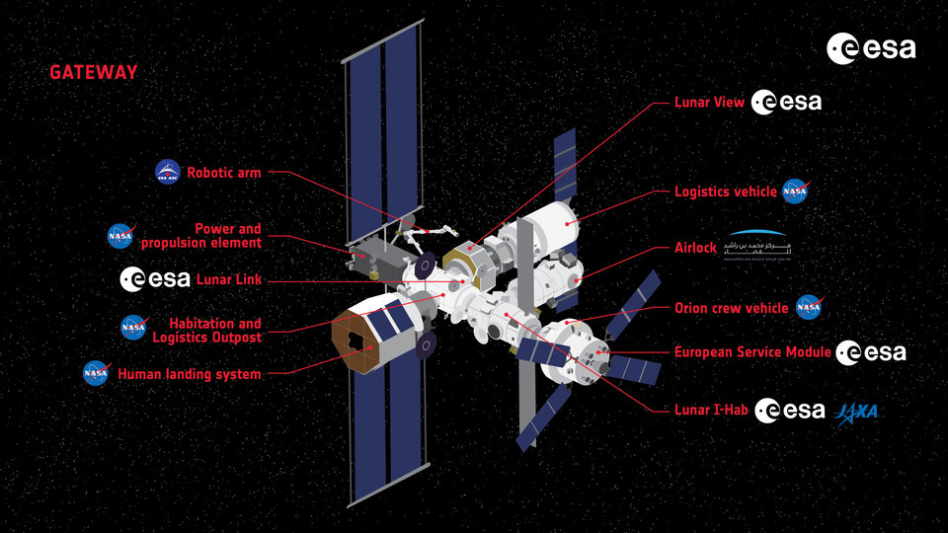
- Eliminating the Gateway, a lunar orbiting space station;
- Terminating the Mars Sample Return mission;
- Reducing ISS funding to prepare for a shift to commercial stations, including cutting research in the onboard lab to include only that which supports Moon and Mars missions.
Who’s affected: The US has become the partner of choice in space, and used collaboration in orbit as a significant soft power tool. As a result, many countries and space agencies will also take a hit. The Gateway is a joint effort between NASA, ESA, JAXA, and the Canadian Space Agency, which was providing the station’s robotic arm. In addition, the United Arab Emirates agreed to build Gateway’s airlock in January 2024.
These contributions were offered under a barter system—the countries would provide the hardware in exchange for flying their own astronauts on future Artemis missions. For example, Jeremy Hansen is expected to be the first Canadian astronaut flying around the Moon on Artemis II, early next year.
ESA is a top partner for NASA beyond Gateway. It’s working on multiple programs on the chopping block—including providing the European Service Module for Orion, which serves as the spacecraft’s source of electricity, propulsion, and live support. ESA is also building the orbiter to return samples from Mars.
The reduction of funding for ISS research during the next few years will have a global impact. Researchers from 108+ countries have sent experiments to the lab, according to NASA.
The bottom line: International agencies and companies are actively trying to figure out what this means for them. After its stock plummeted following the budget release, MDA Space, which is building the Canadarm3 for the Gateway, released a statement emphasizing that its contract is with the Canadian Space Agency—not NASA. It also highlighted potential commercial opportunities for the tech, and promised more info on its May 8 earnings call.
ESA is also working with NASA to figure out the path forward, and is likely to have a clearer idea of next steps after an assessment at its June Council.
“ESA remains open to cooperation with NASA on the programmes earmarked for a reduction or termination, but is nevertheless assessing the impact with our member states,” Director General Josef Aschbacher said in a statement on Monday. “ESA has strong partnerships with space agencies from around the globe and is committed to not only being a reliable partner, but a strong and desirable partner.”

European MNOs Join Forces to Explore Joint MSS Spectrum Bid
Deutsche Telekom, Telefónica, Orange, and Vodafone plan to establish ground network infrastructure across Europe, and partner with an as-yet undetermined satellite operator for the D2D connection.

Congress Seeks Answers On Starlink Disruptions in Ukraine
“The United States government has a fundamental obligation to protect American personnel serving overseas,” the senators wrote. “The possibility that American personnel were endangered by preventable disruptions, inadequate coordination, or decisions made by their own government demands immediate scrutiny and accountability.”
Reaction Dynamics Targets 2031 for Borealis Medium-Lift Launch
In the contest to build up commercial launch capabilities in Canada, Quebec-based startup Reaction Dynamics has entered a new weight class.

Seraphim Space Investment Trust Doubled its Value in 2026
Seraphim’s major holdings—ICEYE, ALL.SPACE, D-Orbit, HawkEye 360, and Xona Space Systems, which together represent more than 75% of the firm’s portfolio—all had a great year, and that success has trickled upwards.


Amid major shifts in US foreign policy under President Donald Trump, European governments have unshackled budget rules and funded a five year rearmament plan, including a €800B ($905B) investment in defense technologies that will benefit space contractors.
Invent it: Paris-based Dark was founded in 2022 by former defense industry engineers, CEO Clyde Laheyne and CTO Guillaume Orvain. It’s building an air launched space vehicle that can grab a “problem” satellite in LEO and actively deorbit it—in theory, a kinetic space weapon without a debris problem.
The company, which raised $11M and has development contracts with the French government, is planning a 2027 test mission to demonstrate its rendezvous capabilities.
Keep reading