

Part 3 in a series on orbital communications
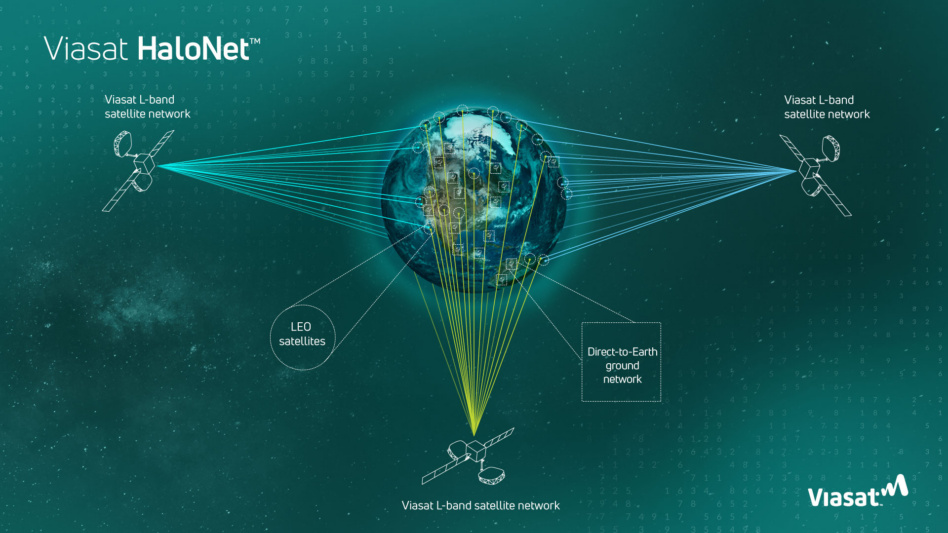
In today’s rapidly proliferating orbital environment, spacecraft are only as capable as their ability to stay connected. Traditional communications architectures—built around scheduled ground passes and line-of-sight links—can’t keep pace with the speed and complexity of modern missions.Viasat’s HaloNet hybrid terminal aims to change that by unifying multiple communications pathways into one adaptive system, designed to keep satellites in constant contact—from launch, through orbit.
Inside Viasat’s labs, David Greenidge and Skylar Cox lead a team of engineers who are designing a hybrid communications terminal to modernize and evolve not just the way missions are executed, but how they are conceived.
“We’re still flying missions like we did 40 years ago,” Cox said. “But today, Viasat has the infrastructure to talk to a satellite whenever we need to. Instead of planning around constraints, we’re planning around possibilities.”
A Bridge Between Eras
The hybrid terminal answers a pragmatic question: How can spacecraft evolve without abandoning decades of proven operational systems and methods?
HaloNet’s hybrid terminal design merges L-band’s always-on capability with traditional S-band direct-to-Earth links. The result is a continuous lifeline that keeps missions in contact when spacecraft no longer maintain line of sight to the ground. Greenidge calls it a bridge from the “old concept of operations, into the new.”
Physically, the hybrid terminal is “essentially identical” to what spacecraft already fly, Cox said. The difference lies in its functionality. A single package manages multiple frequency bands, which automatically selects the best path for data, and falls back to a low-rate L-band link when needed.
In practice, that means the terminal can:
- Switch automatically between available communications paths;
- Maintain a persistent low-rate L-band “lifeline” when unable to access ground antennas;
- Optimize each link for mission data, telemetry, or command needs.
“Instead of adding another payload,” Cox said, “we just upgrade an existing component and gain a new capability.”
That quiet reliability defines the design. Rather than chase higher throughput or flashier antennas, Viasat focuses on making space operations simpler and smarter. Missions don’t need to redesign spacecraft or rewrite flight software—they can simply step into continuous connectivity with a hybrid terminal connected to the HaloNet comms network.
Behind the hardware sits a software brain: the Multi-Mission Orchestrator, or MMO. This software tracks what data a satellite carries, its latency or security needs, and which network is available. The MMO autonomously decides which link—L-, S-, Ka-, or eventually optical—to use at any given moment.
“MMO is fundamentally a mission-optimization engine,” Cox said. “It knows the requirements and generates the commands to make sure the right data moves over the best path.”
Together, the hybrid terminal and MMO create an adaptive system that manages bandwidth and responds to anomalies without constant human oversight. As satellite fleets grow, that kind of autonomy will prove essential.
The Bigger Picture
Greenidge and Cox see the hybrid terminal as a step toward something larger: a connected orbital ecosystem where spacecraft coordinate rather than operate alone. Greenidge compares it to aviation’s ADS-B system—the network that lets every aircraft broadcast its position, ID, altitude, and velocity.
“That’s all L-band,” he said of ADS-B. “It’s how every plane knows where the others are. A ubiquitous hybrid terminal could enable something similar in space—a way for satellites to identify themselves and avoid collisions.”
Viasat’s first flight unit is projected for deployment in the next few years, but much of the technology already exists. The challenge now lies in integration—combining separate radios and encryption systems into one seamless package. The team’s current focus centers on integration rather than invention, bringing together:
- Separate radio systems into a unified communications package;
- The new Space Reprogrammable Crypto unit for secure, multi-link operations;
- Future support for Ka-band and optical communications, coordinated through L-band.
Beyond L- and S-bands, the architecture will expand to support Ka-band and optical communications, with the low-rate L-band serving as the coordination layer that stitches everything together. “Optical and Ka are high-capacity but directional,” Greenidge explained. “L-band is what orchestrates it all.”
The Next Era of Spaceflight
Viasat’s hybrid terminal represents more than a hardware milestone. It enables a future where spacecraft function as nodes in a connected, resilient network—not isolated machines waiting for ground contact.
This vision also democratizes access. “It used to be that only organizations with deep pockets could afford that kind of infrastructure,” Cox said. “Now, HaloNet can provide continuous connectivity to any customer’s spacecraft.”
“What we’re building isn’t just communications equipment,” Greenidge said. “It’s the foundation for the next era of spaceflight.”

The Lunar Economy Could Be Worth $566B by 2050. First, We Have to Build It.
The return to the Moon is an infrastructure story, and Deloitte has created numbers to back it up. The number: A new report from Deloitte, Building the Lunar Economy: How a Sustained Presence on the Moon Could Transform Life, Industry, and Infrastructure on Earth and Beyond, puts the lunar economy’s cumulative economic value through 2050…
The Commercial-First Shift in National Security Space
For decades, the model for building national security space systems was relatively straightforward. The government defined a mission, established requirements, funded a spacecraft designed specifically to meet them, and ultimately owned and operated the resulting capability.
The New Middle Ground in Spacecraft Development
For years, the commercial space industry has focused on making spacecraft more affordable and accessible. Today, a new wave of customers want to build their own hardware to gain full ownership of the systems that define their mission.
A Faster Path to Orbit: How Hosted Payloads Are Changing Access to Space
Historically, deploying a new capability in space required significant time, investment, and technical expertise. Companies often had little choice but to build nearly everything themselves—from spacecraft and payload integration to ground infrastructure and mission operations. Today, the space industry offers a different model: hosted payloads. “We’re seeing companies looking for the fastest, most economical way…

LEO is getting crowded, but there’s plenty of real estate available closer to home if you can make it work. California-based Viridian Space is aiming to do just that.
The company is developing air breathing electric propulsion (ABEP) technology to fly future satellites in VLEO, and the US government is lending a hand to get the tech off the ground.
Viridian CEO Slava Spektor told Payload the company signed a five-year cooperative research and development agreement (CRADA) with the US Air Force to co-develop Viridian’s ABEP tech, and to work together on studies leveraging VLEO.
Keep reading