


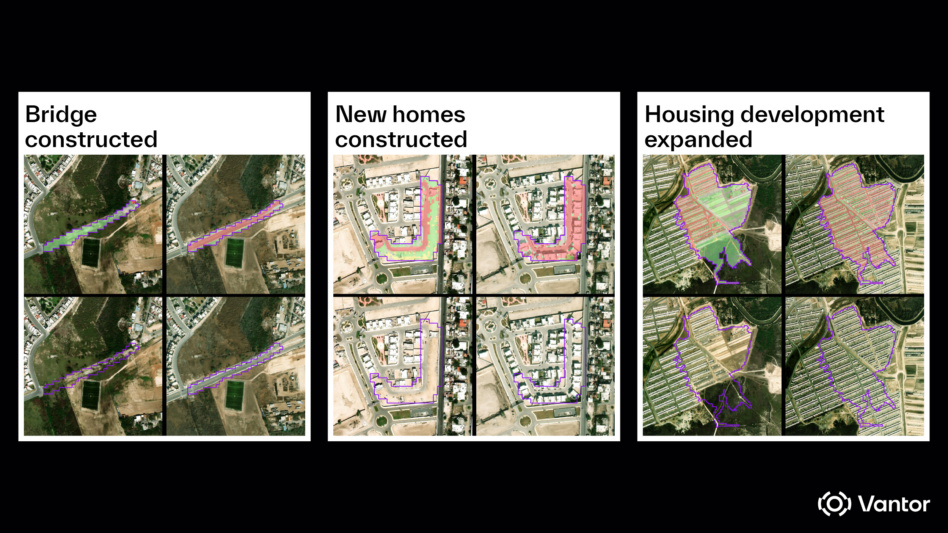
Vantor won a $5.3M NGA contract to help the government combine data sources for accurately tracking changes to Earth’s landscape.
More info: The contract, awarded under NGA’s Luno B program, will see Vantor provide the intelligence community with data about shifts to things like roads, vegetation, and buildings, as well as broader impacts caused by manmade or natural disasters. The company will use AI to rapidly detect any shifts across the huge data set.
Melting pot: To best meet the needs of the NGA, Vantor will combine its own 30-cm high res EO imagery with third-party sensors to give a complete picture of the globe. Different data sources all offer different strengths, including:
- High-res imagery detects small changes in roads or buildings;
- SAR provides a picture of the ground at night, or in clouds.
Combining multiple data sources offers a comprehensive picture for the government to respond to things like regional conflicts or humanitarian disasters—but the approach doesn’t come without challenges, according to Susanne Hake, the executive vice president and general manager of US government at Vantor.
“What we’re seeing is that the missions that our customers are asking us to perform really do require pulling together multiple types of data,” Hake said. “They want a complete picture.”
Hake said Vantor will use its precision alignment tech to make sure the data merges together accurately—a key factor for tracking change.
“Fusing data from multiple sensors is challenging because each one captures the world differently,” Hake said. “For example, there are different resolutions, viewing angles, and levels of spatial accuracy. If those differences aren’t addressed first, change detection models won’t work, because they rely on precise, pixel-level alignment to identify what changed on the ground.”
Watchful eye: Going through the huge mountain of data to detect shifts swiftly requires the use of AI, with a human in the loop for quality control and setting collection parameters.
“Using AI is obviously a time savings, but it’s also to help scale,” Hake said. “To do continuous change detection across the entire world’s terrain at scale, that’s when you really need to be able to use AI.”
European Space Startups Steal the Show in Paris
European space startups have long wondered when big institutional buyers would stop handing large contracts exclusively to legacy A&D primes. During the last few weeks, it’s become clear that time is now.

States Campaign to Host the US Space Academy
Ever since President Donald Trump signed an executive order on Aug. 28 establishing a US Space Academy, states have been coming out of the woodwork to make the case for why the school should call it home.
Exclusive: Space Cargo Unlimited Booked a Third of its Starfall Capacity
Demand appears to be skyrocketing, thanks to a new wave of pharmaceutical companies and researchers realizing that microgravity can provide benefits in drug discovery and research.
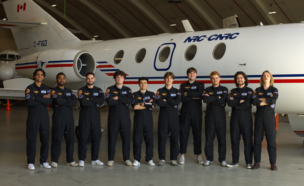
Icarus Robotics Completes Parabolic Flight Test Ahead of ISS Mission
Icarus Robotics completed a four-flight parabolic test campaign of its free-flying robot—named Joy—in preparation for its first ISS mission in 2027.
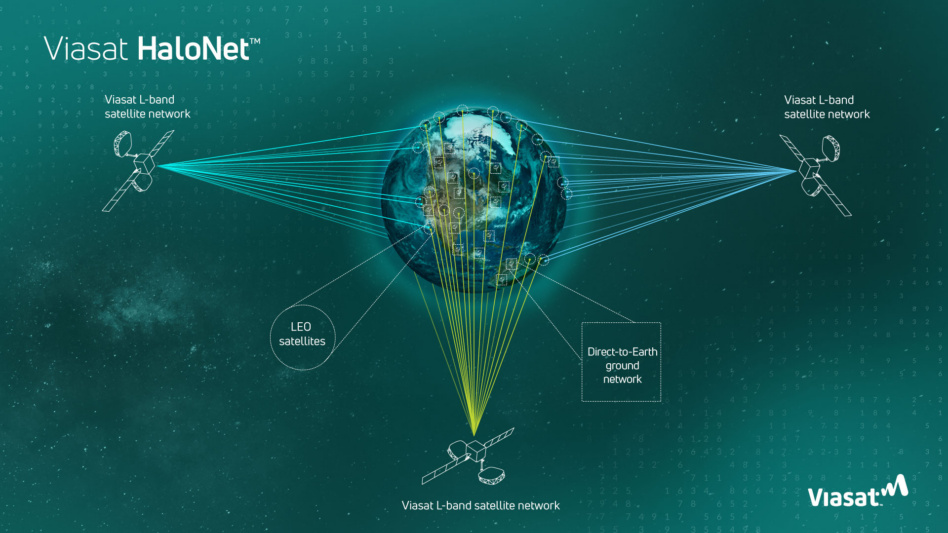
Part 3 in a series on orbital communications
In today’s rapidly proliferating orbital environment, spacecraft are only as capable as their ability to stay connected. Traditional communications architectures—built around scheduled ground passes and line-of-sight links—can’t keep pace with the speed and complexity of modern missions.Viasat’s HaloNet hybrid terminal aims to change that by unifying multiple communications pathways into one adaptive system, designed to keep satellites in constant contact—from launch, through orbit.
Inside Viasat’s labs, David Greenidge and Skylar Cox lead a team of engineers who are designing a hybrid communications terminal to modernize and evolve not just the way missions are executed, but how they are conceived.
Keep reading