


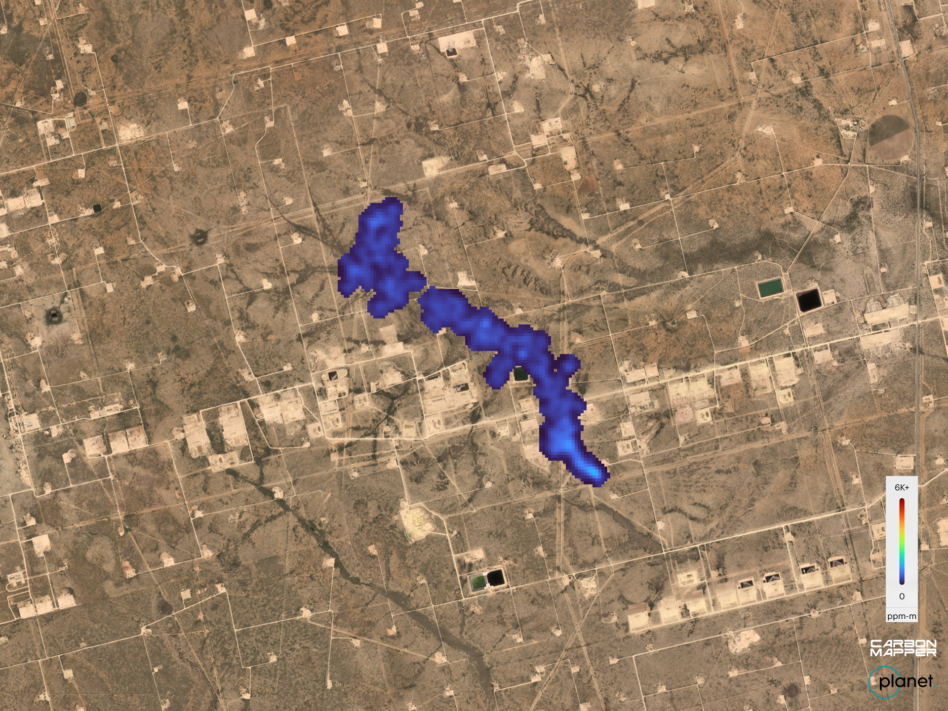
Two lawmakers introduced a bill that would task NASA to improve the nation’s ability to detect cow farts—and all other forms of methane leaks.
Rep. Don Beyer (D-VA) and Rep. Pat Harrigan (R-NC) introduced the Methane Monitoring Science Act this month. The bill would direct the space agency to:
- Evaluate the state of methane monitoring tech;
- Ensure data can be shared across federal and private agencies to quickly find and stop leaks that hurt the atmosphere.
“The conservatives teased the left about cows farting,” Beyer told Payload. “We know that methane gas is a much more powerful greenhouse gas, even, than carbon dioxide. It’s one of the byproducts of fracking; a lot of methane gas is released, and escapes into the air.”
Why NASA? The bill covers methane monitoring tech on the ground, in the air, and in orbit. So why does the bill put the responsibility with NASA?
“We figure space is the most sophisticated [monitoring tech], with the broadest range—and probably where the future science is going,” Beyer said. “Also, NASA has a high trust level among the American public, and also among the energy producers.”
But Beyer was clear that it’s not just a government mission. Commercial companies, including GHGSat, Planet Labs and Vantor, all have sats that detect methane leaks—and they have an important role to play, according to the lawmaker.
“I see them as critically important. I’ve been pushing for years on the space situational awareness act, which again has not gone anywhere yet…Among the provisions in that is to first maximize the use of existing commercial capabilities, before turning to government investment,” Beyer said. “I think the exact same thing here. Why have NASA reinvent something if there’s a great commercial enterprise out there that can already do it?”
Don’t call it a comeback: Beyer introduced a similar methane-monitoring bill in 2024 with Rep. Doug Lamborn (R-CO), who has since retired. For this iteration of the bill, Beyer teamed up with Harrigan, a freshman serving his first term.
“This is a good bipartisan thing we can do together, that protects the environment and makes sure those still committed to fossil-fuel production have a way to do it safely,” Beyer said.
Next steps: The bill was adopted as an amendment to the NASA reauthorization bill that passed the House Science, Space, and Technology Committee. The standalone version of the bill, introduced Feb. 10, could be another vehicle to advance the methane monitoring proposals if the NASA reauthorization stalls or the amendment gets stripped during negotiations with the Senate—but Beyer said he hopes it won’t come to that.
“The standalone [bill] will hopefully become irrelevant,” he said.
FCC Poised To Advance Sat Licensing Reform
FCC Chair Brendan Carr announced last week that the commission is expected to vote on the Space Modernization Order on July 22.

NASA Watchdog: Launch Infrastructure Nearing Capacity
NASA’s launch facilities will likely reach capacity by the end of the decade as the number of commercial launches continues to skyrocket, according to a report from the space agency’s inspector general released Monday.

Bill Spotlight: NEW HORIZON Act
A bipartisan pair of senators introduced a bill last week that would consider allowing national security missions to tap into the commercial orbital data center craze.


Orbital data centers are closer to reality than you might think.
Sophia Space closed a $10M seed round to accelerate the development and testing of its in-orbit computing technology, laying the groundwork for operational orbital data centers by the 2030s.
The round was led by Alpha Funds, KDDI Green Partners Fund, and Unlock Venture Partners, and brings the company’s total funding to $13.5M.
Keep reading