


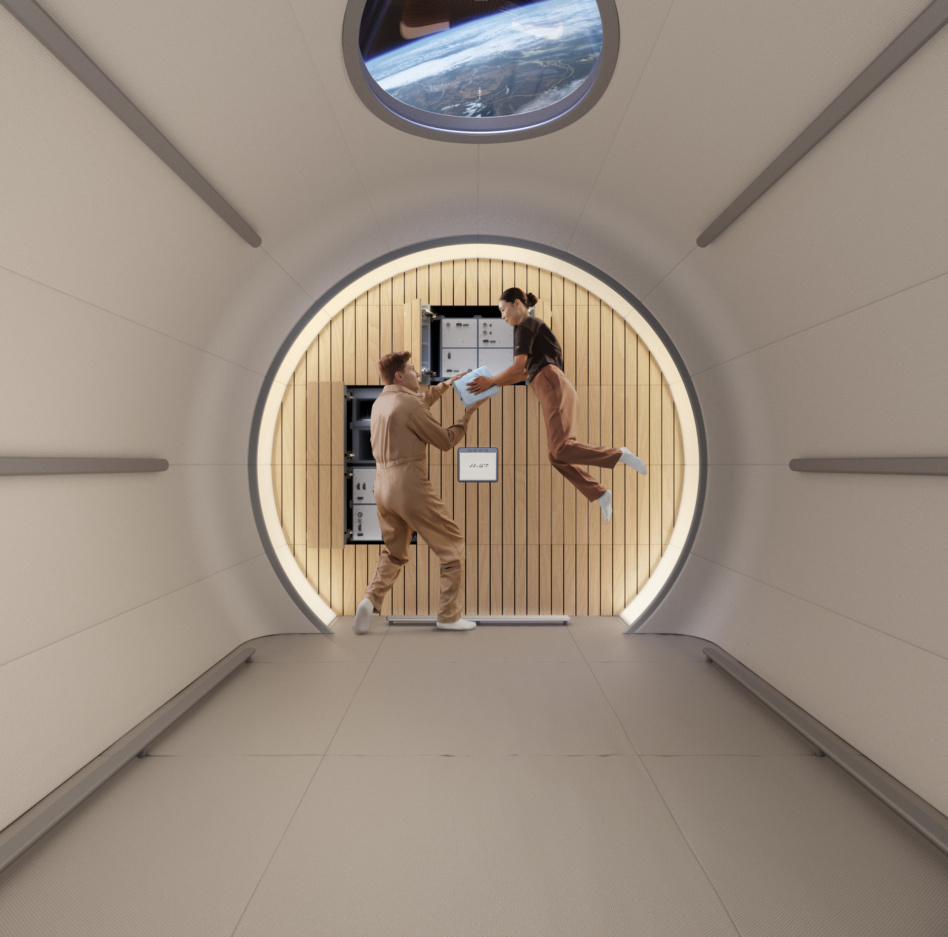
COLORADO SPRINGS, CO—Commercial space station builders say NASA’s wrong about the lack of commercial business case in LEO. NASA Administrator Jared Isaacman says, prove it.
“I’m not surprised that CLD providers didn’t like what we had to say,” Isaacman told Payload on the sidelines of the Space Symposium. “So, prove we got it wrong.”
Context: Last month, NASA announced a proposal to make major changes to the CLD acquisition, saying the market is not strong enough to sustain commercial stations—and that in any case, NASA did not have the money to provide more support.
The space agency asked for industry’s input on the new plan, which would see NASA purchase a core module that would attach to the ISS, where commercial CLD providers could dock modules. When CLD tech matures, the modules could detach and become free flying commercial stations.
Industry’s take: The CEOs of Axiom Space and Vast said Monday that they had submitted feedback on NASA’s proposed changes to the CLD program. While there’s usually no love lost between CLD competitors, the two executives agreed on one key thing: NASA is wrong that the commercial market isn’t ready for private stations.
“We’ve flown 166 payloads to date. I think that’s evidence of a market,” Axiom Space CEO Jonathan Cirtain said in a press briefing. “We do that, and generate revenue and income as a consequence of those payloads. We’ve flown 14 astronauts….That’s a marketplace.”
Max Haot, the CEO of Vast, also said the market goes far beyond the tourism and in-space manufacturing programs that NASA says are not ready for prime time. Instead, Haot said the CLD companies are selling astronaut missions to space—something NASA and global space agencies have already committed to buy, proving that there is a market.
“Since 2018, [NASA] has committed that once the ISS is retired, they will be buying that product from commercial actors,” Haot said, adding that customers like ESA and JAXA have also committed to buy flights. “If they maintain that commitment to transition to commercial, there is a verifiable market. The budgets exist.”
Starlab Space, a joint venture also competing for the CLD program, did not return a request for comment.
NASA’s response: Isaacman said his view is shaped by his own experience paying (twice) for expensive private spaceflight missions on SpaceX, as well as his nearly half-year of experience leading NASA—where he says he’s talking with international space agencies about whether they are realistically ready to buy sovereign space flights.
“I can tell you that if somebody wants to sign up today for the next [private astronaut mission], there’s a seat available,” Isaacman said. “That doesn’t support a robust demand signal, in my mind, but I hope we have it wrong.”

Bill Spotlight: Space Superiority Readiness Act
A bipartisan pair of senators introduced a bill last week aiming to ensure the US military is prepared for conflict with Beijing in orbit.
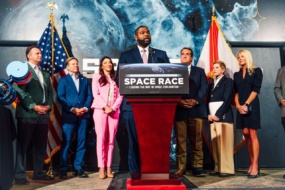
FL Governor Candidate Launches Space Race Policy
“Right now, other states and other countries are competing for the launches, the investments, and the high-paying jobs that belong to our workers, our graduates, and our families. We are going to change that,” Donalds said at a press event.
Space Science’s Golden Age Problem
Last week, the White House OSTP released a sweeping vision for the nation’s R&D enterprise.
NASA Puts $2B Price Tag on Nuclear Mars Mission
The $2B Space Reactor-1 Freedom is said to be the first fission-powered interplanetary spacecraft.
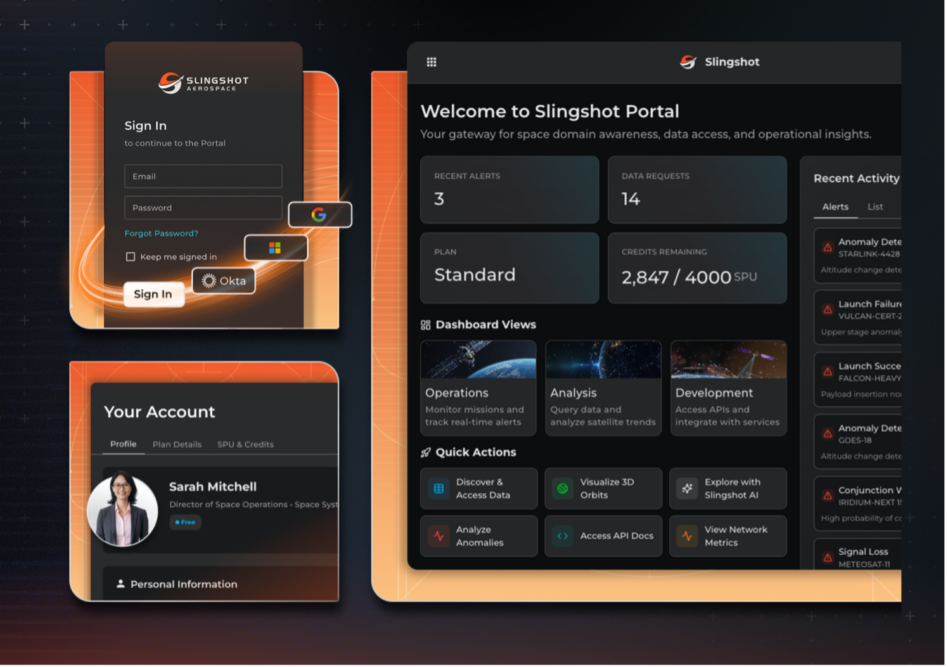
Slingshot Aerospace introduced a new platform today that will allow operators to spot anomalies—and make decisions—in an AI-powered, one-stop-shop.
Meet the portal: Slingshot Portal brings together data from a variety of sources, including:
The goal of fusing this data with AI and analytics tools is to let customers monitor space missions in near real time, quickly spot any problems, and plan out maneuvers—all in a single platform.
Keep reading