



Space-tech startup Observable Space has closed a $90M Series A to boost its production of laser and optical hardware—in addition to expanding internationally beyond the US.
Lux Capital led the round, announced on Thursday, which was co-led by Upfront Ventures, Detroit Venture Partners, Island Green Capital, and RTX Ventures. BRV Capital Management and Fathom Fund also joined the round.
Observable Space: The company was founded in February 2025, when telescope company PlaneWave Instruments merged with OurSky, a space-data-application company. The goal of the merger was to create a vertically integrated company that could provide operators real-time insights about what’s happening in orbit by combining hardware and software into one offering.
Observable Space builds hardware—at its facilities in Los Angeles, CA and Michigan—focusing on three areas:
- Laser communications ground stations;
- Ground-based sensing;
- In-space optical payloads.
To scale production, Observable Space will grow its manufacturing capabilities in Detroit. The company did not say where it would focus its international expansion efforts
“The companies and nations that precisely track objects, navigate spacecraft, and communicate terabits per second will define the next era of the space economy,” CEO and cofounder Dan Roelker said in a statement. “At Observable Space, we’re building the vertically integrated systems right now that makes this possible.”
What’s next: The company announced it had won an IDIQ contract from the Space Force worth up to $94M. The award is part of the military’s Accelerate the Procurement and Fielding of Innovative Technologies (APFIT) program to boost satellite-tracking capabilities, using optical ground-based telescopes.
Observable Space has been awarded $22M for the initial task orders.
The company is also preparing to send its Iguana in-space imager into orbit for the first time this year, on board an Apex Space satellite bus. The compact system—which customers will be able to purchase with just eight weeks’ notice—is designed to help operators conduct SDA or RPO missions.

Starcloud Announces $250M Series A Extension
Starcloud has raised a $250M extension to its March $170M Series A funding round, bringing it to a a $2.3B valuation.
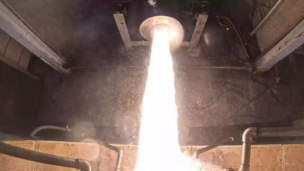
Letara Raises ¥2.6B to Build its Hybrid Rocket Engine Tech
Japanese propulsion startup Letara closed a ¥2.6B ($16M) pre-Series A round to fund the development of its low-cost, hybrid engine tech.
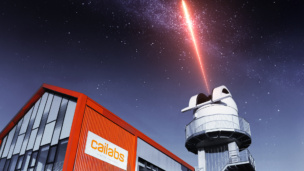
Op-ed: The Technologies That Could Define the Future of Space
Daniel Biedermann, a partner at NewSpace Capital, gives his insights on what technologies are driving the future of space tech.
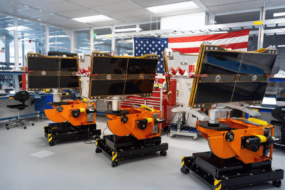
Muon Space Raises $250M Series C
Muon Space closed a $250M Series C to expand its satellite production capacity and broaden the types of missions it can fly.
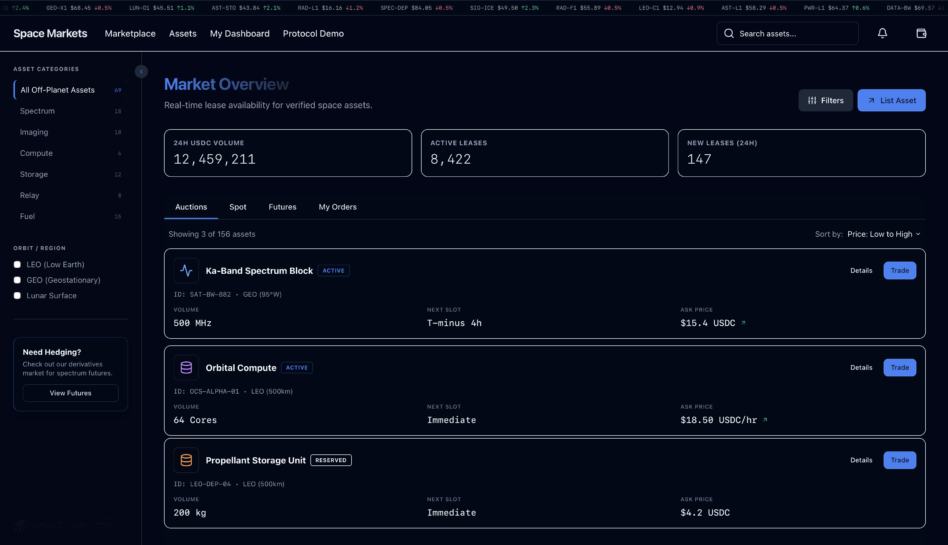
People already trade on future markets for everything from oil, to corn, to gold. Space Markets is asking: Why not space?
Space Markets, which emerged from stealth today after being founded in December, is also announcing an investment from Coinbase Ventures for an undisclosed amount. The platform will be built on Coinbase’s Ethereum Layer-2 network.
Meet Space Markets: Today’s space industry is built mostly around private contracts that can span years, or even decades. But, as the industry continues to grow, Space Markets CEO Nick Trudgen says now is the time to launch futures trading for commodities in orbit, including satellite bandwidth, launch capacity, and EO data.
Keep reading