


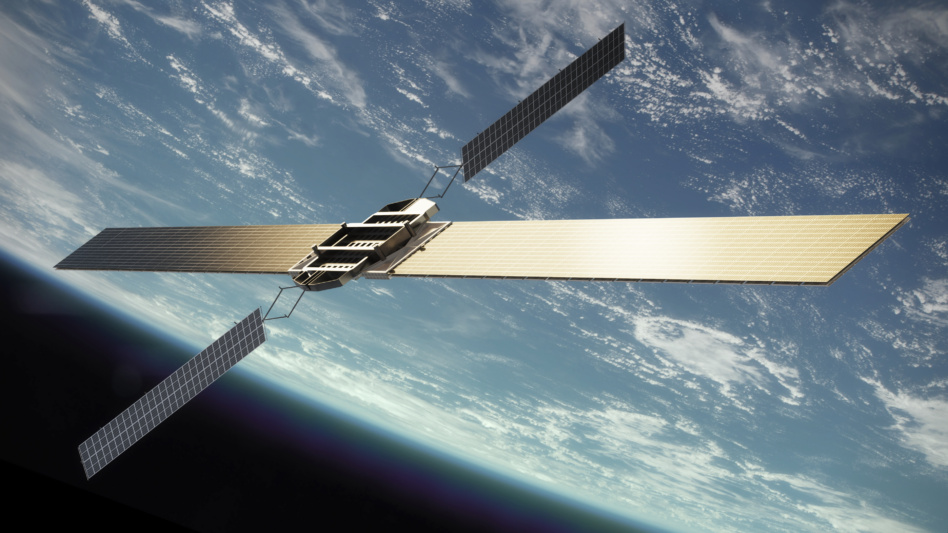
Sophia Space is operating on overdrive.
The orbital-compute startup today announced new fundraising—as well as a demo flight with Apex. Both initiatives are aiming to position the company to begin deploying its edge compute hardware in-orbit.
Sophia announced it’s finalizing $7M in SAFE financing. The funding round—which included participation from EverGreen (the NVIDIA Alumni Investment Network), SparkLabs Group, and other undisclosed investors—is expected to close on Sunday, and will bring Sophia’s total funding to $22M.
Mo’ money, no problem: Sophia plans to continue investing in R&D, expand its team of engineers and salespeople, and build a manufacturing pipeline to churn out Sophia’s TILE compute platform at scale.
In the meantime, Sophia has two in-orbit demos planned to prove out its core technology. Sophia announced today that it selected Apex to supply a Nova satellite bus for a planned in-orbit demonstration of TILE next year. But another demo is coming before that.
- The first demo, scheduled for this fall, will validate Sophia’s orbital operating system—nicknamed SOOS—on board Kepler’s in-space network.
- That demo will inform the TILE hardware flight with Apex. During the 2027 demo, Sophia’s TILE will interact with data from on-board sensors, allowing engineers to test TILE’s ability to host AI inference models to perform image processing and other tasks.
Sophia officials hope the two demos will prove that TILE is uniquely prepared to handle the growing demand for in-orbit compute, especially for nearer-term applications before full-scale orbital data centers come online.
“We’ve got these satellites in orbit right now. They have these amazing sensors that collect terabytes or petabytes of data, [and] they throw most of it out because there’s not enough processing on board and bandwidth to Earth is pretty horrible,” Sophia CEO Rob DeMillo told Payload.
SpaceX who? While there’s no shortage of companies attempting to build orbital data center technologies at scale, including SpaceX, DeMillo says Sophia’s approach to operating heat-intensive compute hardware in a vacuum will differentiate it from the pack.
“There’s a couple different ways to approach the problem of putting data centers in orbit,” DeMillo told Payload. “There’s a brute-force way to do it. There’s a many-many-satellite way to do it, and there’s a way to do it where you’re not fighting with physics…lo and behold, when you don’t fight physics, it’s cheaper, it weighs less, and it’s more efficient.”
DeMillo said he believes Sophia’s approach—the TILEs—offers this third pathway. As opposed to other ODC concepts, TILEs don’t just rely on larger radiators or distributed compute nodes across hundreds of sats. Instead, Sophia’s tech distributes heat and computing power across each TILE to ensure the system doesn’t overload itself.
The tech has applications for in-orbit data centers, but critically, the compute capacity is expected to come in handy long before ODC demand takes off.
As for competition with SpaceX, DeMillo remains convinced that there’s enough demand to go around.
“The harsh reality here is the LEO orbital data centers that SpaceX is putting up are more than likely going to be used for, you know, their own purposes. I’m sure they’ll have a few anchor tenants, but I think for the most part this is going to be used internally,” DeMillo said. “We’re talking about generic data centers—usable data centers with colocation and managed hosting, and all the rest of it…none of this deters me.”
Exclusive: Xona Ramps Up Production Ahead of Pulsar Launch
With FCC approval in hand and six sats ready for the pad, Xona is turning to its next challenge: building the next 250.
ArbaLabs Launches AI Verification Demo On South Korea’s Nuri Rocket
“In short, tons of companies are looking at the latest and greatest physical AI deployments,” ArbaLabs CEO Ashley Reeves told Payload. “Nobody is really thinking about putting some checks and balances on what these AI models are doing.”
HawkEye 360 Turns its RF-Sensors to Orbital Targets
The DoD wants to better understand what’s going on in orbit. HawkEye 360 ($HAWK) has the inside scoop.

Nebex Partners with Thrusters Unlimited to Unlock $700M for Mexico’s Space Ecosystem
The capital will fund EO, telecoms and other strategic capabilities, according to Nebex.


Ubotica Technologies, the Dublin-based space AI company, raised $11M today to accelerate the commercialization of its AI-powered intelligence platform for maritime security.
Ireland’s Act Venture Capital and Finland’s Greencode Ventures co-led the round, which also included participation from Atlantic Bridge, a global growth equity technology firm and existing Ubotica investor.
“We spent the last eight years proving out our capabilities in orbital AI,” Ubotica CEO and cofounder Fintan Buckley told Payload. “We have the proof points now, on over ten different missions. We understand what it takes to deploy edge applications on board a satellite.”
Keep reading