


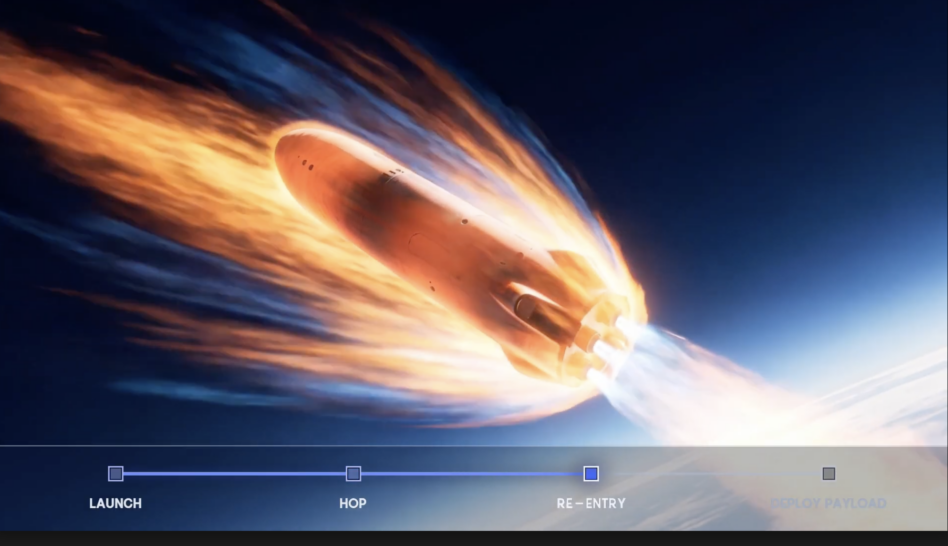
Shipping freight fast is a frustrating problem. Hop Aero wants to solve it using Rook–an autonomous suborbital rocket meant to launch and land cargo hundreds of kilometers away in minutes. The company launched on Y Combinator this week with a rendered video of a small launcher capable of flying a 15-minute delivery route between Okinawa and Taiwan.
Meet Rook: Rook is designed to launch from a standard 12-m shipping container, fly a suborbital arc, fly in at low hypersonic speeds, and land on unprepared surfaces, including in contested environments.
Hop Aero CEO and cofounder Matija Milenovic said Hop Aero’s first product, Rook Two, will:
- Stand ~6 m tall;
- Carry 250 kg of cargo over ~750 km.
Since Hop’s founding in 2024, the company has hot-fire-tested its engine and ignition system, and flown one piece of hardware: a tether test of a ~3 m prototype at Infinity One Oklahoma Spaceport, roughly two hours west of Oklahoma City.
The idea grew out of two painful logistics failures:
- While serving in the Marines, CTO and cofounder Jacob Balaj watched aircraft sit grounded in Okinawa, Japan during a Marine Corps typhoon-relief mission;
- Meanwhile, Milenovic once flew 23-hours round trip to hand-deliver satellite hardware because a courier couldn’t guarantee the delivery.
“If the US military—all the way down to a small startup—has had this problem, there’s probably a large market in between,” Milenovic told Payload.
Hop Aero credits its pace to hopOS, an in-house software suite Milenovic said is modeled on SpaceX tools. One hopOS program generated the design for Hop Aero’s engine, which went from software to hot-fire in about two months.
Order confirmation: Hop Aero was awarded a $1.25M Direct-to-Phase-II SBIR in September 2025 from AFRL for a program it calls “Rapid Operations Over Kilometers.” While still a research contract, the award lets companies skip Phase I by proving feasibility work is already done.
Rush delivery: Rocket-delivered cargo isn’t new.
- The Air Force has pursued point-to-point rocket logistics for years, recently through a DoD effort called Point-to-Point Delivery.
- A crowd of companies is chasing cargo reentry from space, including startups like Outpost Space. SpaceX also has multiple irons in the fire, with Starship being floated as a point-to-point option, and the company’s Starfall reentry capsule demonstrating its first flight this year.
The hard part is landing—setting a vehicle down precisely and intact after a hypersonic reentry is no easy task—and the cost has to appeal to the market despite these expensive obstacles.
Milenovic noted that storing cargo on-orbit and re-entering on demand means relying on third-party launch availability, standing up a constellation of vehicles, and exposing hardware to space hazards, but it keeps cargo pre-positioned and ready to deploy. Hop Aero is taking an alternative approach by betting on suborbital, point-to-point “hops.” This approach eliminates the launcher dependency and constellations, but still inherits the challenge of a soft landing.
“Everything you build in aerospace is just always a series of trade-offs,” Milenovic said. “We felt like this was the best set of trades that we could make.”

Exclusive: EraDrive Lands $13M DoD Award For Autonomy Module
EraDrive won a $13M DoD award, under which the Space Force will buy an undisclosed number of the company’s Era-Node vision-based autonomy modules.
WarpWare Closes Pre-Seed to Bring Agentic Tools to Flight Software
CO-based WarpWare closed its $1.2M pre-seed round today to expand what it calls an AI-enabled engineering platform for space missions.

RATLOG Wants to Cut ~90% of a Rocket Engine’s Parts
The heavy-lift rocket startup debuted on Y Combinator as part of the Fall 2026 batch.

Seraphim Space Investment Trust Doubled its Value in 2026
Seraphim’s major holdings—ICEYE, ALL.SPACE, D-Orbit, HawkEye 360, and Xona Space Systems, which together represent more than 75% of the firm’s portfolio—all had a great year, and that success has trickled upwards.

The Payload Pioneers program has recognized 90 young stars of the space industry. After three years, we wanted to check in on where some of our 30-under-30s are today.
It’s no surprise that our Pioneers have seen their careers continue to skyrocket after being recognized by Payload. From landing new jobs to publishing books to founding companies, this group has kept itself busy. And other organizations have seen the promise first recognized by Payload, with Pioneers being named to other prestigious lists—including Forbes’ 30 under 30.
Here’s a roundup on our past Pioneers.
Keep reading