


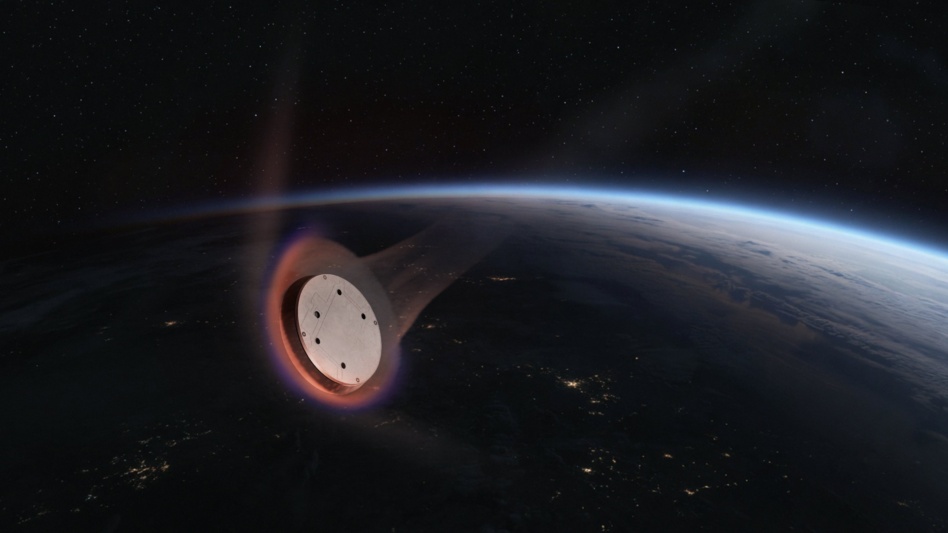
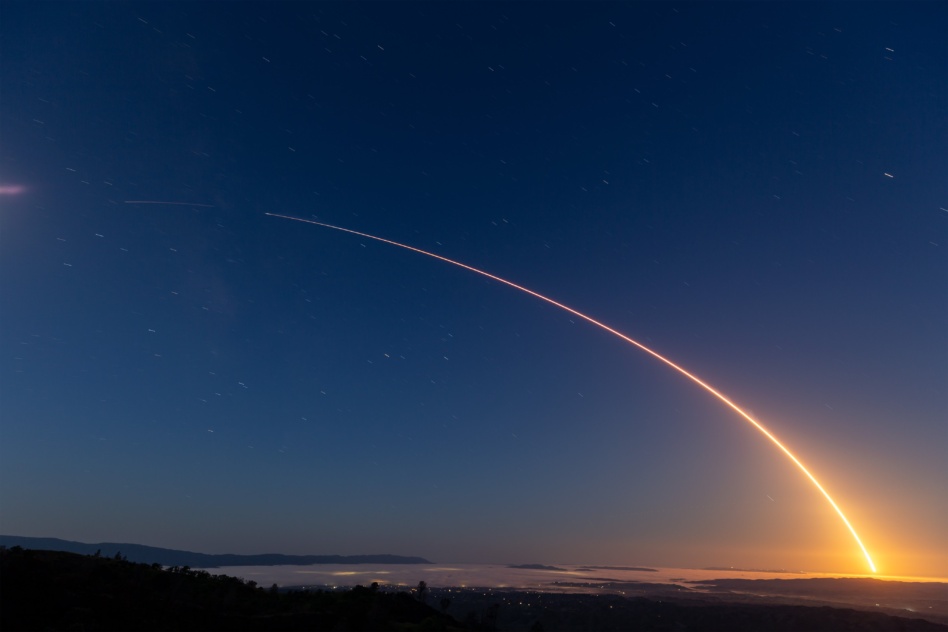
SpaceX ($SPCX) launched a demo mission of its Starfall reentry capsule yesterday, kicking off a new era of competition in the budding reentry sector.
While SpaceX has yet to share details about Starfall’s performance, the mission is evidence of SpaceX’s commitment to build hardware for future in-orbit manufacturing applications—first highlighted as a single bullet point in SpaceX’s S1 filing.
This reentry market isn’t all green pastures, however, and about a dozen startups have been working for years on reentry vehicles of their own.
So how does it feel when an industry giant side-quests into your space? Payload spoke with founders of four reentry startups, and the mood was largely positive—with every founder pointing to Starfall as confirmation that they’re on the right track.
“SpaceX does not tend to go after bullshit markets,” Inversion Space CEO Justin Fiaschetti told Payload. “They tend to only go after things where there’s a very clear demand signal…So I think this is very much a rising tide situation.”
Commoditize this: Unlike launch, where SpaceX has benefited from first-mover advantage, the reentry sector is already crowded with competition, including flight-proven capsules, lifting-body vehicles, and high-volume solutions.
In comparison, Starfall offers a mixed bag of technical specs. Starfall is considerably larger than other flight-proven alternatives—it’s about 3x the size of Varda’s Winnebago series—however, it does not offer any built-in in-orbit maneuverability, and cannot yet guide itself to a precise landing zone.
- Starfall stands ~10 ft in diameter and 2.5 ft tall.
- It weighs 4,600 lb unloaded, and can carry roughly 1 metric ton of payload.
- It can be deployed from a standard Falcon 9, Falcon Heavy, or Starship launcher.
For existing reentry players, these specs don’t scream monopoly. Many of the founders predicted that the future market for reentry will require different vehicles for different applications, and SpaceX will be forced to find its own niche.
“We don’t look at SpaceX—or any of the others doing [Earth] return, really—as competitors,” Outpost Space CEO Jason Dunn told Payload. “All of these different return techs that are being developed, they’re all very different, [and] they all serve very different use cases.”
If anything, the reentry execs told Payload, Starfall’s entry into the sector provides confirmation that the potential demand is larger than any one company can satisfy. The wide variety of use cases for reliable Earth return vehicles—including in-orbit manufacturing, scientific experimentation, hypersonic testing, and in-orbit logistics—means that the market will likely support a diverse set of solutions.
“While there’s absolutely going to be a large segment that can just move into this right gigantic thing, we still see that a really large percentage—if not the majority—is going to require dedicated missions,” Reditus Space CEO Stef Crum told Payload. “The [demand] flood gate hasn’t opened in any capacity yet.”
Devil’s advocate: Positive thinking aside, SpaceX’s entrance into the sector does raise the likelihood of boxing out too-similar alternatives. Both Dunn and ATMOS Space Cargo CEO Sebastian Klaus predicted that Starfall would create a tougher market for those who fail to differentiate.
“There’s absolutely going to be losers,” Dunn said. “There are quite a bit of smaller return vehicles and startups that are all focused on a similar set of mission objectives, which are kind of like a shiny object today, but not really that big of a market in the future.”
Luckily for ATMOS, differentiation by location can be just as good as the technical specs, and Klaus seemed confident that most of the institutional demand in Europe would be loath to abandon local reentry startups for a Musk-run alternative.
“In the US, several companies are going into that market…if I were them, I would be a little bit concerned,” Klaus said. “In Europe, right now…this is really good news. We’re all celebrating a little bit inside.”
Exclusive: Xona Ramps Up Production Ahead of Pulsar Launch
With FCC approval in hand and six sats ready for the pad, Xona is turning to its next challenge: building the next 250.
ArbaLabs Launches AI Verification Demo On South Korea’s Nuri Rocket
“In short, tons of companies are looking at the latest and greatest physical AI deployments,” ArbaLabs CEO Ashley Reeves told Payload. “Nobody is really thinking about putting some checks and balances on what these AI models are doing.”

Nebex Partners with Thrusters Unlimited to Unlock $700M for Mexico’s Space Ecosystem
The capital will fund EO, telecoms and other strategic capabilities, according to Nebex.
Satlyt Raises $8M Seed to Expand Its Virtual ODC Network
Satlyt was founded in 2024 by Afullo, an alum of SpaceX and Google who spent years trying to convince both companies to invest in in-space edge computing opportunities.

NASA’s launch facilities will likely reach capacity by the end of the decade as the number of commercial launches continues to skyrocket, according to a report from the space agency’s inspector general released Monday.
You can beat the heat: The IG found extensive problems at the agency’s main launch center at KSC that are only expected to get worse as the launch cadence rises to reach 268 in 2030—up from 109 in 2025.
The electrical system at NASA’s Wallops Flight Facility in Virginia was updated in 2018, and construction began on the causeway bridge to reach the base in 2025, so it doesn’t face the same scale of issues—though the number of launches from the small facility is expected to grow by to 44 in 2030, up from 17 in 2025.
Keep reading