


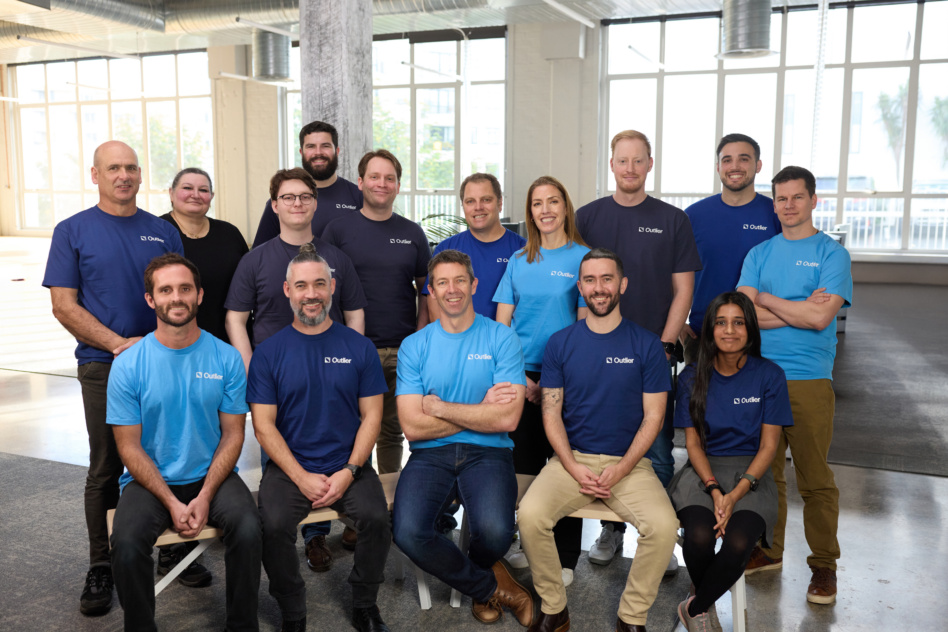
Outlier Space, a New Zealand-based reentry startup, announced a $7.35M pre-seed round yesterday to fund the development of the company’s microgravity research and return vehicle, which is scheduled to fly its debut mission in 2028.
Global from Day One led the round, which included additional participation from Nova Threshold, Brian Cartmell, Airtree, Icehouse Ventures, Investible, and Side Stage Ventures.
Meet the Outliers: Founded in 2024 by Jamie France, Rocket Lab’s former global director of the Electron launch vehicle, Outlier is developing a reusable Earth-return capsule to offer better mission economics compared with the growing pool of reentry vehicles on the market.
While France declined to discuss many of the technical specifics about the vehicle Outlier is building, he shared the company’s plan to lower the cost of reentry through comparatively larger reusable capsules—by focusing as much as possible on increasing the ratio between payload mass and total vehicle mass.
“If someone wants to make money from microgravity, they need to have cost-effective access, and that’s really what we’re trying to provide,” France told Payload.
Outlier’s return vehicle will offer space on board that is comparable to three ISS mid-deck lockers—and that comparison is important. As the ISS winds down operations ahead of its planned demise after 2030, Outlier is betting that much of the demand for slots on the ISS will shift over to the reentry market.
Outlier is planning a three-pronged approach to deploying its new capital ahead of its NET 2028 launch date.
- Technical development: Outlier is developing its own heat shield to protect the capsule and its payloads through reentry, and will spend the next two years testing its hardware, and qualifying its subsystems.
- Regulatory approval: Despite being based in New Zealand, Outlier will fly its first mission under an FAA license (presumably on a US launcher), and plans to complete regulatory approvals early to dodge any red-tape roadblocks.
- Market traction: Outlier plans to pre-book its missions early, so that it can demonstrate revenue potential ahead of its first flight and ease the pathway to future funding rounds for building at scale.
The market: Outlier is the latest reentry startup to emerge from stealth into an increasingly crowded and mature pool of competition. Alongside these startups, SpaceX demonstrated its own reentry vehicle for the first time in June.
But Outlier remains confident that it can build a moat for itself through exceptional unit economics—hence the name. The company says it is targeted in its go-to-market strategy, because it is not focusing on every application for reentry—hypersonics testing, or point-to-point logistics. Outlier is instead focusing on the demonstrated demand of ISS customers and other microgravity researchers.
The idea is to provide a “microgravity chamber” to host pharmaceutical or semiconductor manufacturing experiments, with a form factor that can allow customers to easily scale to higher-volume production.
“I know that we’re not the first free flyer on the market,” France told Payload. “I did 10 years in a company being a fast follower to SpaceX, and they’re a multi-billion-dollar company now. I’ve seen what it can be like if you can deliver really great, cost-effective engineering that works really well…We think we can do that for reentry.”

RATLOG Wants to Cut ~90% of a Rocket Engine’s Parts
The heavy-lift rocket startup debuted on Y Combinator as part of the Fall 2026 batch.

Seraphim Space Investment Trust Doubled its Value in 2026
Seraphim’s major holdings—ICEYE, ALL.SPACE, D-Orbit, HawkEye 360, and Xona Space Systems, which together represent more than 75% of the firm’s portfolio—all had a great year, and that success has trickled upwards.
Exclusive: In Orbit Aerospace Pivots From Re-entry Vehicles to Spacecraft Autonomy
In Orbit has won new government contracts for its onboard AI system, which the company says can run a spacecraft’s operations without waiting on ground control.
Reflect Orbital Buys Two Skyroot Aerospace Launches
Reflect Orbital announced the purchase of two launches today from Indian launcher Skyroot Aerospace.


ESA has tapped Aalyria to build a piece of the internet’s off-world extension: a network-operations center that allows spacecraft, lunar missions, and ground stations to share data reliably across the solar system.
The center will run delay-/disruption-tolerant networking (DTN), which is a store-and-forward protocol built for space when a constant, instant connection is often impossible.
“What’s new here is our combination of that implementation at the protocol level with the [Aalyria] Spacetime orchestration, so that we’re directing antennas where to point when—and when to establish links,” Aalyria CEO and cofounder Brian Barritt told Payload.
Keep reading