



The Autobahn is coming for in-space data traffic.
German startup NeuralSat announced a €2.9M ($3.2M) pre-seed funding round today to develop a 72-sat in-space data relay and processing network, aimed at speeding up the flow of data to and from space.
Capnamic Ventures and Bayern Kapital led the round, which included additional participation from ZOHO.VC, Robin Capital, KIEMIS Holding, and Mission E Capital. NeuralSat is also a member of ESA’s Business Incubation Center (ESA BIC) and the NVIDIA Inception Program.
Sharing is caring: Unlike other orbital compute startups—namely, those pitching orbital data centers (ODCs) as a replacement for terrestrial ones—NeuralSat is focusing primarily on the data being gathered and distributed in space today.
As the number of satellites in orbit increases—with ESA projecting ~100,000 by 2030, up from 10,200 in 2024—the amount of data being gathered is starting to hit bottlenecks on its path to Earth.
NeuralSat’s proposed constellation would allow satellite operators to share compute and communications resources, sending their data to NeuralSat nodes which can process and downlink it to available ground stations. The idea is to enable satellites to outsource some of their communications and computing resources—sacrificing self-sufficiency, but gaining extra space and power for their core payloads.
“We believe the next major evolution in space will…come from connecting satellites to shared infrastructure that enables them to communicate, access computing resources, and operate together,” CEO Mohd Bilal said in a statement. “Just as the internet transformed how computers interact on Earth, we intend to transform how intelligence is connected and delivered in space.”
How it works: NeuralSat’s constellation will feature two core capabilities:
- A data relay network using optical and high-frequency radio links, and targeting data rates up to 50 gigabits per second.
- A distributed computing network, so satellite operators can utilize shared processing power on orbit.
NeuralSat also plans to offer hosted-payload capabilities, allowing customers to integrate their own payloads into NeuralSat birds.
NeuralSat plans to use the new capital to fund an in-orbit demonstration mission in 2027 to “validate the core elements of its orbital data relay and processing architecture,” according to the announcement. Following the demo, NeuralSat expects to begin deploying its first operational sats in 2028.
OwlO Cloud Emerges from Stealth to Build European Orbital Cloud Network
OwlO Cloud is planning to have at least 10 spacecraft—orbital cloud nodes (OCN)—operational by 2030.
Exclusive: Lyra Systems Emerges from Stealth to Solve the Valley of Death
Lyra Systems announced an agreement with the DoD aimed at helping early-stage technologies traverse unscathed across the Valley of Death.
European Bodyguard Sats are Closer Than You Think
PAVE Space announced plans to launch a demo mission of its IBEX spacecraft—a highly maneuverable platform for commercial and defense payloads. But PAVE isn’t the only startup building a security detail.

Exclusive: Orbital Taps Orca Aerospace for Onboard Autonomy Software
Satellite autonomy startup Orca Aerospace announced a deal worth up to $20M with LA-based Orbital to put its software on Orbital’s planned data-center fleet.
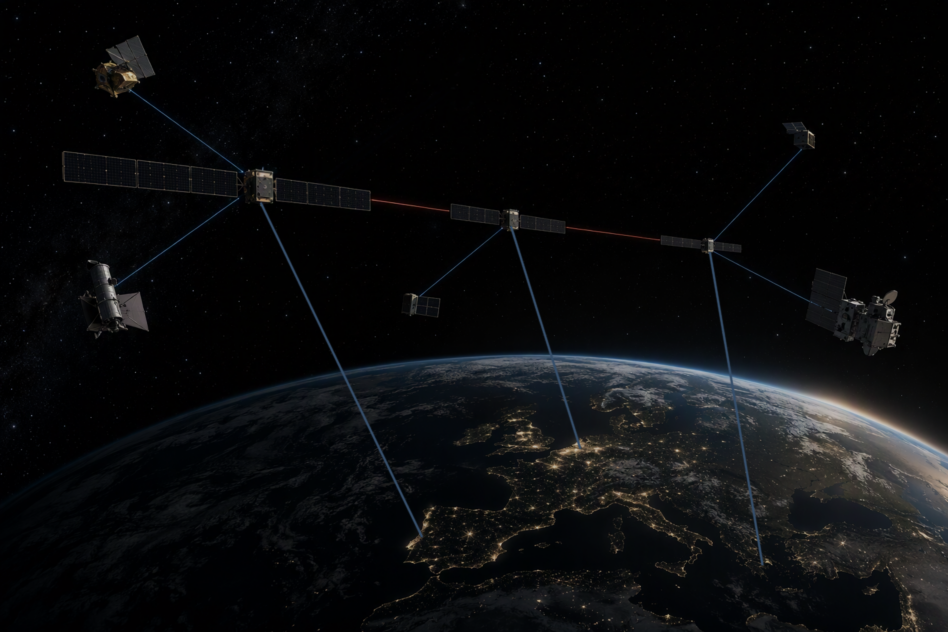
Luxembourg-based OwlO Cloud emerged from stealth today with plans to build a sovereign European orbital-cloud network.
The company is aiming to help European satellite operators process more of their data in orbit. To do so, OwlO Cloud is planning to have at least 10 spacecraft—orbital cloud nodes (OCN)—operational by 2030. Each OCN will be equipped with data processing and storage hardware, as well as optical-comms tech, provided largely by European suppliers.
“There’s people in Europe doing a lot of those pieces: either the busses, the compute, optical comms…but nobody’s working on an integrated end-to-end system that they plan to finance, build, commission, and then operate as an actual infrastructure service,” CEO Jason Aspiotis told Payload. “Our goal as a company is to come in as an operator of this infrastructure that catalyzes all the pieces—[and] to move forward and deploy it by 2030.”
Keep reading