



The last time the US released a space transportation policy in November 2013, SpaceX Falcon 9 had flown just six times. Now, Falcon 9 has ~700 flights behind it—and the White House is aiming for more than 1,000 launches and reentries annually by 2030.
The new National Space Transportation Policy (NSTP), signed Aug. 20, which replaces the 2013 edition, asks what it would take to get to 1,000 annual launches. The answer? More pads, more airspace, more spectrum, and somewhere for all of it to come back down.
“The overwhelming concern is just reliable access to orbit,” Fenix Space CEO Jason Lee told Payload. “This [policy] is encouraging to foster looking at options and ways to facilitate that.”
Fenix has a prototype launch vehicle designed to take off and land without traditional launch pads. “From our perspective, we have a very flexible system that can support that document and the objectives of that policy,” Lee said.
#Throwback: The 2013 and 2026 space-transportation policies share a core goal: assured access to space for US customers—ideally driven by the private sector.
Three differences that set the old and new ones apart:
- The 2013 directive telling NASA to build its own heavy-lift system and crew vehicles is gone, replaced by commercial architectures.
- Spectrum and airspace appear for the first time, with the Commerce Department and the FCC on the hook for launch and reentry spectrum, and the Department of Transportation (DoT) folding launch into air-traffic-control modernization.
- Space superiority is the name of the game in the update, including requirements for launching within 48 hours, expeditionary sites, and security for the ranges themselves.
Forgetting someone?: The NSTP elevates reentry from a licensing question to an infrastructure priority.
“For the first time, the United States has acknowledged that reentry from space is a national priority, along with launch,” Outpost Space CEO Jason Dunn told Payload via email. “The National Space Transportation Policy further validates the critical role reentry plays in US space superiority, and accelerates access to the downmass and through-space logistics market.”
Beyond rebranding federal sites as “launch and reentry” facilities, agencies must now:
- Identify federal land that could host an additional designated reentry site;
- Evaluate reentry safety criteria;
- Produce a development plan for the site, by considering commercial access, infrastructure, and co-development.
“We are excited to see the White House’s focus on enabling the growth of the space industry at large, especially the emphasis placed on reentry,” Reditus Space cofounder and CEO Stef Crum told Payload via email. “Reditus Space has always focused on guaranteeing the ability to reenter within the United States, but reentry capacity has been limited. How this capacity grows will strongly influence the commercial reentry cadence over the coming years.”
All hands on deck: The memo tasks more than a dozen agencies and officials, among them:
- NASA: Facilitate commercial transportation to and from the Moon, and explore commercial pathways for sending robots and humans to Mars;
- DoD: Pursue in-space transportation services;
- FCC: Ensure reliable spectrum access for launch, reentry, recovery, and on-orbit activities;
- Office of Science and Technology Policy: Develop a space transportation industrial base strategy;
- State and Commerce Departments: Ensure US market access.
As with similar policies, impact will come down to implementation. Deliverables are due to the White House during the next 60 to 240 days, including reports on federal reentry sites and priority airspace for launch corridors. The memo is also still subject to the availability of appropriations.
Great minds: The US isn’t the only country rewriting rules for space transportation. Canada and Japan are both taking legislative action to advance domestic space transportation. Ottawa’s Canadian Space Launch Act—introduced in April— would give the only G7 country without domestic launch its first launch and reentry framework.
In June, Japan’s National Diet passed an amendment to its Space Activities Act, shifting from a satellite-centric-permitting regime to one built around rocket launches themselves.
The amendment:
- Extends launch permits to rockets carrying no satellite, including test flights with dummy payloads, letting startups enter the regulatory process earlier;
- Adds a certification system for the structure of objects carried on board;
- Expands government indemnity to cover accidents during rocket reuse and object reentry.
Japan stopped short of the US on infrastructure, though. Lawmakers considered licensing systems for spaceports and reentries and left both for future deliberation.

Deep Dive: FY27 Defense Space Budget
The Space Force’s FY27 budget request made headlines earlier this year at a record-breaking $71.3B.

Bill Spotlight: Space Superiority Readiness Act
A bipartisan pair of senators introduced a bill last week aiming to ensure the US military is prepared for conflict with Beijing in orbit.

FL Governor Candidate Launches Space Race Policy
“Right now, other states and other countries are competing for the launches, the investments, and the high-paying jobs that belong to our workers, our graduates, and our families. We are going to change that,” Donalds said at a press event.

Space Science’s Golden Age Problem
Last week, the White House OSTP released a sweeping vision for the nation’s R&D enterprise.

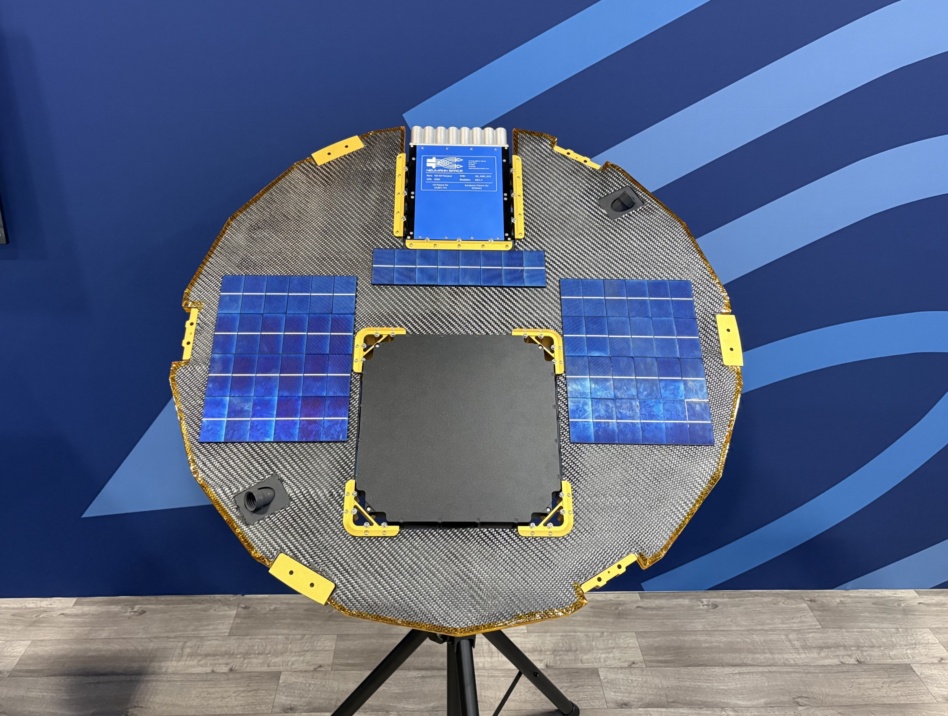
SALT LAKE CITY, UT — Thinking outside the box is paying off—at least for The Aerospace Corporation, which is starting to gain commercial traction for Disksat, its new box-less satellite configuration.
Aerospace officials shared updates on its Disksat demonstration mission on the sidelines of the Small Satellite Conference in Utah, including the announcement that Australian propulsion startup Neumann Space plans to license the Disksat architecture for future missions.
How’s it going: Aerospace launched four Disksats on a Rocket Lab Electron rocket in December. The mission, which is still underway, has been a success so far, according to company officials.
Keep reading