


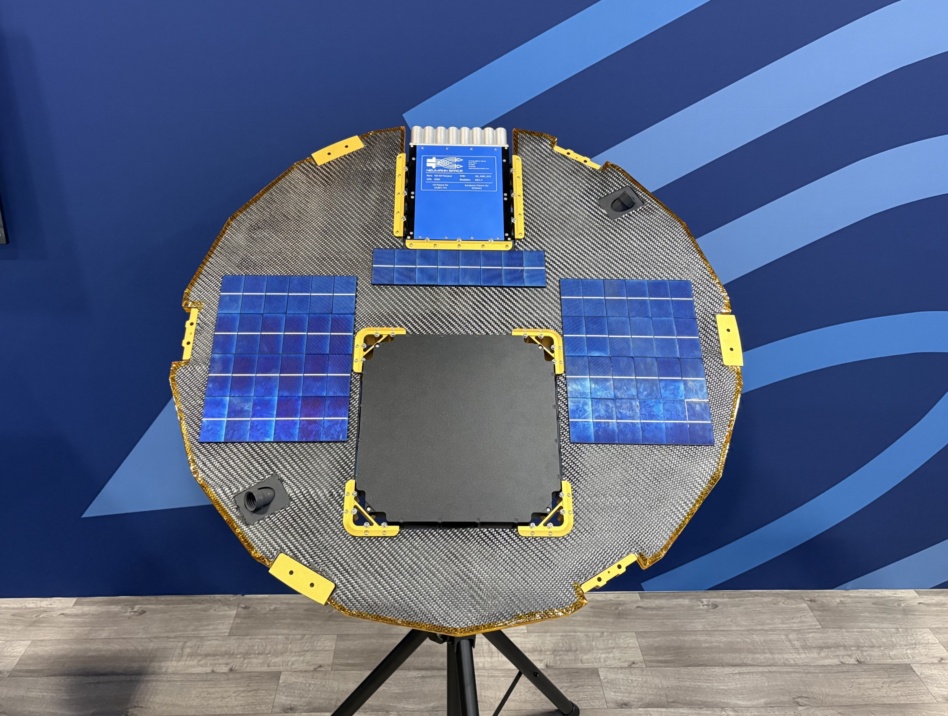
SALT LAKE CITY, UT — Thinking outside the box is paying off—at least for The Aerospace Corporation, which is starting to gain commercial traction for Disksat, its new box-less satellite configuration.
Aerospace officials shared updates on its Disksat demonstration mission on the sidelines of the Small Satellite Conference in Utah, including the announcement that Australian propulsion startup Neumann Space plans to license the Disksat architecture for future missions.
How’s it going: Aerospace launched four Disksats on a Rocket Lab Electron rocket in December. The mission, which is still underway, has been a success so far, according to company officials.
The satellites:
- Deployed from Electron,
- Demonstrated their ability to produce 100W of peak power, and
- Transmitted S-band signals back to Earth through the Naval Postgraduate School’s Mobile CubeSat Command and Control Ground Network.
But the mission isn’t over. Disksat’s next tasks will be to turn on its electric thrusters—provided by European propulsion company Enpulsion—lower its altitude, and begin testing its ability to fly in VLEO, at altitudes below 350 km.
If all goes well, Aerospace hopes to usher in a new era of satellite design—out with the old, boxy cubesats, and in with the frisbees.
At a size of just 1 m in diameter by 2.5cm tall, Disksat’s design aims to solve multiple problems at once:
- They’re built to stack on top of one another inside a rocket faring, maximizing the number of satellites that can share a ride, and improving economics at a time when launch availability is increasingly constrained.
- Disksat’s thin side profile is also intended to decrease orbital drag as much as possible to allow payloads to stay in VLEO for longer missions.
“We’re in a phase where stackable, highly capable small satellites are being launched dozens at a time on a single rocket,” Mike Fox, systems director at Aerospace, said in a press conference. “Flat stacks are becoming the new normal. DiskSat was designed from day one to fit into that paradigm: stackable, containerized, optimized for high-rate production and launch integration.”
Upward trajectory: At least three customers have signed on to license the new satellite design, including Neumann Space, Satlyt, and Orbotic Systems.
For its license, Neumann Space plans to incorporate its Flatypus propulsion system into the Disksat design. Flatypus uses the same core technology as the company’s Neumann Drive propulsion system, but is designed specifically to fit into the Disksat’s pancake-like form factor—offering greater thrust compared to the Enpulsion thrusters, without increasing drag, according to Neumann Space CEO Herve Astier.
With the license, Neumann Space is upgrading its ambitions—going from a propulsion system provider to offering buses as well. The idea is to capitalize on the growing pool of companies looking to fly constellations, and begin offering more robust solutions for payload operators wanting to fly in VLEO, Astier told Payload.
Astier expects to be able to launch its first Flatypus-powered disksats as early as 2028, depending on customer demand.

Colare Raises $2.5M to Expand its Hardware-Focused Hiring Platform
Colare’s technical-assessment platform maps the requirements of a role, and recreates decisions future engineers could face on the job.

Exclusive: DoD Taps Orbital Operations for Cryogenic Spacecraft Demo
The Long Beach, CA, startup has won up to $35M from the DoD under a prototype Other Transaction Agreement to fly a full-scale, in-orbit demo of Astraeus—its cryogenic-maneuvering vehicle.
Xona Raises $250M Series D to Scale Commercial GPS Constellation
Xona’s long-term plan is to build a ~258-sat constellation to offer an upgraded commercial alternative to government GPS networks.
Hewlett Packard Enterprise to Send AI Compute Module to the Moon
Hewlett Packard Enterprise ($HPE) is taking remote working to a whole new level.

OrbitAID Aerospace is aiming to prove it can gas up satellites in orbit as early as next year.
The Indian company told Payload that it is expecting to conduct a demo life-extension mission in LEO in Q1 2027.
How to save a life: During the demo, two satellites will launch to LEO—a chaser and a target. The mission seeks to prove out each step of the life-extension process for a target spacecraft, including:
Keep reading