



The Space Force officially has its third leader.
Gen. Douglas Schiess became the chief of space operations on Sept. 3, following the retirement of Gen. B. Chance Saltzman, who led the almost-seven-year-old service for nearly four years.
“Our way of life, our economy, and our national security all depend on our ability to achieve space superiority,” Schiess said during a ceremony at Joint Base Andrews in Maryland.
Schiess mate: Schiess, who most recently served as the deputy chief of space operations for operations, was nominated to lead the Space Force in May. The Senate Armed Services Committee met to consider his nomination in July, and the full Senate confirmed his appointment in August.
In his written statement at his confirmation hearing, Schiess highlighted the threats in orbit posed by both China and—to a lesser degree—Russia. He doubled down on that message in remarks delivered last week as he became the Space Force’s top officer.
“Every day, our potential adversaries advance their efforts to disrupt, degrade, or destroy our space capabilities—and they try to add to their own capacity to exploit space to their advantage,” he said. “As CSO, I want to be clear—our purpose is not confrontation, but deterrence, ensuring no adversary believes aggression against the United States will succeed.”
The people problem: However, if deterrence fails and conflict with Russia or China erupts in space, the US does not have the workforce to quickly rebuild destroyed military space assets, according to a RAND report published last week.
In “Breaking Glass, Missing Hands,” RAND recommended that the Space Force invest to ensure the industry base could reconstruct critical national security space infrastructure after an attack.
While companies can do much on their own here, by establishing apprenticeships and ensuring they are retaining trained talent, RAND said that only the government can set policy that treats the workforce as a national security asset.
The report recommended that the Space Force:
- Develop a clear policy that ties the defense-industrial-base workforce to national-security priorities;
- Invest in internships and scholarships, and promote careers in space;
- Allow ROTC grads to meet their service obligations after graduation by working at approved national-security companies focusing on space;
- Study how automation can help fill workforce gaps, while also seeking to bring more people into skilled space jobs.

Congress Seeks Answers On Starlink Disruptions in Ukraine
“The United States government has a fundamental obligation to protect American personnel serving overseas,” the senators wrote. “The possibility that American personnel were endangered by preventable disruptions, inadequate coordination, or decisions made by their own government demands immediate scrutiny and accountability.”

Velos’ Election Day Tracker for Space
Space may not be top of mind when voters head to the ballot box, but Election Day outcomes still have a big impact on US policy and funding above the Kármán line.
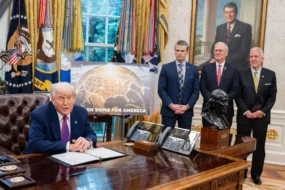
Colorado Springs, Huntsville Team Up on Golden Dome
“It’s a transformed relationship between Colorado Springs and Huntsville,” Rep. Jeff Crank (R-CO) told Payload. “When I took office, I don’t think it was a bad relationship, but it was one where both communities were kind of looking over their shoulder at the other. That wasn’t good for America, and I don’t think it was good for Colorado Springs or Huntsville either.”

Artemis Accords To Meet on Lunar Debris, Emerging Space Help
The Artemis Accords Principals’ Meeting in Turkey will be led by NASA Deputy Administrator Matt Anderson and Maj. Gen. Roberto Melgar Sheen, director of the Peruvian Space Agency.


Pixxel, the hyperspectral-satellite operator with offices in India and the US, announced the closing of a $100M Series C to expand its satellite production footprint in the US, and begin churning out larger, more capable satellites for an increasingly global customer base.
Temasek and Seraphim Space led the round, which included additional participation from new investors 360 ONE and IMM Investment, as well as existing investors Radical Ventures, growX ventures and others. The round brings Pixxel’s total funding to $195M since its founding in 2019.
Eye spy: At a time when national-defense ministries and civil-space programs are spending huge pools of capital to secure sovereign-sensing capabilities, Pixxel has found itself “at the right place, at the right time,” CEO Awais Ahmed told Payload.
Keep reading