


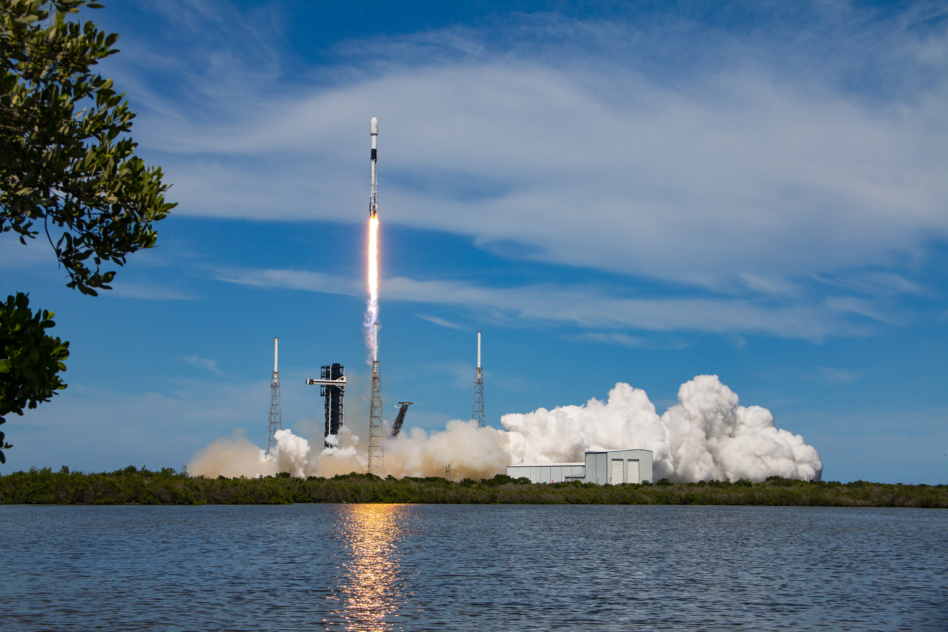
PARIS, FRANCE — Everybody’s looking for launch capacity these days, and for those who have it, the phones are ringing off the hook.
Maverick Space Systems announced yesterday it booked 10 400-kg class Kepler Communications Tranche-2 sats to fly aboard Portal Space Systems’ Motus Via Sol mission, which is expected to launch on a SpaceX Falcon 9 in mid-2028.
“Signing 10 Kepler communications Tranche-2 spacecraft to this mission fills the majority of the remaining capacity, leaving just a single half-cake-topper slot open,” Maverick COO and cofounder Vidur Kaushish told Payload. “We’re in a capacity constrained launch environment, and missions like Motus Via Sol are exactly the kind of high-density rideshare architecture the market needs more of.”
Under new management: The Kepler deal comes less than one month after Portal announced it purchased a full Falcon 9 rocket for Motus Via Sol, and tapped Maverick to handle launch integration and to fill the rocket’s excess capacity.
The mission is the latest where launch integrators are taking a larger role in the launch process compared to years’ past. The shift comes in response to SpaceX reportedly pausing orders for its Transporter missions beginning in late 2028 or early 2029, leaving a hole that launch integrators are more than happy to fill.
While other launch integrators—such as Exolaunch and SEOPS—have bet the house, buying full Falcon 9s to run dedicated rideshare missions of their own, Maverick has played a less risky hand, by partnering with Portal who’s financing the flight.
And the model Maverick and Portal have built might lead to more dedicated rideshare opportunities for the industry, as both companies are actively evaluating future dedicated and shared missions across a range of launch vehicles, according to the announcement.
Up the ante: One of the reasons Maverick hasn’t gone down the same path as Exolaunch and SEOPS is due to the fact that Maverick doesn’t have the capital necessary to fund a full flight of Falcon 9.
Maverick has been able to operate since its founding in 2019 without raising equity capital, so while the company could potentially make a bid for a small launch vehicle, according to Kaushish, it hasn’t bootstrapped its way into Falcon 9 money just yet.
Stoke Space Raises $1B Initial Series E Round
Stoke Space Technologies announced today that it has closed an initial $1B tranche of a Series E round, bringing the company’s total capital raised to $2.3B.

Isar Aerospace Reaches Orbit on Second Attempt
Isar Aerospace became the first European Launcher Challenge startup to reach orbit this weekend, after the second launch attempt of its Spectrum rocket.

PLD Space, HyImpulse Close Major Extension Rounds
This week, two European launch hopefuls—Spain’s PLD Space, and Germany’s HyImpulse Technologies GmbH—closed major extension rounds to support their launch efforts.

SpaceX Announces New Starbase, Louisiana Spaceport
Gwynne Shotwell joined Louisiana Gov. Jeff Landry on Tuesday to announce a high-cadence launch site for future Starship operations.

Finnish hyperspectral satellite operator Kuva Space released data today from a pilot program that demonstrated its ability to monitor illegal crop farming from space.
The study used Kuva’s Hyperfield-1 satellites to analyze an area in Afghanistan’s Helmand Province. It combined data from the EU’s Copernicus Sentinel-2 sats with 363 hyperspectral images gathered by Hyperfield to identify 8,835 potential poppy fields in a survey of ~250,000 agricultural plots in the area.
New model, who dis: The results of the study show a modest improvement over the publicly available imagery—Kuva was able to identify poppy fields with 75% accuracy, compared with Sentinel-2’s 71% accuracy. However, Kuva’s real success was reducing false positives. Even for hyperspectral sats, opium poppies can be hard to spot, as they’re often grown alongside legal crops.
Keep reading