


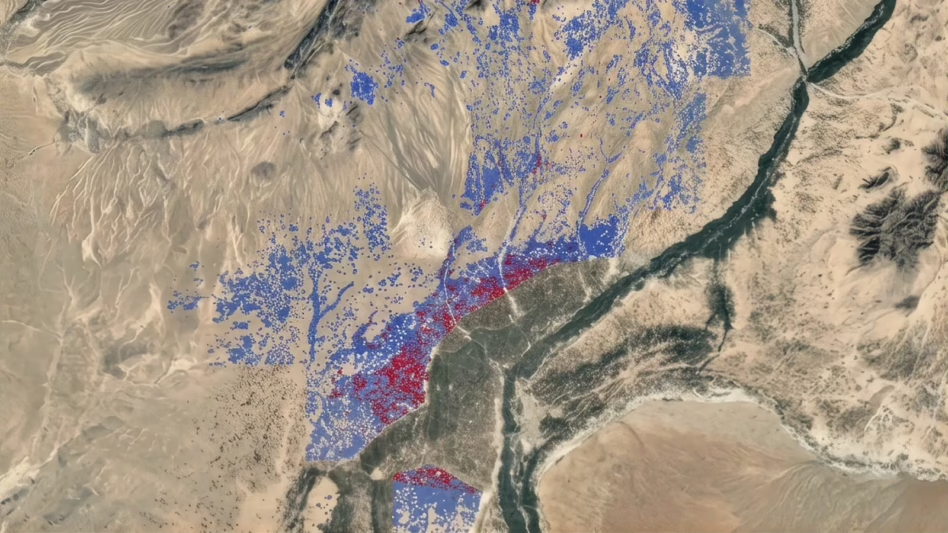
Finnish hyperspectral satellite operator Kuva Space released data today from a pilot program that demonstrated its ability to monitor illegal crop farming from space.
The study used Kuva’s Hyperfield-1 satellites to analyze an area in Afghanistan’s Helmand Province. It combined data from the EU’s Copernicus Sentinel-2 sats with 363 hyperspectral images gathered by Hyperfield to identify 8,835 potential poppy fields in a survey of ~250,000 agricultural plots in the area.
New model, who dis: The results of the study show a modest improvement over the publicly available imagery—Kuva was able to identify poppy fields with 75% accuracy, compared with Sentinel-2’s 71% accuracy. However, Kuva’s real success was reducing false positives. Even for hyperspectral sats, opium poppies can be hard to spot, as they’re often grown alongside legal crops.
Kuva’s Hyperfield sats spotted the spectral signatures of opium poppies in 3.6% of the plots in the region, and provided a greater level of accuracy to analysts—who can then run more targeted follow-on imagery campaigns using high-resolution optical EO. The result means illegal crop monitoring from space can be more accurate, and more affordable.
“Satellite monitoring has traditionally forced a trade-off between covering very large areas, and seeing enough detail to identify what is actually growing there. Hyperfield data and in-house AI-powered models start to close that gap,” Kuva CEO Jarkko Antila said in a statement. “By detecting differences in vegetation that conventional imagery miss, we can screen entire regions, and focus the most expensive analysis on a much smaller set of high-probability areas.”
What’s next: While hyperspectral-imaging satellites are not nearly as proliferated as optical or SAR sats, the data they gather can be transformational to the entire EO process. Hyperspectral imagery has broad use cases—from mineral identification for mining prospectors, to classifying crop health over large agricultural areas—but by proving its ability to detect illegal crop operations, Kuva opens the door for a new type of customer: international legal authorities.
Illegal crops are often grown in areas that are hard to reach, and when authorities crack down on operations in one area, they can quickly spring up in another. Kuva’s hyperspectral imagery gives authorities a way to monitor the entire world in near-real time, spotting new operations as they spring up.
Kuva’s AI-enabled hyperspectral sats can also be trained to identify other illegal crops, such as coca and cannabis.
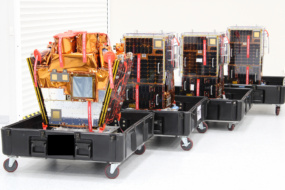
Satellogic Expands DoD Work As it Preps for Next Launch
Satellogic is gearing up to launch its latest batch of satellites next month, potentially including the company’s first Merlin sat, which is designed to gather constant 1-m-resolution EO imagery.

Sophia Space, SLI Set Terms for $300M Satellite Leasing Deal
Orbital compute startup Sophia Space and space asset leasing company SLI have set terms for a $300M asset-financing deal.

International Space Summit Highlights the Strength of Europe’s Space Ecosystem
Efforts by the US government to rain on Europe’s parade this week backfired.

Tomorrow.io Unveils Next-Gen Weather Forecasting Instruments
Tomorrow.io announced the five instruments that will fly aboard DeepSky—its next-gen constellation built for real-time global atmospheric monitoring.

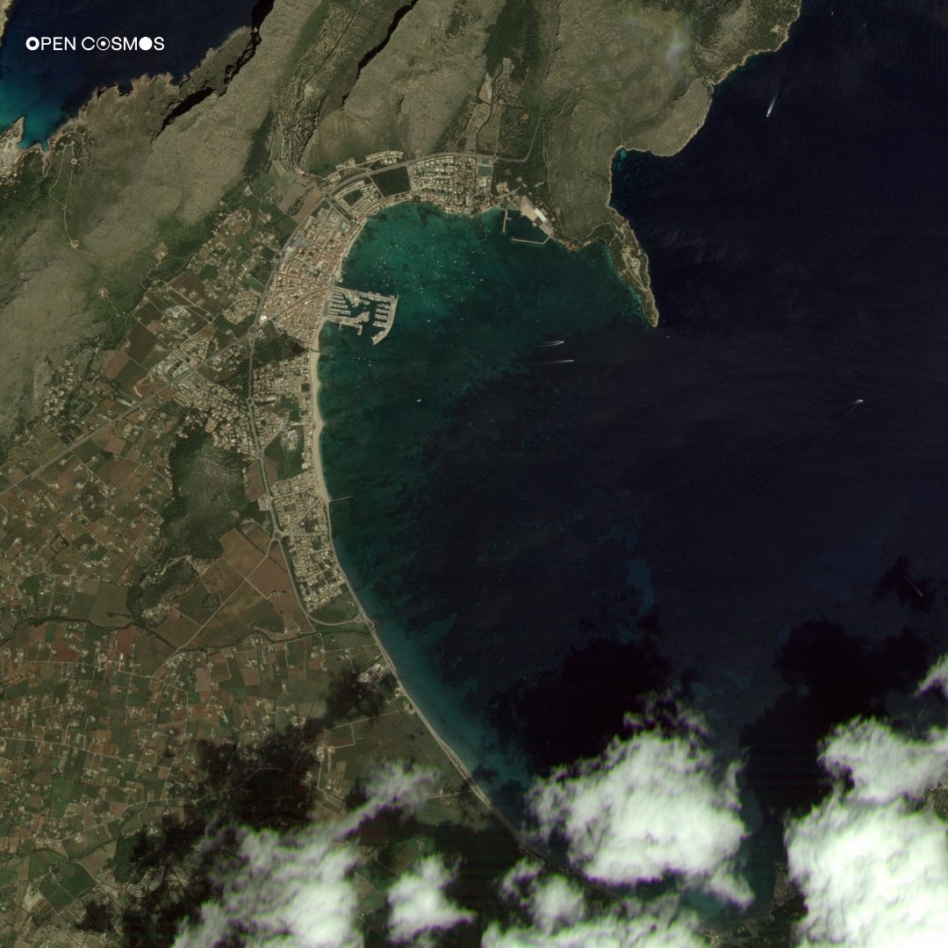
Open Cosmos has closed a €300M ($348.6M) funding round—the latest sign that the European VC landscape is heating up.
The funding round for the European satellite-manufacturing company, announced today, was led by investors on the continent, including participation from Lightrock, ETF Partners, Institut Català de Finances (ICF), and Entrepreneurs First.
“We deliberately wanted strong European representation because we’re building strategic infrastructure in Europe, while also bringing in investors from elsewhere where it made sense,” Open Cosmos cofounder and CEO Rafel Jorda Siquier told Payload via email.
Keep reading