


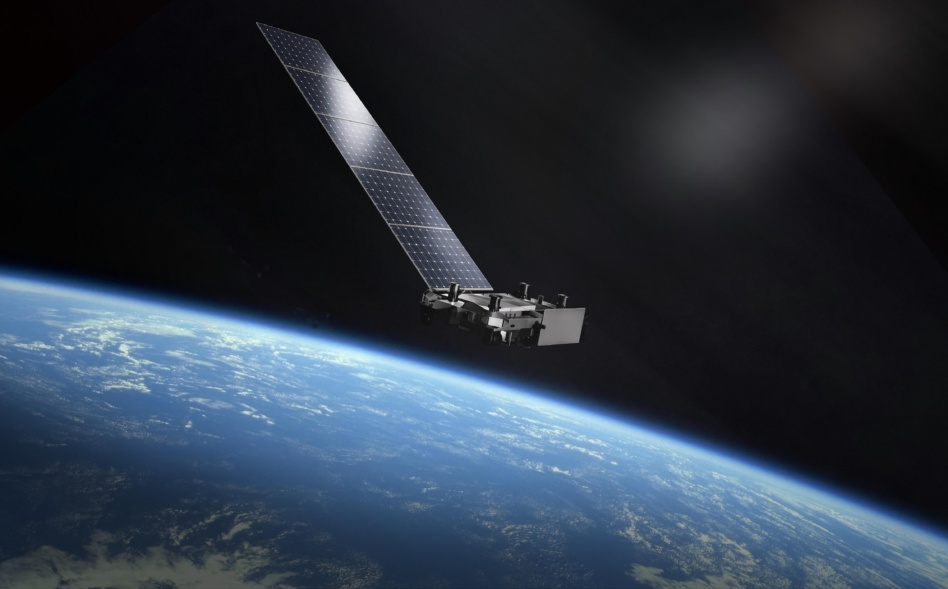
Humans can land a probe on an asteroid, but still can’t promise it won’t rain Saturday. Tomorrow.io wants to fix that data problem.
On Thursday, the company announced the five instruments that will fly aboard DeepSky—its next-gen constellation built for real-time global atmospheric monitoring.
With DeepSky, Tomorrow.io hopes to close the early-warning gaps in today’s forecasting by observing the parts of the world other instruments miss: the oceans, the Global South, and the vertical columns of atmosphere that shape how storms develop.
“A forecast can only be as good as what was actually measured,” Tomorrow.io cofounder and CSO Rei Goffer said in a statement. “Across most of the planet, nobody ever built the instruments to do the measuring, so the models have been filling in blanks. DeepSky is us going out and taking measurements.”
Refresher: Tomorrow.io announced DeepSky in January as the evolution of its existing Gen-1 constellation. The upgrades include:
- 12 different satellites of ~800kg each;
- Three new instruments beyond Gen-1’s microwave sounder and radar;
- Continuous monitoring of every location on Earth.
The company tapped York Space Systems as prime contractor for DeepSky’s initial phase, delivering its M-CLASS platform under an $187M contract first disclosed in March.
AEyes: Unlike AI models trained on the open internet, weather forecasting is bottlenecked by observation, not computing power.
“DeepSky is going to become the infrastructure of data for everywhere in the world,” Tomorrow.io cofounder and CEO Shimon Elkabetz said in a virtual press briefing. “The problem today is that, in most of the world, we don’t even know what’s happening in real time. If you don’t know what’s happening in real time, it’s very hard to know what’s going to happen in an hour, in two hours, in three hours.”
The company gave no launch date, describing it only as within “low single-digit years,” and said Gen-1 will keep operating until DeepSky comes online.
Sensor and sensibility: To feed accurate forecasts, DeepSky will aim to expand the observable atmosphere by packing five instruments onto one satellite:
- Precipitation radar pings storms and reads the echoes to show where rain sits in the column, where it melts, and how tall the updraft grew.
- Hyperspectral microwave sounders read temperature and moisture at many heights through most clouds, day or night, forming the baseline picture over oceans.
- Infrared and visible imagers capture clouds, surfaces, and thermal states during each pass, as well as track heat signatures to spot and monitor fire conditions.
- GNSS radio occultation resolves the sharpest vertical profiles in orbit, timed by atomic clocks and unbothered by clouds, calibrating the rest of the fleet.
- GNSS reflectometry recovers surface wind inside a storm’s rainy core, where other instruments go blind.
The instruments work in tandem, letting the suite cover the atmosphere’s full vertical range.
That combined view feeds AI weather models, which will enable enterprise customers to issue more accurate early-warning announcements and hopefully—according to Tomorrow.io—help keep the US from falling behind China on space sensing.
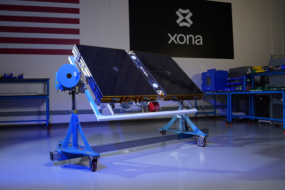
Xona Raises $250M Series D to Scale Commercial GPS Constellation
Xona’s long-term plan is to build a ~258-sat constellation to offer an upgraded commercial alternative to government GPS networks.
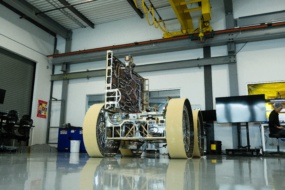
Hewlett Packard Enterprise to Send AI Compute Module to the Moon
Hewlett Packard Enterprise ($HPE) is taking remote working to a whole new level.
BlackSky Renews HEO Deal, Adds Gen-3 Imagery for Space Domain Awareness
BlackSky Technology inked a seven-figure deal to extend its partnership with Australian non-Earth imaging (NEI) provider HEO for another year.
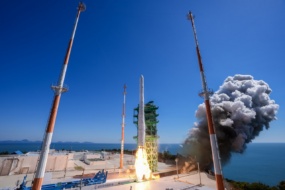
ArbaLabs Launches AI Verification Demo On South Korea’s Nuri Rocket
“In short, tons of companies are looking at the latest and greatest physical AI deployments,” ArbaLabs CEO Ashley Reeves told Payload. “Nobody is really thinking about putting some checks and balances on what these AI models are doing.”

Building a data center in space is hard enough. Orbital is doing it across an ocean too.
Orbital, an LA-based orbital data center startup, announced today it has selected German satellite manufacturer Reflex Aerospace as the exclusive platform partner for Orbital-1—the first satellite in a planned constellation of up to 100,000.
Under the exclusive design-and-development deal, Reflex will bring the “brains” of the spacecraft—its flight-tested bus—freeing Orbital’s engineers to focus on the compute payload, targeting a 2028 launch. Each satellite will pair large solar arrays and radiators with a stack of GPUs, built to run a full Nvidia Vera Rubin rack and cooled by space itself.
Keep reading