


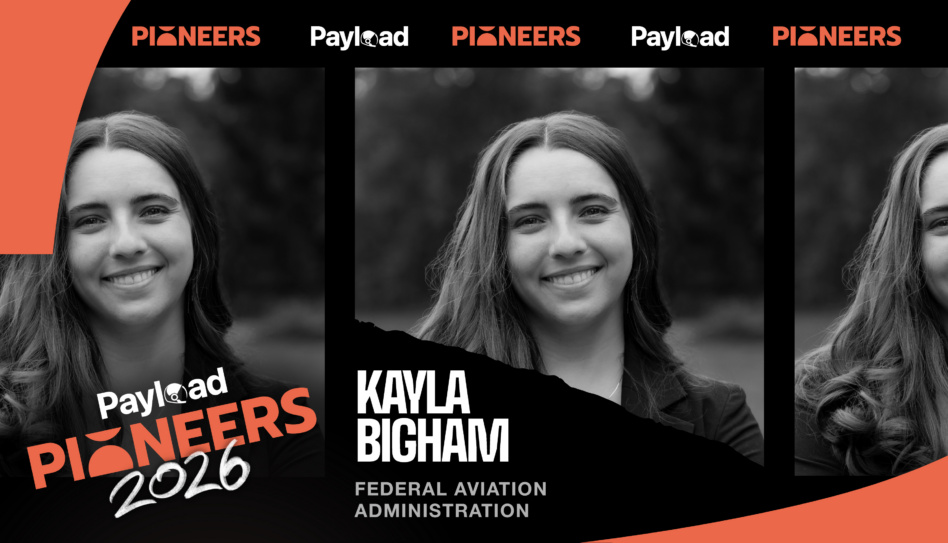
Kayla Bigham grew up wanting to be an astronaut. Then, after learning about the Apollo 1 and Apollo 13 emergencies in elementary school, her goal shifted—she knew she wanted to keep space exploration safe.
Bigham, 27, is now living out that dream as a flight-safety analyst at the FAA’s Office of Commercial Space Transportation. In her job, she analyzes rockets and reentry capsules looking to fly, and studies—in a worst-case scenario—how to ensure the public remains safe from space debris.
“There are definitely industries—nuclear is a great example—where huge disasters have stunted an industry that otherwise could bring a lot of good,” she told Payload. “I would hate to see that happen to space.”
Go boom: Bigham’s first job was investigating fire and gas explosions in the oil and gas industry, to provide evidence after a disaster. While this first job was outside the space industry, she credits the role with preparing her for the FAA. She points to a lot of overlap: the two positions are very safety-oriented, and study how failures can cause property damage and personal harm.
New horizons: Working for the FAA, Bigham says every day offers a new challenge.
“If I was doing design work for a company, I’d be looking at the same system on the same rocket for months,” she said. “I’m looking at every system on every rocket to get a holistic picture.”
She’s also gotten to be on the front lines of developing Part 450, the new regulations that aim to ease burdens for launchers seeking permission to fly, though these regulations have faced some criticism from industry.
Bigham has a message to those who claim the government is seeking to stifle commercial space innovation.
“Our entire office is very pro-commercial space. I think sometimes regulators get a bad rep for being difficult, or you don’t want to see [the industry] succeed, but we champion every success,” she said. “We want the industry to succeed. We just want to make sure it’s done safely.”

Maximillian Bhatti, Basalt
Max Bhatti’s recipe for success in the space industry is one part luck, and nine parts hustle.

Robert Ihnatisin, Orbital Matter
As an expert in 3D printing for terrestrial applications, Robert Ihnatisin was surprised by how slow the in-orbit manufacturing industry was progressing. So, naturally, he started a company to solve the problem himself.

Patrick Miga, Advanced Space
In first grade, Patrick Miga saw a photo of Neptune (snapped by the Voyager 2 spacecraft).. Ever since then, his life has been directed toward space.

Muhammad Hunain, Melagen Labs
“That’s where I realized we’re stuck at a 1980s standard: still shielding spacecraft with aluminum, and rad-hardened electronics [were] too expensive to build at the scale this economy demands,” Hunain told Payload.

Dallas-based Balerion Space Ventures has surpassed its $200M target for its second fund, the firm announced Thursday. Fund II—which remains open—is more than five times the size of the firm’s debut fund, which came in at just under $40M.
Balerion had closed ~$90M as of May, according to Venture Capital Journal. Cofounder and General Partner Daniel Kleinmann chalked up the momentum since then to portfolio companies hitting milestones and raising up-rounds—which he said resonated with LPs.
The firm is also holding back capital for follow-on rounds. “These are really capital-intensive businesses,” Kleinmann told Payload. “Having the ability to reserve capital to continue supporting these businesses as they hit major technical, commercial, government milestones is really important to us.”
Keep reading