


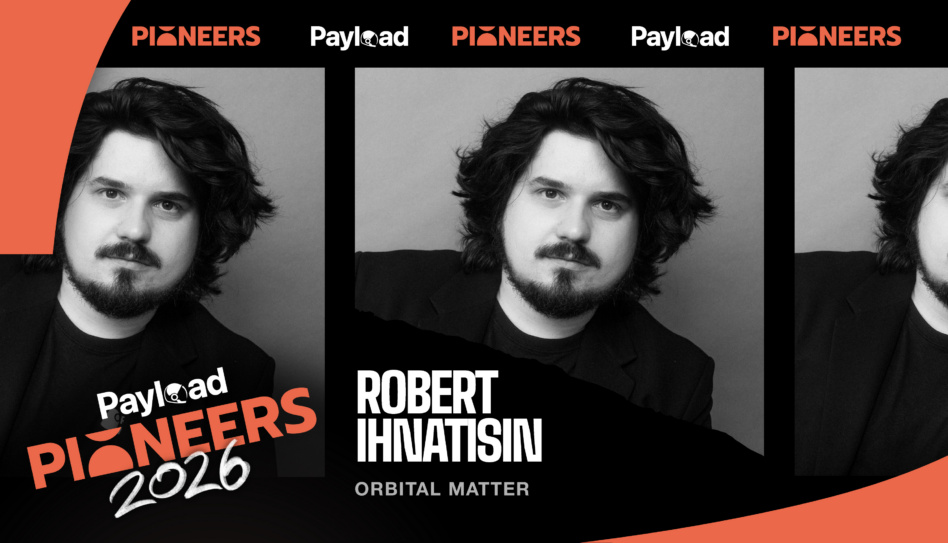
As an expert in 3D printing for terrestrial applications, Robert Ihnatisin was surprised by how slow the in-orbit manufacturing industry was progressing. So, naturally, he started a company to solve the problem himself.
As cofounder and CTO of Orbital Matter, Ihnatisin secured a patent for 3D-printing technology that can operate in the vacuum of space. His mission is to build large structures in space without needing to fit into the form factor of a typical launch vehicle—just bring the raw material, and make it where you need it.
As the number of spacecraft requiring large solar arrays—such as commercial space stations and orbital-data-center concepts—grows, Ihnatisin’s tech aims to help companies reduce the cost and complexity of large-scale missions.
Heritage site: Without any direct aerospace experience, Ihnatisin had to learn about the space industry on the job—an experience that he claims was both an asset and a liability. He didn’t know how hard the problem would be, and might not have dared to try if he had. That said newcomers like him “first had to prove that we were serious.”
Since its founding in 2022, Orbital Matter has flown two demonstration missions to prove out 3D-printing tech in orbit, and has a third, larger mission on the way. The company expects to begin flying construction missions in the 2030s to deploy radiators and kilometer-long solar arrays.
Fairing enough: Ihnatisin hopes to change the way we approach missions in-orbit, leaning on the same out-of-industry expectations that drove him to start Orbital Matter—meaning, without tempered ambitions.
“We deliberately hire people from outside the space sector,” Ihnatisin told Payload. “We want fresh perspectives from manufacturing, robotics, materials, and other engineering disciplines to challenge assumptions that are often taken for granted in aerospace.”

James Shin, K2 Space
“As I begin to understand how much [impact]…things like cellular telecommunications, imaging, climate [research]…have globally—once I started to understand that, I was like, ‘Okay, this is definitely the industry that I want to work in,’” Shin told Payload.

Patrick Miga, Advanced Space
In first grade, Patrick Miga saw a photo of Neptune (snapped by the Voyager 2 spacecraft).. Ever since then, his life has been directed toward space.

Muhammad Hunain, Melagen Labs
“That’s where I realized we’re stuck at a 1980s standard: still shielding spacecraft with aluminum, and rad-hardened electronics [were] too expensive to build at the scale this economy demands,” Hunain told Payload.
Dhruv Jain, Kayhan Space
When Dhruv Jain transferred to a new school, he joined the astronomy club on a whim. Soon, he was chasing meteor showers and tracking the transit of Venus—and now, more than a decade later, he’s built a career helping space companies track objects in orbit.

Dallas-based Balerion Space Ventures has surpassed its $200M target for its second fund, the firm announced Thursday. Fund II—which remains open—is more than five times the size of the firm’s debut fund, which came in at just under $40M.
Balerion had closed ~$90M as of May, according to Venture Capital Journal. Cofounder and General Partner Daniel Kleinmann chalked up the momentum since then to portfolio companies hitting milestones and raising up-rounds—which he said resonated with LPs.
The firm is also holding back capital for follow-on rounds. “These are really capital-intensive businesses,” Kleinmann told Payload. “Having the ability to reserve capital to continue supporting these businesses as they hit major technical, commercial, government milestones is really important to us.”
Keep reading