


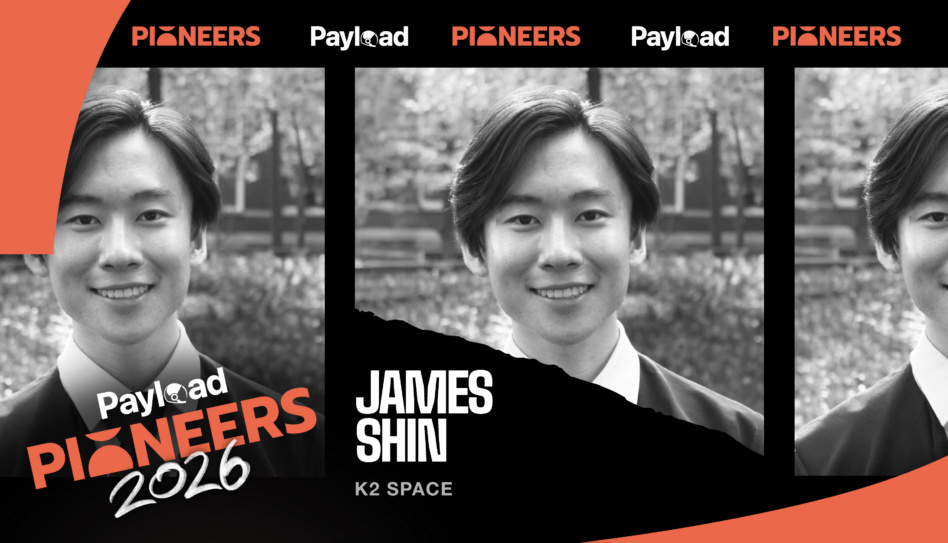
Growing up in a rural town in Georgia—far enough away from city lights to see constellations—James Shin had a front row seat to the vastness of space.
Once he started studying science and engineering, however, Shin realized that space was accessible to those who could push the boundaries of what’s possible.
“As I begin to understand how much [impact]…things like cellular telecommunications, imaging, climate [research]…have globally—once I started to understand that, I was like, ‘Okay, this is definitely the industry that I want to work in,’” Shin told Payload.
As an electrical engineer at K2 Space, Shin is helping to build the next-generation of spacecraft, but his after-hours work is focused solely on community and service—“Two values that definitely have driven my life,” according to Shin.
Constellation prize: As a middle schooler, Shin went to KSC to participate in shuttle simulators under the Student Astronaut Challenge. Later, Shin attended Georgia Tech under scholarship, pursuing an electrical engineering degree to better understand “the electronics that brought satellites to life.”
At Georgia Tech, Shin crafted novel experiments to study how satellites can adapt their communication protocols to better withstand radiation effects—and became the first undergrad student in his lab to publish a first-authored journal paper. Then as a graduate student and Marshall Scholar at the University of Cambridge, his research uncovered a new mechanism for ultra-thin solar cells to heal radiation damage.
For Shin, science is a means to a very specific end: making space a safe and reliable place for international science to flourish. Each advancement begs the question: “How do we apply these space capabilities and technology responsibly?”
Bridging the gap: Shin’s policy-focused work has included contributions to spectrum-sustainability research, and presentations on how optical, RF, and infrared sensors can identify what satellites can do in space, enabling policymakers to enforce treaty compliance and ensure space safety.
While in the UK for grad school, Shin developed a program to introduce elementary school students to satellite engineering, and he continues to work with the European Space Generation Workshop “focused on inspiring and developing the next-generation European space workforce.”
Maximillian Bhatti, Basalt
Max Bhatti’s recipe for success in the space industry is one part luck, and nine parts hustle.
Robert Ihnatisin, Orbital Matter
As an expert in 3D printing for terrestrial applications, Robert Ihnatisin was surprised by how slow the in-orbit manufacturing industry was progressing. So, naturally, he started a company to solve the problem himself.

Patrick Miga, Advanced Space
In first grade, Patrick Miga saw a photo of Neptune (snapped by the Voyager 2 spacecraft).. Ever since then, his life has been directed toward space.
Muhammad Hunain, Melagen Labs
“That’s where I realized we’re stuck at a 1980s standard: still shielding spacecraft with aluminum, and rad-hardened electronics [were] too expensive to build at the scale this economy demands,” Hunain told Payload.

Dallas-based Balerion Space Ventures has surpassed its $200M target for its second fund, the firm announced Thursday. Fund II—which remains open—is more than five times the size of the firm’s debut fund, which came in at just under $40M.
Balerion had closed ~$90M as of May, according to Venture Capital Journal. Cofounder and General Partner Daniel Kleinmann chalked up the momentum since then to portfolio companies hitting milestones and raising up-rounds—which he said resonated with LPs.
The firm is also holding back capital for follow-on rounds. “These are really capital-intensive businesses,” Kleinmann told Payload. “Having the ability to reserve capital to continue supporting these businesses as they hit major technical, commercial, government milestones is really important to us.”
Keep reading