


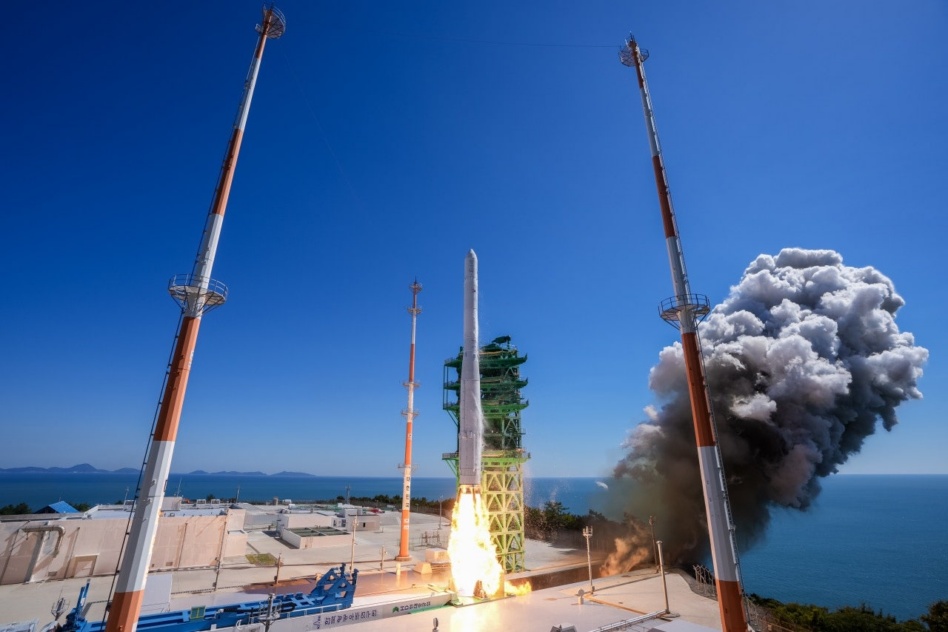
South Korea launched its three-stage Nuri rocket for the fifth time at 11:25 pm EDT last night from the Naro Space Center on an island off the southern coast of the Korean peninsula.
The launch brought 15 satellites to orbit, including:
- Five NEONSATs developed by The Korea Advanced Institute of Science and Technology, as part of the country’s planned 10-satellite EO constellation;
- And 10 cubesats from across the Korean space sector, demonstrating advancements in space medicine, optical comms, and weather observation, and notching flight heritage for a range of locally developed components.
One payload—an AI verification module from ArbaLabs flying on Space & Bean’s demo sat—could change the way autonomous AI systems operate.
Trust the process: Korean startup Space & Bean is flying its first satellite—a 3U cubesat called SD-1Sat—to demonstrate whether its in-house developed protective enclosure can shield COTS components from the harsh environment in orbit.
Space & Bean’s aim is to allow satellite operators to forgo the use of expensive space-rated components, and instead fly cheaper COTS parts inside a Space & Bean enclosure that can eliminate the effects of radiation, thermal stress, and vibration. During the mission, Space & Bean will beam down low-volume radiation readings from the enclosure to test its performance.
The SD-1Sat will also carry ArbaEdge, a module from ArbaLabs that can verify if the onboard AI model on SD-1Sat performed as expected—monitoring its integrity while it runs, signing its output evidence, and producing a verifiable record of what the model actually did.
The module works by creating a digital mirror of the autonomously operating edge-AI process, which can raise red flags when the AI doesn’t match the model—whether that means it’s hallucinated during processing, or delivered an output that shouldn’t be trusted.
“In short, tons of companies are looking at the latest and greatest physical AI deployments,” ArbaLabs CEO Ashley Reeves told Payload. “Nobody is really thinking about putting some checks and balances on what these AI models are doing.”
Down bad: As more and more satellites begin to fly with onboard AI and edge-compute capabilities, ArbaLabs is positioning itself to provide a verification layer to make autonomous systems more trustworthy, and lower costs created by AI-generated mistakes.
ArbaEdge’s verification data is incredibly lightweight—a maximum of two megabytes—so it can save EO operators from downlinking reams of unusable data if something goes wrong on-orbit.
But space-based applications are just a “beachhead” for ArbaLabs, according to Reeves, and the company is working to develop its technology to work across the physical AI space—from autonomous vehicles and drones, to humanoid robots.
Reeves also told Payload that ArbaLabs has gotten the request from customers to develop a kind of “kill-switch,” to stop a hallucinating AI piloting a physical system in its tracks—you know, like when the humanoid robot you bought to do your laundry suddenly picks up a knife.
MP Space Raises AUD $23M to Scale Satellite Battery Manufacturing
MP Space’s batteries launched for the first time last week with an undisclosed customer on SpaceX’s Bandwagon-5 mission, and already the company has orders to support 500+ spacecraft.
Colare Raises $2.5M to Expand its Hardware-Focused Hiring Platform
Colare’s technical-assessment platform maps the requirements of a role, and recreates decisions future engineers could face on the job.

Exclusive: DoD Taps Orbital Operations for Cryogenic Spacecraft Demo
The Long Beach, CA, startup has won up to $35M from the DoD under a prototype Other Transaction Agreement to fly a full-scale, in-orbit demo of Astraeus—its cryogenic-maneuvering vehicle.

Inside Starburst’s First Flight, and Portal’s New Bothell Office
“I feel like 80% success now,” CEO Jeff Thurnburg said. “But honestly, to get this far this fast, I’m tempted to call it 100%.”


After years of Colorado Springs, CO, and Huntsville, AL, sparring over the location of US Space Command, the two cities are teaming up for an even bigger priority—the Golden Dome missile-defense program.
Officials from the two cities met yesterday to discuss how each city could contribute to America’s broader missile defense goals.
“It’s a transformed relationship between Colorado Springs and Huntsville,” Rep. Jeff Crank (R-CO) told Payload. “When I took office, I don’t think it was a bad relationship, but it was one where both communities were kind of looking over their shoulder at the other. That wasn’t good for America, and I don’t think it was good for Colorado Springs or Huntsville either.”
Keep reading