


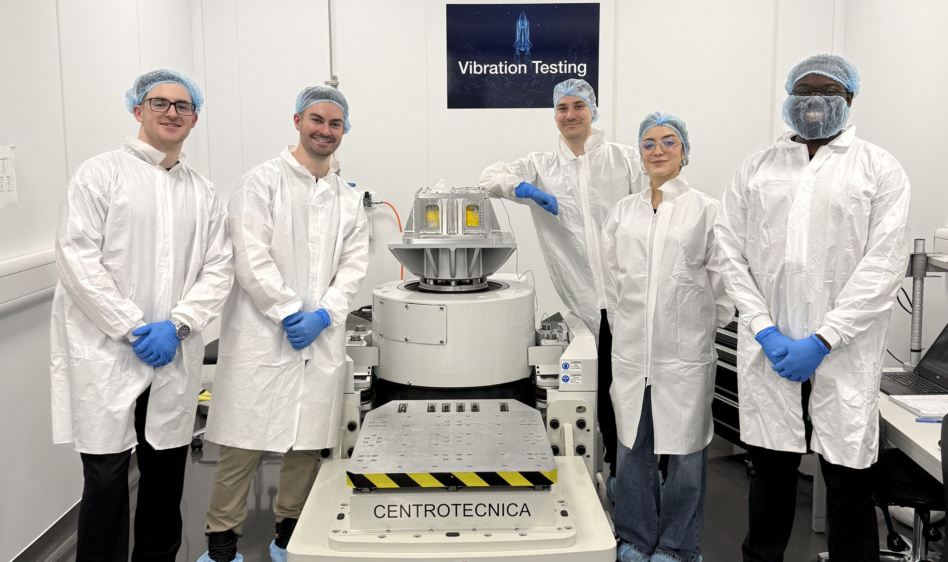
London-based BioOrbit announced a £9.8M (€11.4M) seed round yesterday to ramp up its space-drug manufacturing capabilities and expand its presence in the US market.
LocalGlobe and BREEGA co-led the round, which included participation from Auxxo, Seedcamp, Type One Ventures, 7percent Ventures, and undisclosed angel investors.
Meet BioOrbit: Founded in 2023, BioOrbit is attempting to leverage microgravity to reformulate drugs so that they can be self administered by patients instead of requiring medical staff to administer them.
To achieve this, BioOrbit has built BOX, a microwave-sized, autonomous manufacturing unit that can fly to space and produce crystallized cancer-drugs inside a reentry vehicle or commercial space station. The goal is not to develop new drugs in space, but to make already successful treatments more accessible to the average person.
“Our primary targets are anti-cancer antibodies, because this is where we can bring the biggest value propositions,” BioOrbit CEO Katie King told Payload. “We would be looking at taking marketed products and turning them into subcutaneous versions.”
Spend that money: The seed capital gives BioOrbit the funds to expand its production, as it aims to transition from early-stage demonstrations to industrial capacity.
BioOrbit also plans to open up an office on the East Coast of the US, and has hired two Redwire veterans to help it hunt down contracts with large pharmaceutical firms, according to King.
- Molly Mulligan, formerly on Redwire’s business development team, has been appointed president of BioOrbit. Mulligan signed the first in-orbit pharmaceutical royalty agreement, according to BioOrbit.
- Ken Savin, formerly Redwire’s chief science officer, has been appointed to the same role at BioOrbit. Savin has two decades of experience at Eli Lilly. He also worked for CASIS, as a director working with the ISS National Lab.
What’s next: BioOrbit sent its first BOX to space onboard a demonstrator mission for The Exploration Company’s Nyx spacecraft last year, and is scheduled to send its second mission to orbit this year. King expects to fly as many as two missions in 2027.
It’ll be a long while before BioOrbit-developed drugs make their way into patients’ hands—King expects the regulatory process to take about five years before clinical trials can begin—but the company has multiple revenue streams cooking to get the money flowing before then.
BioOrbit is building terrestrial drug manufacturing capabilities to bring its innovations to market without the need of space, and company officials hope that co-development contracts with pharmaceuticals can start the revenue flow before drugs make their way onto shelves.
Correction: This article was updated to clarify BioOrbit’s first mission. It flew on a demonstration vehicle from The Exploration Company.
Balerion Surpasses $200M Goal for Fund II
Dallas-based Balerion Space Ventures has surpassed its $200M target for its second fund, the firm announced Thursday.

Exclusive: Kapta Space Raises $24M Series A to Build Moving Target Radar Payload
Seattle-based Kapta Space announced a $24M Series A to build next-gen radar payloads designed to track moving targets.
Europe’s Space Defenses Fall Just Shy of Weaponization
Europe doesn’t have any weapons in space—but that doesn’t mean the region is comfortable flying around in orbit defenseless.

DOE Announces $400M for Frontier Science Research
The Department of Energy is super-charging research into bleeding edge energy tech.


CATALYST is rolling out a new product today that aims to make city skylines safer from space.
UrbanSAR will be able to detect millimeter-scale shifts in buildings, on a floor-by-floor basis. The changes will be spotted by interferometric SAR, which uses data from at least two SAR sats to determine very small changes over time, according to a press release from CATALYST—a brand of Ottawa, Canada-based remote sensing software firm PCI Geomatics.
Why it matters: As cities put up new construction, builders don’t know what they don’t know—and there are many blind spots when it comes to traditional monitoring, according to CATALYST. One study in Toronto found that the top floors of new buildings—higher than ground-based monitoring can measure—moved up to 30 millimeters.
Keep reading