



The Space Force’s FY27 budget request made headlines earlier this year at a record-breaking $71.3B.
But the topline reflects a shift underway across the whole Pentagon, one the Space Force illustrates more sharply than any other service. Two new breakdowns, one from The Aerospace Corporation’s Center for Space Policy and Strategy and one from the American Enterprise Institute, reach overlapping conclusions from different angles.
Aerospace’s Robert Wilson—who called the 120% jump from FY26 the largest percentage increase for any military service in 75 years—found the growth is sharply targeted: more than 75% of it flows to just four capability areas.
Meanwhile, AEI’s Todd Harrison, breaking down the full FY27 defense request, found a similar lopsidedness department-wide. Modernization takes the bulk of the increase, tilted toward air-and-missile defense, munitions, shipbuilding, and space.
The Space Force is a clear winner in the FY27 request, with a proposed percentage increase more than 3x any other service according to Wilson. But Harrison notes space’s growth is “less a discontinuous change and more a continuation” of the emphasis that’s been building since the Space Force was created in 2019.
Follow the money: The FY27 budget draws from two sources:
- $59.2B from annual appropriations, more than double the FY26 level.
- $12.1B from the White House’s proposed reconciliation bill—part of $350B in added Pentagon spending.
At 120%, the rate of growth is likely unsustainable, but the elevated funding level looks to be stable. FY28 materials project $69.6B for the Space Force without any reconciliation package. Because reconciliation money is temporary, that signals the growth is meant to carry into the recurring base budget, unlike last year, when the projections didn’t.
“The White House is planning for this growth to stay,” Wilson told Payload.
Winners and losers: Like the broader defense budget, the growth is not distributed evenly across capability areas:
- Classified spending is roughly 30% of the total growth.
- Of the remaining unclassified growth, more than 45% comes from moving-target-indication, command and control, and missile warning.
Space-based air-moving target indication takes home the title for the largest unclassified Space Force program in the FY27 budget, at $7.9B.
Bringing home the silver is space data network, a command-and-control capability that accounts for nearly 75% of growth in the capability area.
Shiny objects: While the FY26 Space Force budget grew largely because of Golden Dome spending. FY27 stands all on its own—at least on paper.
None of the proposed FY27 Space Force budget falls under Golden Dome spending, whereas FY26’s budget housed more than a quarter of the proposed Space Force budget. Programs that previously had Golden Dome affiliations, like the already-cited space-based air-moving target indication and space data network, have instead been recategorized under “Space Superiority.”
Golden Dome’s own FY27 budget still includes $4.5B for space, but that stacks on top of the Space Force’s $71.3B request rather than sitting inside it. Wilson noted the moved programs serve multiple missions, not just missile defense, though the rationale for the recategorization isn’t clear from the budget documents.
One big but: None of this is guaranteed. Neither the reconciliation bill nor an appropriations act has passed. Under a long continuing resolution, the Space Force could be working with anywhere from $26B to $71B, which is a tough range to plan a record request around.
“It’s hard to plan and execute when your budget could be $26B, your budget could be $32B, or your budget could be $60B, or your budget could be $70B,” Wilson said.
Nevertheless, the House has already marked up the base budget at 94% of the request, an early sign Congress may back the increase.

Velos’ Election Day Tracker for Space
Space may not be top of mind when voters head to the ballot box, but Election Day outcomes still have a big impact on US policy and funding above the Kármán line.

Colorado Springs, Huntsville Team Up on Golden Dome
“It’s a transformed relationship between Colorado Springs and Huntsville,” Rep. Jeff Crank (R-CO) told Payload. “When I took office, I don’t think it was a bad relationship, but it was one where both communities were kind of looking over their shoulder at the other. That wasn’t good for America, and I don’t think it was good for Colorado Springs or Huntsville either.”

Artemis Accords To Meet on Lunar Debris, Emerging Space Help
The Artemis Accords Principals’ Meeting in Turkey will be led by NASA Deputy Administrator Matt Anderson and Maj. Gen. Roberto Melgar Sheen, director of the Peruvian Space Agency.
FCC to Vote on Waiving NEPA Review for Space Ops
The FCC will vote Sept. 30 on whether to narrow which commission activities face environmental review, and streamline the process for the ones that require assessment.

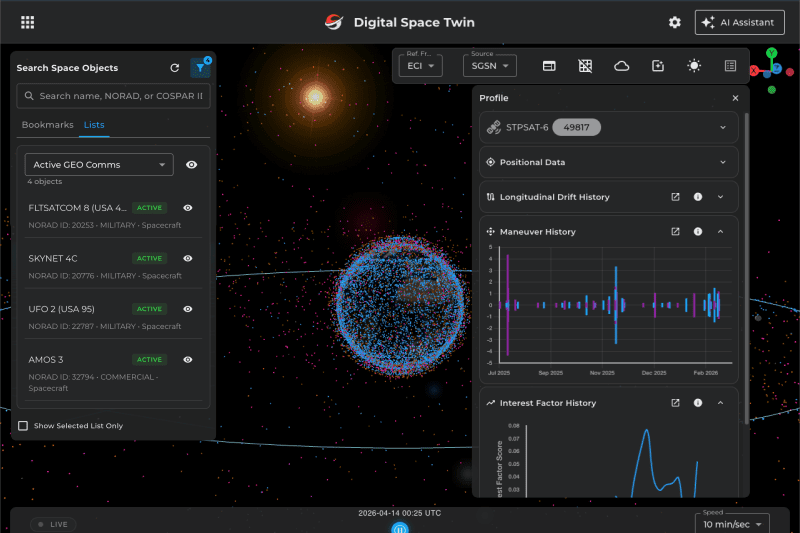
More than 16,600 spacecraft are operating in orbit, according to Slingshot Aerospace. Today, the company announced it is adding new capabilities to its Portal platform to help operators better monitor that crowded environment—and avoid another worst-case collision scenario.
Uptake: Slingshot announced that Portal was open for business in April, enabling customers to sign up for the AI-powered one-stop-shop for data and analytics to understand and operate in LEO as it becomes increasingly congested.
In just four months, Portal’s customer base has grown to 630+ users, representing 330 industry and government organizations in 19 countries. Those customers have been able to monitor their assets in orbit, spot anomalies, and detect potential collisions in a single platform.
Keep reading