Earth Observation (EO) missions generate vast datasets which traditionally rely on ground-based processing. Unfortunately this processing model comes with considerable challenges like high latency and limited bandwidth, making it difficult to retrieve the real time insights that Earth Observation missions require.
Slow, costly, and inefficient, traditional ground-based processing like this has now become ill-suited to meet the demands of modern day EO missions. The solution lies in edge processing – transforming raw data into actionable insights directly in space and delivering real time intelligence with unmatched efficiency.
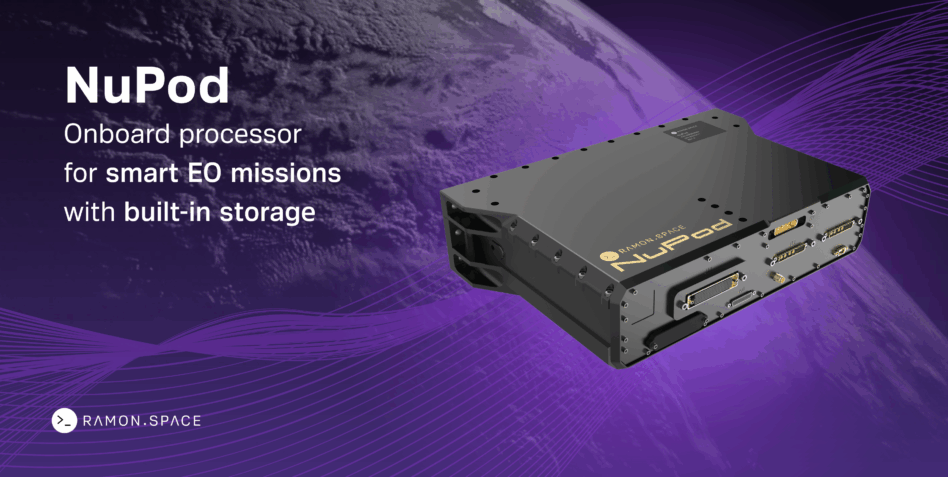
Ramon.Space has developed such a solution with their NuPod onboard processor. It combines advanced edge processing with terabyte storage in one compact system to allow operators to analyze data onboard and enable cognitive applications directly in space.
NuPod: the onboard brain of intelligent space missions
NuPod transforms satellites into autonomous data processing centers, combining cutting-edge AI capabilities with high-capacity storage to handle large volumes of data in real time. This integrated approach eliminates the bandwidth constraints and latency issues associated with traditional ground-based systems.
- All-in-One System: NuPod integrates compute power, storage, DSP/AI functionality, and custom interfaces into one software-defined platform. This streamlined design simplifies system design while maximizing operational flexibility.
- Massive Data Handling: By integrating advanced edge processing with NuStream – our in-house high-throughput, 1-terabyte storage system – NuPod is a single compact solution engineered for demanding data-intensive space applications.
- Decision-Making at The Edge: Onboard AI/ML processing capabilities enable NuPod to facilitate responsive and flexible missions, allowing operators to gain faster insights and respond rapidly during mission-critical or time-sensitive events.
- Adaptive, In-Orbit Operations: NuPod is fully reprogrammable in orbit, allowing operators to update mission parameters or deploy custom AI applications as needs change throughout the mission lifecycle.
- Third-Party App Integration: By supporting third-party applications, NuPod allows operators to tailor functionality to specific mission requirements. This adaptability extends mission utility without requiring hardware upgrades, future-proofing the satellite’s capabilities.
- Sustained Performance in Space: Built with radiation hardened technologies, NuPod delivers sustained performance in the harsh space environment across missions lasting 5 to 10 years.
Advance capabilities
Acting as the mission’s central intelligence hub, NuPod connects directly to sensors to compress, store, and analyze imagery in-orbit, enabling near-instant event detection and autonomous decision-making.
NuPod’s onboard storage and AI/ML processing capabilities creates new possibilities across critical application areas:
- Weather and climate intelligence: NuPod’s AI processes electro-optical meteorological data in orbit, identifying weather patterns and extracting atmospheric measurements, that enhance forecasting accuracy and speed.
- Resource Monitoring: NuPod analyzes infrared or hyperspectral sensor data in orbit, identifying material signatures and transmitting only the most relevant information rather than overwhelming ground stations with raw data feeds.
- Defense and emergency response: NuPod rapidly processes data for applications like wildfire tracking and missile detection, dramatically reducing the timeline from observation to actionable intelligence.
Powering cognitive satellite missions with NuPod
With its advanced computing, and integrated storage capabilities, NuPod’s software-defined system enables cost-effective, efficient, and flexible satellite missions that meet today’s needs.
By bringing edge computing to space, NuPod is transforming how we approach Earth Observation missions – making missions more responsive and capable of delivering the real-time insights our world increasingly demands.