


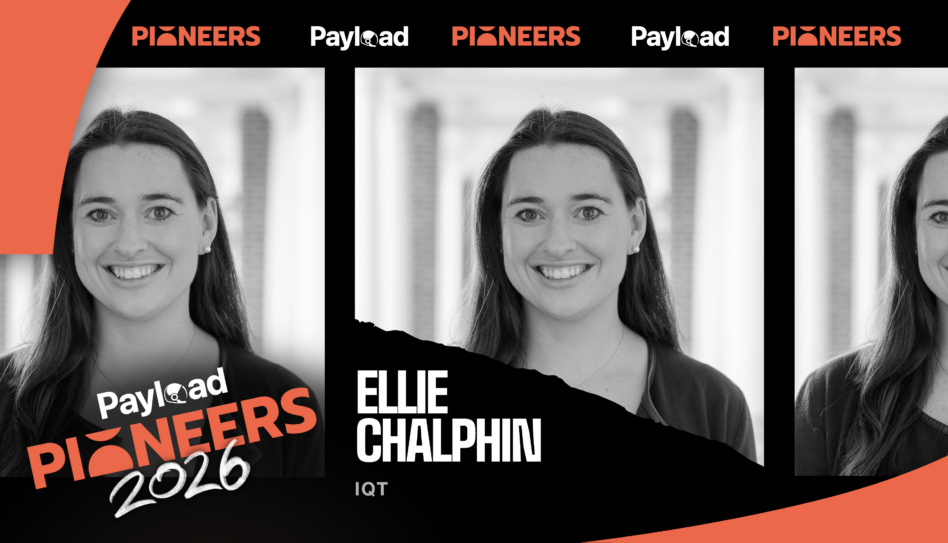
Ellie Chalphin’s career has mostly been about trying to make things move, whether its rocket parts across borders or launch contracts through NASA. Now at In-Q-Tel, Chalphin is tackling one of the most challenging moves yet—moving startup technology into the hands of the government.
As manager of space partnerships at the CIA-chartered venture firm, Chalphin is working at the intersection of founders, investors, and the defense and intelligence agencies that might buy what they build.
Things that go boom: As an undergraduate researcher with MIT’s Election Data + Science Lab, Chalphin studied how local voting rules shaped turnout and got hooked on “outdated regulations…that aren’t aligned with how quickly the technology is moving.” That led her to Raytheon, supporting missile programs in Tucson, AZ, and naval systems in Rhode Island. “I love things that go boom,” Chalphin told Payload.
“I didn’t go to space camp, and I didn’t take AP physics,” she said. “But now that I’m here, I’m like, oh, these are definitely my people.”
Eat your veggies: In 2021, she joined SpaceX’s international trade team, working with four federal agencies on export controls, launch licensing, and hazmat permits. She later negotiated launch contracts for NASA and the US military while earning a night MBA at UVA’s Darden School of Business.
“Sometimes it feels like eating spinach,” she said of government contracting. “Every space company needs government contracts.”
Export rules are a tougher meal. When the war in Ukraine cut off Russian engines and Ukrainian rocket hardware, US launch companies were left hunting for new suppliers. Many replacement parts face strict export controls because, she said, “a rocket and a missile are the same thing with a different payload.” She wants it to be easier to source parts from allies and to train non-US astronauts for commercial flights.
Mind the gap: Chalphin joined In-Q-Tel last year, and a lot of her job involves explaining timelines. A startup needs a contract fast enough to make payroll. The government needs to de-risk the technology before it spends taxpayer dollars.
Logistics still excites her most. Launch gets satellites to orbit, but she’s watching what comes after, like orbital transfer vehicles and on-orbit refueling.
“How do you get to space?” she said. “But then once you’re there, how do you move?”
Maximillian Bhatti, Basalt
Max Bhatti’s recipe for success in the space industry is one part luck, and nine parts hustle.

Robert Ihnatisin, Orbital Matter
As an expert in 3D printing for terrestrial applications, Robert Ihnatisin was surprised by how slow the in-orbit manufacturing industry was progressing. So, naturally, he started a company to solve the problem himself.

Patrick Miga, Advanced Space
In first grade, Patrick Miga saw a photo of Neptune (snapped by the Voyager 2 spacecraft).. Ever since then, his life has been directed toward space.

Muhammad Hunain, Melagen Labs
“That’s where I realized we’re stuck at a 1980s standard: still shielding spacecraft with aluminum, and rad-hardened electronics [were] too expensive to build at the scale this economy demands,” Hunain told Payload.

Dallas-based Balerion Space Ventures has surpassed its $200M target for its second fund, the firm announced Thursday. Fund II—which remains open—is more than five times the size of the firm’s debut fund, which came in at just under $40M.
Balerion had closed ~$90M as of May, according to Venture Capital Journal. Cofounder and General Partner Daniel Kleinmann chalked up the momentum since then to portfolio companies hitting milestones and raising up-rounds—which he said resonated with LPs.
The firm is also holding back capital for follow-on rounds. “These are really capital-intensive businesses,” Kleinmann told Payload. “Having the ability to reserve capital to continue supporting these businesses as they hit major technical, commercial, government milestones is really important to us.”
Keep reading