



Europe made its most concrete claim yet for sovereignty in orbit this week.
The EU commission proposed new rules for its spectrum allocation that would reserve at least two-thirds of available frequencies to European satellite operators, leaving foreign satcoms to compete for table scraps.
The move immediately elicited a response from the US Chair of the FCC, Brendan Carr:
“Reciprocity and nondiscrimination have been at the heart of the FCC’s approach to the many European satellite operators that do business in America,” Carr said—adding a reminder of the FCC’s open proceedings aimed at combatting the EU Commission’s decisions.
This month, the FCC filed a document aimed at “aggressively update[ing] its rules to ensure Americans reap the abundance of innovation and investment by the space industry.”
On our own: Sovereignty comes up at at every European space conference, but discussions at the SmallSat Europe conference in Amsterdam this week celebrated system-wide decisions driving Europe toward greater independence in space. European leaders highlighted many of the programs they’re building to tangibly increase Europe’s sovereignty, including:
- Italy’s €1B+, 60+-sat IRIDE EO constellation, already being deployed.
- Germany’s €10B, 100-sat Starlink alternative, set to come online in 2029.
- Europe’s €10.6B, 290-sat IRIS2 constellation, which is set to be fully operational by 2030.
Military sovereignty: European states have gone to great effort to ensure they have sole control over defensive—and offensive—capabilities in orbit. In the past 12 months alone, European nations have approved billions in funding on sovereign-defense, and the results are starting to roll in.
German-speaking nations are angling to be the tip of the spear. In September, Germany earmarked €35B for investment into space-defense capabilities. Leaders from Germany and its neighbors have since signaled that investments would fund both German and region-wide defenses.
- Last week, Germany held a conference with leaders from Austria, Switzerland, and Luxembourg where Austrian Defense Minister Klaudia Tanner confirmed the country plans to launch three military sats (plus a test object) to orbit next year.
- German Defense Minister Boris Pistorius formally proposed the idea of a European Space Component Command to reduce redundancy in regional space systems.
- German Maj. Gen. Wolfgang Ohl said his country is also looking to add offensive capabilities to further “deter aggression against our own space systems.”
But the “DACH-L” nations aren’t alone.
- Poland set up a new military agency—the Geospatial Intelligence & Satellite Services Agency—which is managing the country’s growing fleet of EO sats.
- In November, France announced an additional €4.2B in military space funds to be deployed by 2030.
- This month, the UK fast-tracked MoD contracts to 13 local defense-tech startups, and Leonardo UK announced it would increase its headcount on the expectation of greater defense spending.
Capital sovereignty: A recent report showed that European capital deployed into its space industry in 2025 lagged considerably behind the US and China. This week, leaders highlighted multiple changes (including from ongoing initiatives) that could put Europe on better footing for the future.
- Last year, the EU Commission proposed a €131B fund for space and defense;
- At ESA’s 2025 ministerial conference, the agency collected €900M+ in commitments in support of the European Launcher Challenge, to set up sovereign-launch capabilities on the continent.
- Project Bromo, the proposed €6.5B merger between the space divisions of Airbus, Leonardo, and Thales, is expected to become operational in 2027, consolidating much of Europe’s space prime infrastructure.
But there’s still a lot of work to do before Europe deploys the capital necessary to stand on its own.
The most glaring roadblocks, according to panelists at SmallSat, are the procurement mechanisms.
Alpine Space Ventures Principal Sven Meyer-Brunswick said the issue lies in government contracts, which are often directed to traditional primes, while new space startups get passed over.
“[We need] actual programs of record being awarded to new entrants into the market—not just grants being given out to hundreds of companies,” Meyer-Brunswick said.
Without an influx of local revenue streams, European space startups will continue to be forced to look abroad for financing and income.
The bottom line: Europe remains reliant on US launch capabilities to access space, and in many cases the US is the only game in town for later-stage-funding opportunities. This week, however, proved that Europe is marching in the same direction.
European space-industry independence from the US will come through an increasing pool of capital, a series of demonstrated capability improvements, and ultimately, through more cooperative agreements between European nations to collaborate on shared systems.

Skyrora Shifts Orbital Launch Timeline to 2030
First-mover advantage isn’t all it’s cracked up to be—at least, that’s the thought process for UK launcher Skyrora.

Foundational Raises £8.2M for Satellite Laser Ranging
Foundational emerged from stealth today with Europe’s largest space tech pre-seed round.
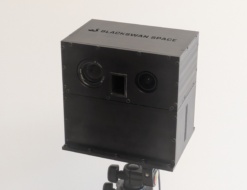
Blackswan Space Raises €2.5M Seed to Fund RPO Kit Demo
The round comes as Blackswan gears up for its first in-orbit mission of its RPO Kit payload.

Isaacman Doubles Down on New NASA Model for International Partnerships
Isaacman is less than a year on the job, but he’s already upended the way the agency interacts with the rest of the world.


Space-tech startup Observable Space has closed a $90M Series A to boost its production of laser and optical hardware—in addition to expanding internationally beyond the US.
Lux Capital led the round, announced on Thursday, which was co-led by Upfront Ventures, Detroit Venture Partners, Island Green Capital, and RTX Ventures. BRV Capital Management and Fathom Fund also joined the round.
Observable Space: The company was founded in February 2025, when telescope company PlaneWave Instruments merged with OurSky, a space-data-application company. The goal of the merger was to create a vertically integrated company that could provide operators real-time insights about what’s happening in orbit by combining hardware and software into one offering.
Keep reading