


Austria is pressing its bet on space.
The Austrian Ministry of Defence has selected local startup R-Space to act as the prime contractor for the country’s second military satellite, which is expected to launch in 2027, according to R-Space CEO Carsten Scharlemann.
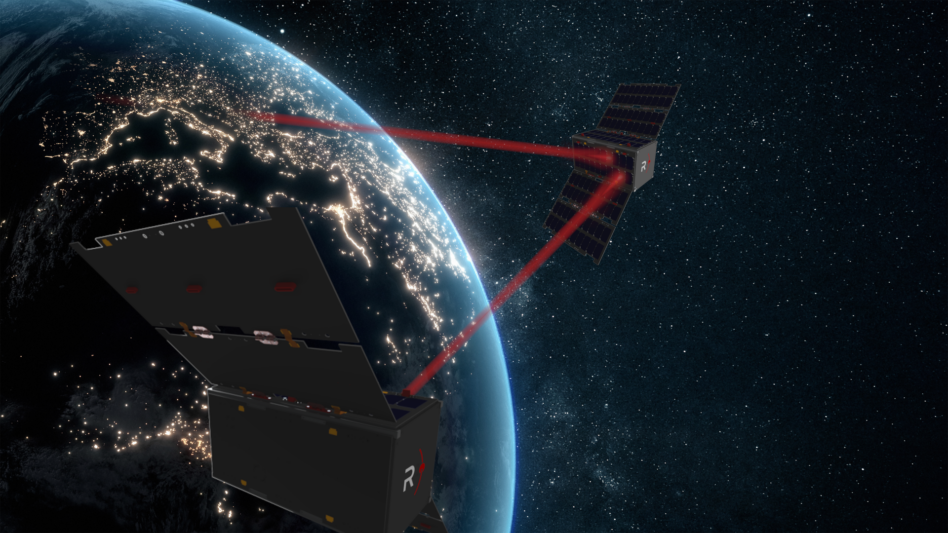
The mission—dubbed Aurora—will attempt to demonstrate space-to-ground laser communications, as well as quantum encryption technologies, using Austrian space industry expertise
Light show: The goal of Aurora is to find a faster, more robust way to transmit data from orbit.
“The data we are generating [in orbit] is much more than actually we can bring down in a reasonable time,” Scharlemann told Payload. “We were tasked to build up a communication system for the Austrian military, which is highly reliable, cannot be jammed, cannot be listened in—and we suggested laser communication.”
The mission also involves pan-European partners:
- Quantum Technology Laboratories, an Austrian optical ground station (OGS) startup, will supply the ground link for the mission through its OGS in Budapest, Hungary.
- SSC Space will supply other OGS links from its global network.
- A spinoff from the Austrian Academy of Sciences will provide the quantum payload.
- R-Space is still finalizing its partner for the optical satellite link, but told Payload that it was selecting from a shortlist of European suppliers.
Field promotion: In typical Austrian fashion, the country’s plan to improve orbital capabilities is calculated and methodical.
Aurora is one of three missions in a series of planned government-backed demos to validate new technologies in orbit—before potentially building larger-scale constellations.
Austria has two other missions planned to fly in 2027, each focusing on a different next-gen technology—and each giving a different Austrian space startup a chance at bat.
- Austria commissioned its first military sat in March. BEACONSAT, led by GATE Space, will demo technologies to detect instances of satellite spoofing and jamming.
- Austria is also working on the European Defence Agency’s LEO2VLEO project in partnership with the Netherlands, to demonstrate EO capabilities at altitudes below LEO. The project is primed by Dutch satellite manufacturer ISISPACE, and will rely on an optical payload from Austrian startup Astrosysteme.
“There’s this joke about the normal Austrian: ’He wears suspenders and a belt,’” Scharlemann said. “This is also what I think they are doing: Trying to build up not only one competence, which you can lose, but to build [multiple] up in parallel.”
Europe’s Space Defenses Fall Just Shy of Weaponization
Europe doesn’t have any weapons in space—but that doesn’t mean the region is comfortable flying around in orbit defenseless.

Fortastra Raises $30M Series A to Fund its Next Security Spacecraft
The US military has weapons in space, and—with the orbital arsenal expanding—security is becoming a top priority.

Colorado Springs, Huntsville Team Up on Golden Dome
“It’s a transformed relationship between Colorado Springs and Huntsville,” Rep. Jeff Crank (R-CO) told Payload. “When I took office, I don’t think it was a bad relationship, but it was one where both communities were kind of looking over their shoulder at the other. That wasn’t good for America, and I don’t think it was good for Colorado Springs or Huntsville either.”
HawkEye 360 Turns its RF-Sensors to Orbital Targets
The DoD wants to better understand what’s going on in orbit. HawkEye 360 ($HAWK) has the inside scoop.

NASA has set out an aggressive plan to build a Moon base, equipped with power, comms, mobility—you name it. But not much attention has been paid to where all of that stuff is going to live.
Enter: Lunar Forge.
Lunar Forge is a startup working on technology to turn lunar regolith into construction material for housing, and shielding critical technologies on the Moon—specifically, lunar fission reactors. The company emerged from stealth recently, and shared its detailed plans exclusively with Payload.
Keep reading