


NASA has set out an aggressive plan to build a Moon base, equipped with power, comms, mobility—you name it. But not much attention has been paid to where all of that stuff is going to live.
Enter: Lunar Forge.
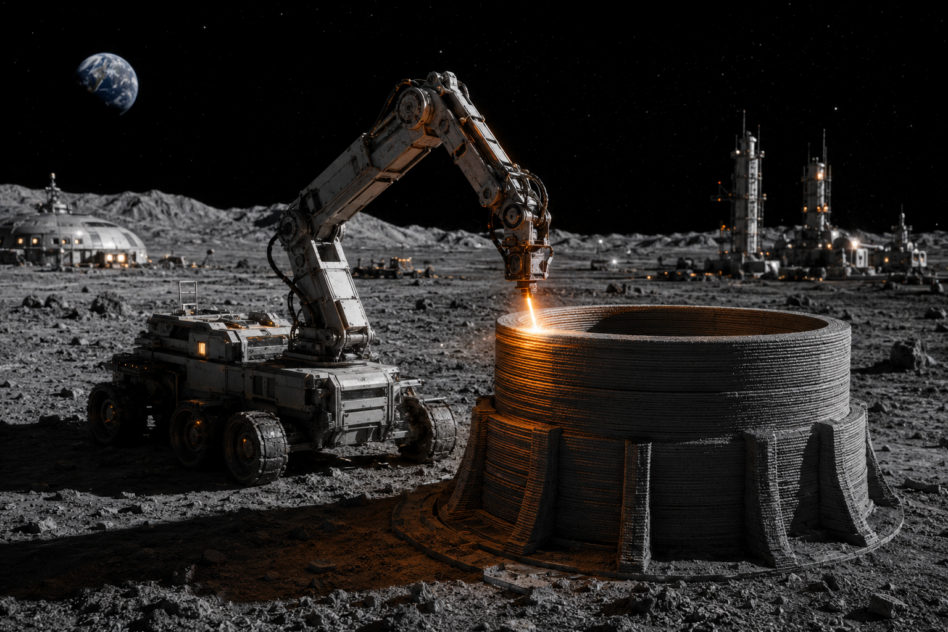
Lunar Forge is a startup working on technology to turn lunar regolith into construction material for housing, and shielding critical technologies on the Moon—specifically, lunar fission reactors. The company emerged from stealth recently, and shared its detailed plans exclusively with Payload.
The pitch: Lunar Forge’s core technology is laser sintering. Sintering describes the method of fusing powdered material into a solid mass, using high heat, without melting inputs to the point of liquefication.
Lunar Forge isn’t the first company to try to repurpose lunar dust as building material. Others include Redwire’s Mason tech, which has received NASA support for building landing pads and roads off world, and ICON Prime, which relies on lasers to melt 3D printed regolith for building structures.
Lunar Forge’s idea is to drastically reduce the cost required to set up fission reactors, by using regolith to build the majority of the support structure to house and shield the reactor core.
“Transporting construction materials from Earth to the lunar surface runs approximately $1M/kg at current launch economics,” Lunar Forge CEO Alex Bell told Payload. “A single reactor housing, built from shipped materials, would cost hundreds of millions in launch mass alone. Sintering regolith in-situ eliminates that mass penalty almost entirely.”
How it works: When done right, the sintering process is a bit like a magic box: regolith in, construction material out.
Inside, Lunar Forge is collecting raw regolith, filtering, and sieving it to control the distribution of particles, and then laser-heating it to fuse particles together without melting.
Luckily, lunar regolith contains a hodgepodge of useful minerals—“iron, aluminum, titanium, and everything that you typically would use to build reactor shielding,” according to Bell—but that also means the system has to adapt in real-time based on the variation of the feedstock.
The structural output of the system has to be strong enough to stand-in for terrestrial, reactor-grade infrastructure. In lab tests, Lunar Forge demonstrated compressive strengths exceeding 200 MPa—with some samples reaching 345 MPa. For context, consumer-grade concrete has a compressive strength of 20 to 30 MPa, and 350 MPa steel is typically reserved for extreme load-bearing applications.
Next steps: Lunar Forge is miniaturizing its lab tech to fit into a lunar lander, and outlined a three-step plan to begin demonstrating the tech on the moon beginning next year:
- Lunar Forge is targeting its first lunar-surface demo in 2027, on an as-yet unannounced lander, where it will deploy a solar- and battery-powered sintering unit to test its capabilities with real regolith.
- Lunar Forge’s second flight to the Moon will upgrade the power input to a radioisotope power system to demonstrate persistent, day-and-night capabilities.
- For Phase Three, Lunar Forge hopes to deploy multiple regolith filtering-and-sintering devices, operating as an AI-controlled hivemind for fully autonomous operations.
Following these three demos, Lunar Forge will be “fully ready” to build fission reactor housing infrastructure. Lunar Forge didn’t share dates on when these follow-on missions could fly, but the company’s ultimate achievement—building the first fission reactor shield—will have to predate the arrival of the first fission core. NASA and the DOE have set a target to have a lunar reactor up and running by 2030.
Go with the (cash) flow: To make this three-part plan possible, Lunar Forge’s strategy is to partner with prime contractors of NASA’s Fission Surface Power (FSP) program, including:
- Lockheed Martin, in partnership with BWXT and Creare;
- Westinghouse Electric Company, in partnership with Aerojet Rocketdyne and L3Harris;
- And a JV, known as IX, between Intuitive Machines and X-Energy that will work in partnership with Maxar (likely Lanteris, now owned by IM after Maxar’s rebrand) and Boeing.
“None of the awarded teams are focused on manufacturing reactor housing and shielding directly from lunar regolith,” Bell told Payload. “Reactor development is their mission. Manufacturing the housing and supporting infrastructure from lunar materials is outside their scope.”
Lunar Forge is raising a $7M pre-seed funding round to get off the ground, but expects to need an additional ~$160M in capital over the next three years to complete its phased-development approach. Alongside these funding rounds, however, Lunar Forge is anticipating hundreds of millions in revenues from partnerships with FSP primes before the end of the decade.
Ultimately, the company is betting that NASA will continue backing its bold and aggressive plans to deploy space nuclear power.
“Surface power is funded. Surface manufacturing is the gap we fill,” Bell said. “Once reliable surface power becomes a priority, manufacturing infrastructure from lunar materials becomes a prerequisite rather than a nice-to-have.”
Fortastra Raises $30M Series A to Fund its Next Security Spacecraft
The US military has weapons in space, and—with the orbital arsenal expanding—security is becoming a top priority.
Exclusive: Xona Ramps Up Production Ahead of Pulsar Launch
With FCC approval in hand and six sats ready for the pad, Xona is turning to its next challenge: building the next 250.
ArbaLabs Launches AI Verification Demo On South Korea’s Nuri Rocket
“In short, tons of companies are looking at the latest and greatest physical AI deployments,” ArbaLabs CEO Ashley Reeves told Payload. “Nobody is really thinking about putting some checks and balances on what these AI models are doing.”

Nebex Partners with Thrusters Unlimited to Unlock $700M for Mexico’s Space Ecosystem
The capital will fund EO, telecoms and other strategic capabilities, according to Nebex.

Blue Origin appears to be recovering well from its New Glenn explosion last month—all thanks to some clever engineering.
Blue maintains it will fly again this year. CEO Dave Limp said yesterday that the company will ramp up flights quickly with a new pad design. The company plans to join rocket stages in a facility, ferry an already integrated New Glenn to the launch pad, crane the rocket there to a vertical position, and then mate payloads.
NASA, however, hasn’t decided if these changes will be enough to meet its ambitious lunar plans. Blue has received several Moon contracts from NASA, and remains one of the vendors being considered to fly with Artemis III NET 2027.
Keep reading