


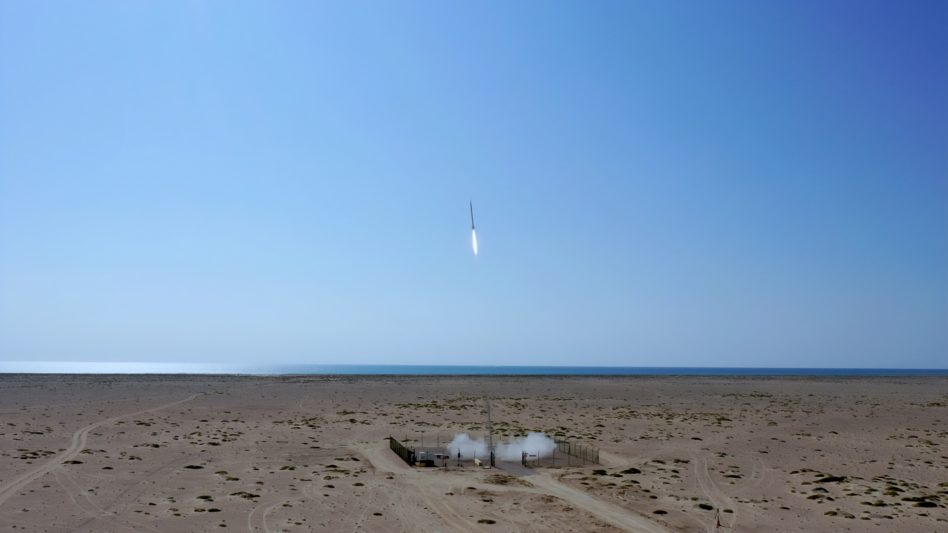
Latitude announced an agreement with Oman’s Etlaq Spaceport this week, giving the French launcher clearance to stage the debut launch of its rocket from Omani shores in late 2027.
While the international partnership stands out in an era of increasing focus on European launch sovereignty, it’s just the latest in a growing number of partnerships between space organizations in Europe and the Middle East.
- For Europe, the Middle East offers access to a new set of customers, new capital, and new missions.
- Nations in the Middle East, meanwhile, are extracting European know-how to quickly build and deploy new space-based capabilities.
Changes in latitude, changes in attitude: Latitude’s choice to launch from Oman was strictly an economic decision, according to Olivier Zarrouati, chair of Latitude’s strategic committee.
“We are not shooting for sovereignty,” Zarrouati told Payload. “Our target is not to make the most amazing launcher ever…It is just to launch 300 kg for less than $7M…Launching from a simple launch pad makes more sense than getting into a more complex facility.”
Despite—or perhaps because of—its relative immaturity as an operational launch facility, Etlaq’s offering was far superior compared with European-owned spaceports, he said.
- Etlaq’s geographic location makes it optimal to reach a variety of different orbits.
- Its distance from population centers (as well as proximity to the Arabian Sea) makes it more convenient than densely populated Europe to host a high-cadence launch program.
- It’s also much cheaper and easier to get to from Europe, compared with launch pads in the Americas.
“It does not make sense to go to the other side of the world, sail over an ocean…to go on an expensive launch pad,” Zarrouati said. “We have good conditions in Etlaq…the conditions that we get permit us to match our business plan.”
Copy and paste: The benefits of setting up shop in the Middle East aren’t just reserved for those looking to access orbit on the cheap, however. The rest of the European space industry has spent the last few years putting together new partnerships in the region—and many are already bearing fruit.
- Orbitworks, a joint venture formed in 2024 between US-based Loft Orbital and UAE-based Marlan Space, has been built in no small part by European capital, European know-how, and the expectation of European revenue.
- In April, CNES signed an agreement to purchase EO data from Orbitworks’ 10-sat Altair constellation, the first sat of which is expected to launch this year.
“We are utilizing both American and European components in our constellation, and it enables us to acquire customers on both sides,” Orbitworks and Marlan Space CEO Hamdullah Mohib told Payload. “I don’t think Europe on its own will be able to stand up all of its capabilities. At Orbitworks, we look at that to be an opportunity to provide Europe with the technologies that—on their own—would take a tremendous amount of time to build.”
In a similar vein, UAE company Space42—formed from a merger between Bayanat and Yahsat in 2024—has been steadily growing its presence in Europe through partnerships to boost continental capabilities.
- In 2025, Space42 and Hisdesat said they would explore collaborative opportunities for new satellite-based services.
- The same year, Space42 announced a joint entity with US-based Viasat—called Equatys—to build a 2,800 satcom constellation that can, among other things, provide connectivity to Europe.
- In 2024, Space42 established a joint venture with Finland-based ICEYE to build a SAR satellite manufacturing facility in the UAE.
“Partnerships are essential to everything that we do. We are not in the game of reinventing the wheel,” Hasan Al Hosani, CEO of Smart Solutions at Space42, told Payload. “Each region brings its own—let’s say, distinct strength, right—so the value of global strategy lies on drawing on all different partnerships, be it from the US or Europe, rather than choosing one against the other.”
The bottom line: While European sovereignty may be driven by a response to the deterioration of geopolitical ties to the US, it’s opened the door for Middle Eastern space companies to offer new capabilities from a geopolitically neutral position.
Talks of European sovereignty may be on the rise, but it’s not an exclusive strategy, and the Middle East is positioning itself as the perfect international partner to lend a hand.
“To actually achieve our ambitions, it’s essential for us to build on partnerships that have the right, clear mutual benefits,” Al Hosani said. “We’re not trying to build for the short term. We’re trying to build for the long term.”
Correction: This article was updated to correct a typo. Space42’s collaboration is with Hisdesat.

Reaction Dynamics Targets 2031 for Borealis Medium-Lift Launch
In the contest to build up commercial launch capabilities in Canada, Quebec-based startup Reaction Dynamics has entered a new weight class.

Seraphim Space Investment Trust Doubled its Value in 2026
Seraphim’s major holdings—ICEYE, ALL.SPACE, D-Orbit, HawkEye 360, and Xona Space Systems, which together represent more than 75% of the firm’s portfolio—all had a great year, and that success has trickled upwards.

UKSA Taps ClearSpace for Country’s First Debris Removal Mission
The UK Space Agency is dressing up as a waste-management company for Halloween.
Europe’s Space Defenses Fall Just Shy of Weaponization
Europe doesn’t have any weapons in space—but that doesn’t mean the region is comfortable flying around in orbit defenseless.


True Anomaly has found, approached, and imaged a Rocket Lab spacecraft, marking the successful end of the first VICTUS HAZE mission.
The company announced that its Jackal spacecraft—dubbed Panther for the exercise—has so far nailed its orders from SSC, demonstrating what’s possible when it comes to tactically responsive space operations.
VICT(orio)US: Here’s just some of what the two industry players have accomplished since the mission began on June 19:
Keep reading