

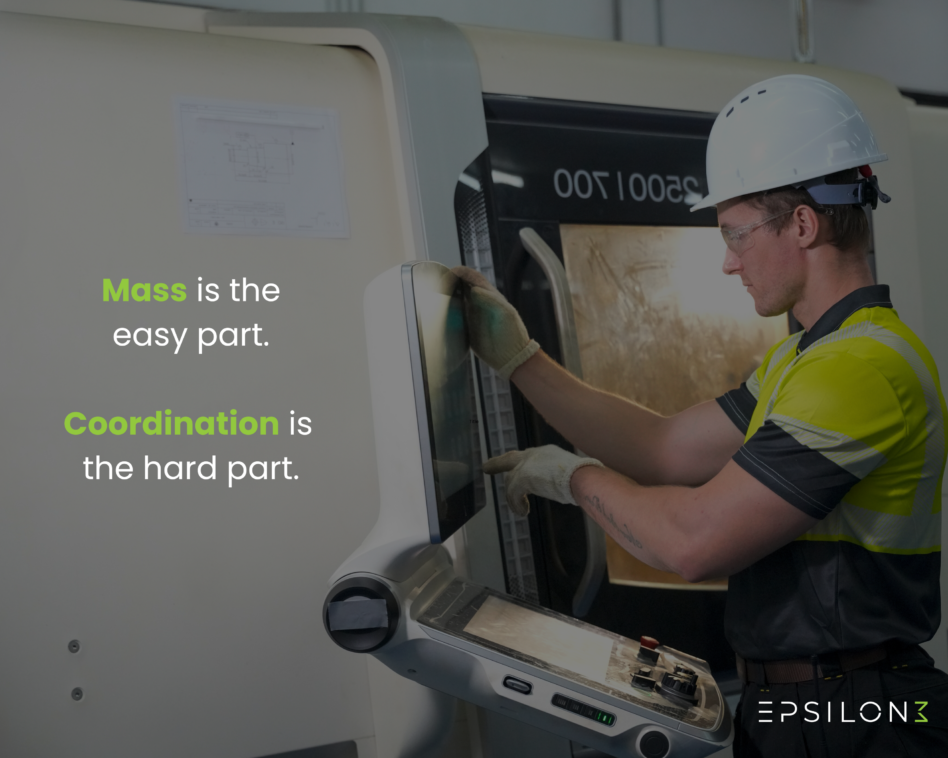
Ukraine rewrote the economics of conflict. When an adversary can field cheap drones by the thousand every month, you can’t answer them with million-dollar interceptors and exquisite platforms, you answer mass with mass. The U.S. has absorbed the lesson and is building autonomous, disposable systems faster than it ever has, led by a new generation of startups that grew up on software, are fueled by AI, and move at break-neck speed.
But building at this scale – thousands of units, across an expansive supply chain, on a wartime clock – is new, and it’s not just startups facing these pressures. It’s new for everyone, with traditional primes trained to operate on multi-million dollar programs, not fast and cost-effective hardware produced at scale. The entire defense industrial base is going to hit a wall, AI or not.
Scale breaks at thousands, when a dozen organizations hand tasks back and forth across boundaries their systems cannot cross.
The bill shows up as schedules slip and budget overruns. The GAO found that cost estimates across thirty major defense programs grew $49.3 billion a year, and the average program takes nearly twelve years to field against an original plan of eight, much of that absorbed at the seams between organizations, not inside any one of them. The Columbia-class submarine spans more than 3,000 suppliers and crosses every one of those boundaries, while the systems holding the work do not.
The space industry faces the same pressure. Artemis moves between five major contractors only by passing through NASA as controlled documents. The engineers who hold these procedures in their heads are retiring faster than the next generation can absorb them. Point an AI model at that fragmented record and you get a faster way to be confidently wrong inside one organization.
The gap is measurable. In a survey we ran of more than 500 operators across manufacturing, aerospace, and defense, 46% said task instructions still aren’t digitized and 42% said even flagging a finished task to a teammate happens by hand — with defense reporting the most friction.
You can see the expense one engineer at a time. Somewhere right now, someone is spending eight days on eight minutes of work – verifying a procedure another organization already ran, complete and signed, on a system one wall over they can’t reach, so it goes out as a PDF, comes back marked up.
After a decade running human spaceflight operations at SpaceX, I know that’s the default.
Software solved this same problem twenty years ago. When companies needed to work across corporate lines, they stopped shipping each other source code and started shipping endpoints – an interface that exposes what a system does without exposing how it does it. The procedure layer of our industry never got that moment. Documents still get frozen into a static database, a PDF, or nothing, because the PDF is legible and no one can reach back into your live system. At the cadence space and defense now demand, that won’t hold.
The fix is smaller than a decade of modernization debate suggests. Let one organization share the state and interface of the work – the assembly it’s running, the test it’s executing, the quality record it just signed, the hold it called, with its inputs, outputs, and current status – without surrendering the proprietary content underneath, or the control that keeps it safe to share.
I started Epsilon3 to solve exactly this. The platform runs the full life of complex hardware — how it’s planned, built, tested, inspected, and operated — inside an organization’s walls. Epsilon3 Connect now carries that same live record across the boundary: a prime and a supplier working the same assembly, a customer witnessing an acceptance test in their own environment, a program office seeing exactly the slice it owns. Simple to share and controlled by whoever owns the work.
The defense industrial base can build the hardware. Whether they can field it at the scale this decade demands depends on the substrate underneath — the layer that connects the supply chain, holds the knowledge walking out the door, and lets every organization a program touches work from one record. Software is the foundation that makes any of it possible.
Laura Crabtree is the founder and CEO of Epsilon3, the execution platform for must-work industries. She previously spent more than a decade at SpaceX as a Crew Operations and Resource Engineer supporting human spaceflight missions, including Dragon.

The Lunar Economy Could Be Worth $566B by 2050. First, We Have to Build It.
The return to the Moon is an infrastructure story, and Deloitte has created numbers to back it up. The number: A new report from Deloitte, Building the Lunar Economy: How a Sustained Presence on the Moon Could Transform Life, Industry, and Infrastructure on Earth and Beyond, puts the lunar economy’s cumulative economic value through 2050…
The Commercial-First Shift in National Security Space
For decades, the model for building national security space systems was relatively straightforward. The government defined a mission, established requirements, funded a spacecraft designed specifically to meet them, and ultimately owned and operated the resulting capability.
The New Middle Ground in Spacecraft Development
For years, the commercial space industry has focused on making spacecraft more affordable and accessible. Today, a new wave of customers want to build their own hardware to gain full ownership of the systems that define their mission.
A Faster Path to Orbit: How Hosted Payloads Are Changing Access to Space
Historically, deploying a new capability in space required significant time, investment, and technical expertise. Companies often had little choice but to build nearly everything themselves—from spacecraft and payload integration to ground infrastructure and mission operations. Today, the space industry offers a different model: hosted payloads. “We’re seeing companies looking for the fastest, most economical way…

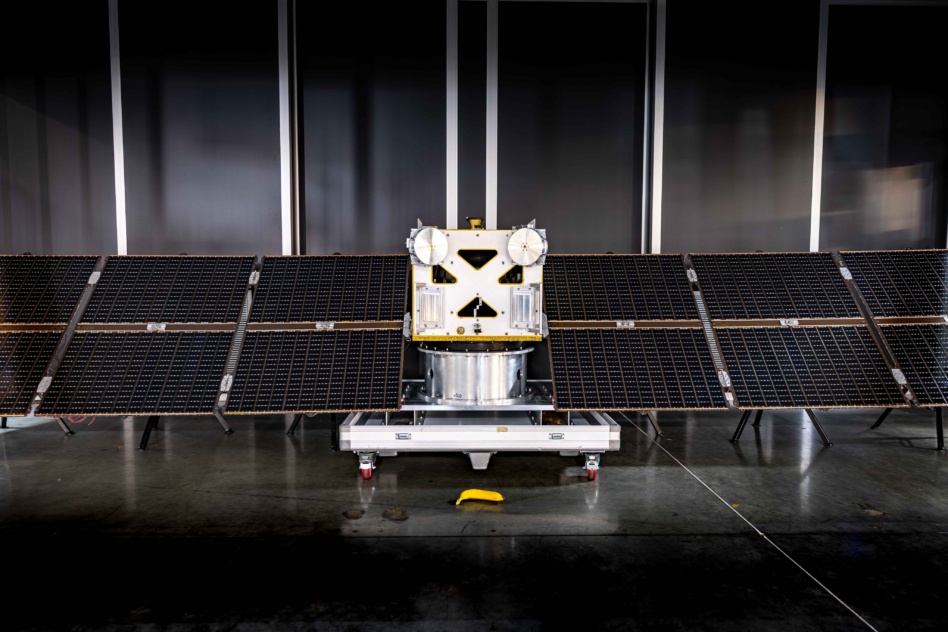
AstroForge finished assembling the major flight hardware for its DeepSpace-2 asteroid rendezvous spacecraft, which is expected to launch before the end of the year, the company announced Thursday.
The spacecraft is scheduled to fly onboard a SpaceX Falcon 9 rocket, which is also carrying Intuitive Machines’ IM-3 lander to the lunar surface.
On the mission, DeepSpace-2 will aim to demonstrate the company’s ability to rendezvous with an asteroid and set the stage for future asteroid mining missions before the end of the decade, according to CEO Matt Gialich.
Keep reading