


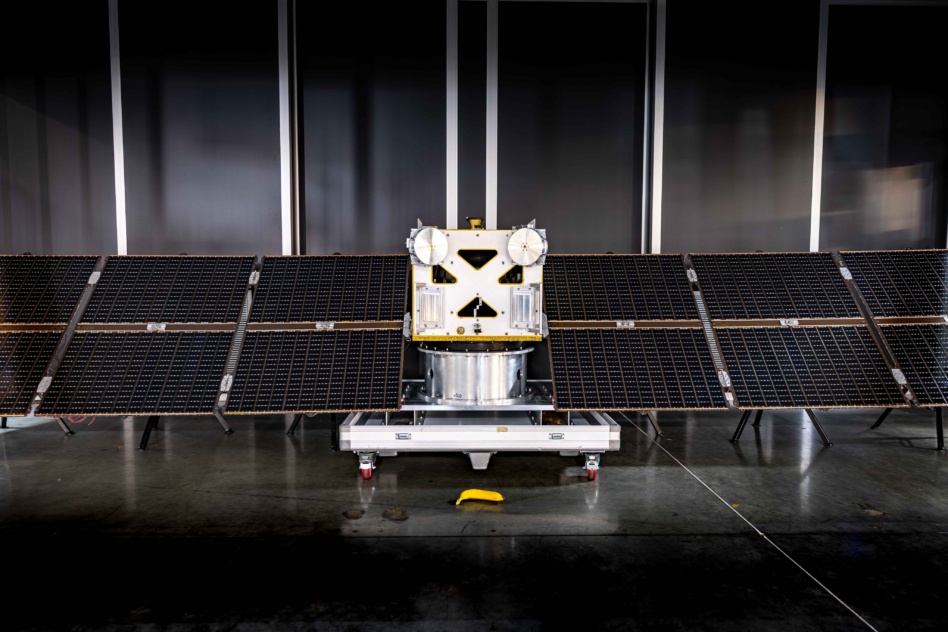
AstroForge finished assembling the major flight hardware for its DeepSpace-2 asteroid rendezvous spacecraft, which is expected to launch before the end of the year, the company announced Thursday.
The spacecraft is scheduled to fly onboard a SpaceX Falcon 9 rocket, which is also carrying Intuitive Machines’ IM-3 lander to the lunar surface.
On the mission, DeepSpace-2 will aim to demonstrate the company’s ability to rendezvous with an asteroid and set the stage for future asteroid mining missions before the end of the decade, according to CEO Matt Gialich.
Bigger and better: DeepSpace-2 is AstroForge’s second attempt at leaving Earth’s orbit and imaging an asteroid up close. In February 2025, AstroForge’s first interplanetary spacecraft—called Odin—had its mission cut short 530,000 miles from Earth after its solar array deployment system failed, leaving Odin powerless.
AstroForge has taken lessons learned from this initial setback to build a bigger, more capable spacecraft with a larger, more capable team:
- At 200 kg, DeepSpace-2 is twice the size of Odin;
- Its solar arrays can power the spacecraft even if they don’t deploy, and AstroForge only needs one of the two arrays to fully deploy to complete its mission;
- It’s equipped with a Hall Effect electric propulsion system from Safran to provide more efficient maneuvering than Odin’s chemical propulsion system;
- DeepSpace-2 is flying with a high-resolution monochromatic camera to capture up-close imagery of an asteroid that can give clues about its mineral composition;
- The spacecraft is built to carry 50 kg of payloads—and has the capability to land on future asteroid mining assignments.
Tell me the odds: Before Odin launched, AstroForge was up-front about the high risk of failure, putting the chance of success at just 30%. Now, Gialich is a lot more confident.
“DeepSpace-2’s odds have gone up dramatically—I’d say we’re probably in the 70 to 80% chance of success [range],” Gialich told Payload. “If I could figure out what that 20% was, I would spend day and night working on it.
That confidence isn’t solely driven by hardware specs. Since it built Odin, AstroForge’s team has tripled, and that team has been given nearly twice as much time to build compared to Odin’s eight-month development sprint.
David and Goliath: But AstroForge also faces a different competitive landscape than it did when Odin took flight. In its IPO prospectus, SpaceX highlighted asteroid mining as a future revenue stream, and for AstroForge, that’s the equivalent of being chased down by a giant. However, Gialich isn’t worried.
“Usually Goliath wins, but that’s not the case [here],” Gialich said. “This is not the focus of SpaceX, this is not the focus of Elon [Musk]. I think Elon has really gotten stretched thin…He’s late to the game.”
Exclusive: DoD Taps Orbital Operations for Cryogenic Spacecraft Demo
The Long Beach, CA, startup has won up to $35M from the DoD under a prototype Other Transaction Agreement to fly a full-scale, in-orbit demo of Astraeus—its cryogenic-maneuvering vehicle.
Inside Starburst’s First Flight, and Portal’s New Bothell Office
“I feel like 80% success now,” CEO Jeff Thurnburg said. “But honestly, to get this far this fast, I’m tempted to call it 100%.”
Xona Raises $250M Series D to Scale Commercial GPS Constellation
Xona’s long-term plan is to build a ~258-sat constellation to offer an upgraded commercial alternative to government GPS networks.
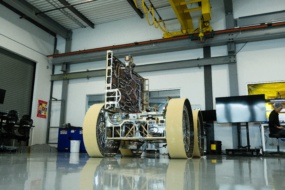
Hewlett Packard Enterprise to Send AI Compute Module to the Moon
Hewlett Packard Enterprise ($HPE) is taking remote working to a whole new level.

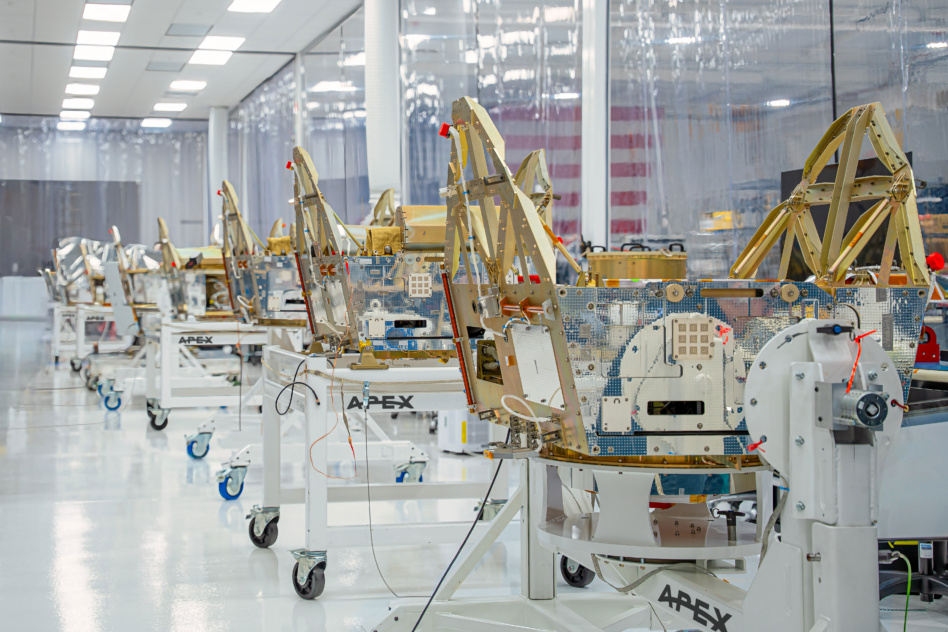
Apex Space has closed a $200M funding round raised at a $2.3B valuation, the company announced on Friday.
Glade Brook Capital Partners led the round, which also included participation from Washington Harbour Partners and other new and existing investors. Apex CEO Ian Cinnamon said the company is raising capital as it sees investor interest, and not labeling the funding as a specific series.
Raking it in: It’s the company’s third $200M round in about 14 months. Apex announced a $200M Series C in April 2025, and a $200M Series D in September.
Keep reading