

In engineering production, hundreds—sometimes thousands—of decisions stand between initial concept and final product.
Some decisions are big, and some are small trade-offs, but collectively, they determine whether a program moves forward efficiently—or stalls under the weight of its own complexity.
Those stalls often stem from an inefficient process of how design decisions are made and tracked. That’s the problem CoLab is built to solve.
“Design reviews are really just a collection of decisions,” said CoLab CTO Jeremy Andrews. “You’re deciding whether to move forward, which trade-offs to make, and when something is ready for the next phase of development.”
While engineering organizations have built increasingly complex workflows around design reviews, the core task remains unchanged: align the right people to make the right decisions at the right time.
Design reviews are more than mere checkpoints—they are opportunities to capture the knowledge and rationale behind engineering decisions.
Capabilities & Innovations
CoLab is a cloud-based software platform designed to enable design review for complex engineering data anytime, anywhere.
Historically, engineering teams have relied on two approaches:
- Live reviews, where experts walk stakeholders through designs in real time;
- Asynchronous follow-up, where complex systems are reduced to screenshots and slide decks.
Both introduce potential friction. Live reviews require schedule coordination; follow-ups introduce abstraction and the risk of misinterpretation.
“You’re taking something inherently complex and passing it through a filter,” Andrews said about the commonly used slideshow presentation deck. “That creates opportunities for misunderstanding.”
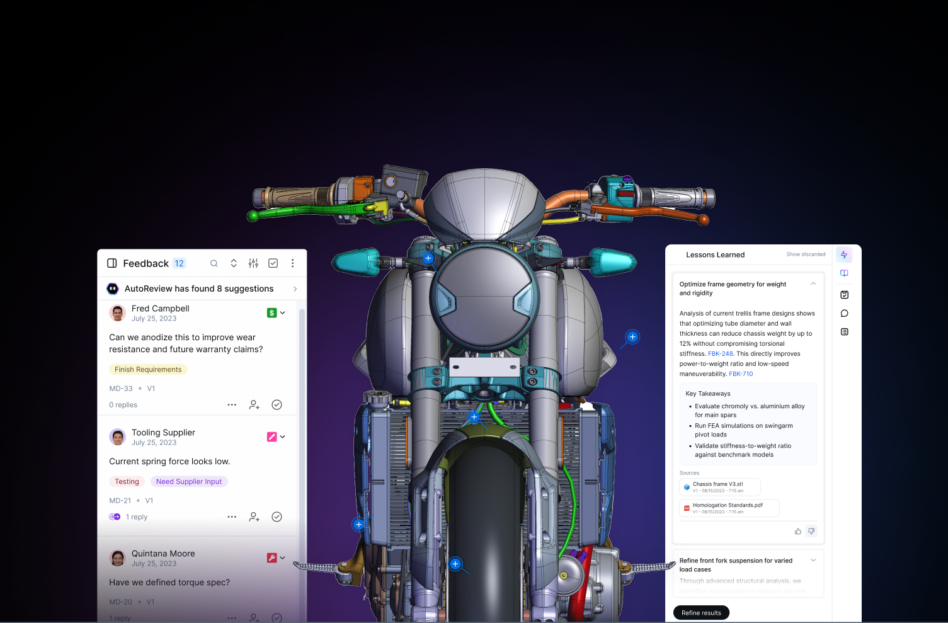
CoLab enables asynchronous review in full 3D context, with capabilities including:
- Model-based collaboration:
Feedback is tied directly to the design; - Revision-aware tracking:
Teams can see how feedback evolves across versions; - Centralized decision history:
Comments, discussions, and outcomes live in one system.
“You don’t have to think about where the notes are,” Andrews said. “You focus on the product—and everything is there.”
CoLab’s vision extends beyond collaboration software. The company sees design review as an ideal opportunity for capturing engineering judgment, trade-offs, and decision rationale—the kinds of institutional knowledge that traditionally exist only in conversations, emails, or engineers’ heads.
According to Andrews, the key to capturing this dataset is making it easy for engineers: “We’re not asking engineers to do anything new. We’re documenting knowledge as a byproduct of a process they already have to do.”
As AI capabilities mature, CoLab is developing engineering-focused AI agents and decision-support systems. Because the platform captures design feedback and rationale within the review process itself, organizations can begin surfacing relevant historical knowledge and guidance to engineers in real time, as new decisions are being made.
Use Case: Idaho National Laboratory
This fundamental shift—from dispersed documentation to unified decision systems—is already being applied in high-stakes environments.
Engineering teams at the Idaho National Laboratory are using CoLab on nuclear-reactor programs that involve large-scale design reviews with hundreds of documents per review. CoLab supports coordination across these reviews by helping teams assign reviewers to technical data packages and track individual comments and action items across documents, drawings, and models.
CoLab has spent nearly a decade refining its platform, with a focus on security, integration, and enterprise deployment. The platform is trusted by a growing list of market leaders in advanced manufacturing, including Bombardier and Lockheed Martin.
Looking ahead, the company is expanding AI-driven review capabilities, supporting additional engineering data types, and deepening integrations with existing systems.
CoLab’s long-term goal is to continue its evolution from a collaboration platform into a decision-intelligence system, which actively informs and streamlines engineering decision-making.
Market Forces & Industry Trends
The need for improved design collaboration is being driven by three converging forces.
- Engineering systems—particularly in aerospace and defense—are growing more complex, requiring coordination across more disciplines and stakeholders.
- Organizations face increasing pressure to accelerate timelines without increasing risk. Delays in decision-making ripple outward, affecting production, cost, and competitiveness.
- AI is reshaping expectations around how knowledge is captured and used. Many organizations are experimenting with generic tools, but these often sit outside core engineering workflows.
Together, these pressures are forcing engineering organizations to rethink how design decisions are made, documented, and revisited over time.
In aerospace and defense specifically, the challenge is amplified by long development cycles, increasingly complex supply chains, and stringent compliance requirements. Programs often involve distributed teams working across suppliers, contractors, and government stakeholders—all of whom need visibility into the reasoning behind technical decisions.
“It pushes everything out—your timelines, your revenue, your market position,” Andrews said about delays in engineering decision-making.
CoLab differentiates by focusing on a single, high-impact part of the engineering process and integrating its platform directly into existing systems.
Rather than replacing Product Lifecycle Management (PLM) or Product Data Management (PDM) platforms, CoLab complements them—addressing the human layer of collaboration and decision-making.
That distinction is important because most engineering organizations already have systems for managing files and revisions. The harder problem is preserving the context behind engineering decisions as teams, programs, and requirements evolve.
“[PLM and PDM platforms] solve version control,” Andrews said. “We focus on how people actually review and decide.”
Uniquely Suited for Aerospace & Defense
Aerospace and defense organizations face a unique combination of pressures: increasingly complex systems, heightened compliance requirements, workforce transitions, and growing expectations around development speed. Those conditions make design review and decision alignment particularly critical.
Built on product focus, workflow integration, and alignment with broader industry shifts, CoLab’s platform:
Targets a universally required process:
Design review is unavoidable, making adoption more natural.
Captures institutional knowledge:
As experienced engineers retire and workforce mobility increases, preserving institutional expertise becomes increasingly important. Capturing design rationale within the review process helps organizations retain critical engineering knowledge over time.
Addresses workforce transitions:
Expert knowledge can be captured and redistributed as teams evolve.
Embeds AI into real workflows:
Because the platform captures structured design review data over time, AI tools can be applied within the review workflow itself—surfacing relevant historical feedback, identifying potential risks, and helping teams apply institutional knowledge earlier in the design process.
In aerospace and defense, design decisions made early in the development cycle impact advanced manufacturing, supply-chain complexity, and overall system performance.
“Design decisions cast a shadow over everything that comes after,” Andrews said.
As systems grow more complex and timelines compress, the ability to capture, understand, and apply decision-making knowledge becomes a defining advantage.
That challenge is becoming more visible as engineering production balances growing technical complexity with pressure to move faster and operate more efficiently. The result is a growing focus not just on managing engineering data, but on improving the quality and speed of the decisions based upon that data.
The fastest teams are the ones making better decisions earlier.
To learn more about CoLab, visit colabsoftware.com.

The Lunar Economy Could Be Worth $566B by 2050. First, We Have to Build It.
The return to the Moon is an infrastructure story, and Deloitte has created numbers to back it up. The number: A new report from Deloitte, Building the Lunar Economy: How a Sustained Presence on the Moon Could Transform Life, Industry, and Infrastructure on Earth and Beyond, puts the lunar economy’s cumulative economic value through 2050…

The Commercial-First Shift in National Security Space
For decades, the model for building national security space systems was relatively straightforward. The government defined a mission, established requirements, funded a spacecraft designed specifically to meet them, and ultimately owned and operated the resulting capability.

The New Middle Ground in Spacecraft Development
For years, the commercial space industry has focused on making spacecraft more affordable and accessible. Today, a new wave of customers want to build their own hardware to gain full ownership of the systems that define their mission.

A Faster Path to Orbit: How Hosted Payloads Are Changing Access to Space
Historically, deploying a new capability in space required significant time, investment, and technical expertise. Companies often had little choice but to build nearly everything themselves—from spacecraft and payload integration to ground infrastructure and mission operations. Today, the space industry offers a different model: hosted payloads. “We’re seeing companies looking for the fastest, most economical way…


Launch companies are calling for a central authority to oversee US launch sites, which would manage the coming wave of payloads seeking to leave Earth, a new report states.
On Tuesday, the Commercial Space Federation shared a report highlighting the expected growth of the launch market over the coming years, the state of existing launch infrastructure—and asks from industry to ease the burden of getting to space.
The report, which was briefed to attendees of the Commercial Space Policy Summit at ASCEND, will be released on May 26.
Keep reading