


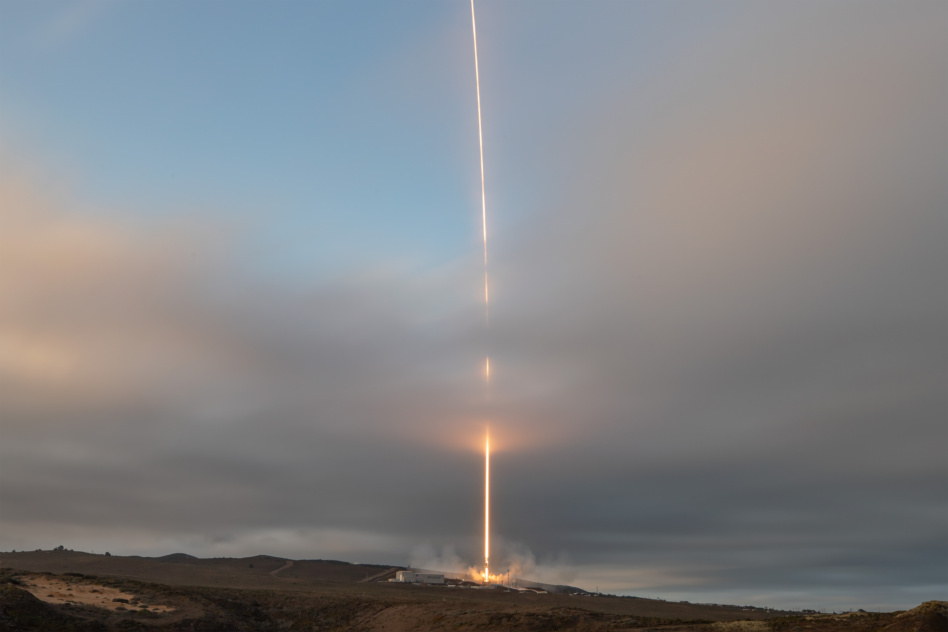
Launch companies are calling for a central authority to oversee US launch sites, which would manage the coming wave of payloads seeking to leave Earth, a new report states.
On Tuesday, the Commercial Space Federation shared a report highlighting the expected growth of the launch market over the coming years, the state of existing launch infrastructure—and asks from industry to ease the burden of getting to space.
The report, which was briefed to attendees of the Commercial Space Policy Summit at ASCEND, will be released on May 26.
Exponential: The report examined the predicted growth in launch demand, looking at three scenarios based on existing data:
- Scenario A looks at missions from the US government, commercial flights to GEO, and spacecraft already approved by the FCC.
- Scenario B adds in satellites that have applied for FCC approval in the past five years, but have not gotten the regulatory green light—except for data-center proposals.
- Scenario C includes all of the above, plus orbital data centers that have submitted applications to the FCC.
Depending on which scenario comes to fruition, the report predicts the space community will want to launch between 6,000 and 230,000 sats per year—requiring up to 7,000 launches annually, according to a release. Under those numbers, demand will surpass capacity for some types of launch vehicles as soon as 2030, according to the report.
Single point: Those interviewed for the report said a central authority—at NASA, DoD, or elsewhere—could help tie together different pieces of the launch-approval process, and tackle priorities such as securing investments in launch infrastructure, improving flight safety, and coordinating shared resources among launchers.
“Interviewees often framed their challenges as ones of coordination among stakeholders, each of whom operates and uses key portions of launch infrastructure,” the report said. “A central authority could coordinate and implement solutions to all the challenges at traditional launch sites.”
Other asks: The report compiled a handful of other common improvements requested by those interviewed, including:
- Establishing a zoning board to ensure someone is thinking about long-term plans when doling out launch pads.
- Reducing the size of evacuation zones based on flight data and enhanced safety measures.
- Changing airspace management, to eliminate aviation-flight disruption during launch operations.
- Studying the use of non-traditional launch sites—and offering them federal range services.
Cowboy Space Reveals “Big Iron” Data Center Rocket
Cowboy Space pulled back the curtain on Big Iron—a launch vehicle whose upper stage is designed to remain in orbit as a megawatt-class data center.

Congress Seeks Answers On Starlink Disruptions in Ukraine
“The United States government has a fundamental obligation to protect American personnel serving overseas,” the senators wrote. “The possibility that American personnel were endangered by preventable disruptions, inadequate coordination, or decisions made by their own government demands immediate scrutiny and accountability.”
Reaction Dynamics Targets 2031 for Borealis Medium-Lift Launch
In the contest to build up commercial launch capabilities in Canada, Quebec-based startup Reaction Dynamics has entered a new weight class.

RATLOG Wants to Cut ~90% of a Rocket Engine’s Parts
The heavy-lift rocket startup debuted on Y Combinator as part of the Fall 2026 batch.


York Space Systems’ ($YSS) M&A team is having a busy year.
York announced a definitive agreement today to acquire Solestial, the space-solar-cell manufacturer, for an undisclosed amount.
The acquisition is York’s third this year.
Keep reading