



NASA still wants to return US astronauts to the Moon in 2028. Today, officials shared a progress update on their efforts, as well as the finer details of the mission plans for Artemis III and IV, targeting flights in 2027 and 2028, respectively.
Long story short: NASA remains confident it can meet the timeline for both missions.
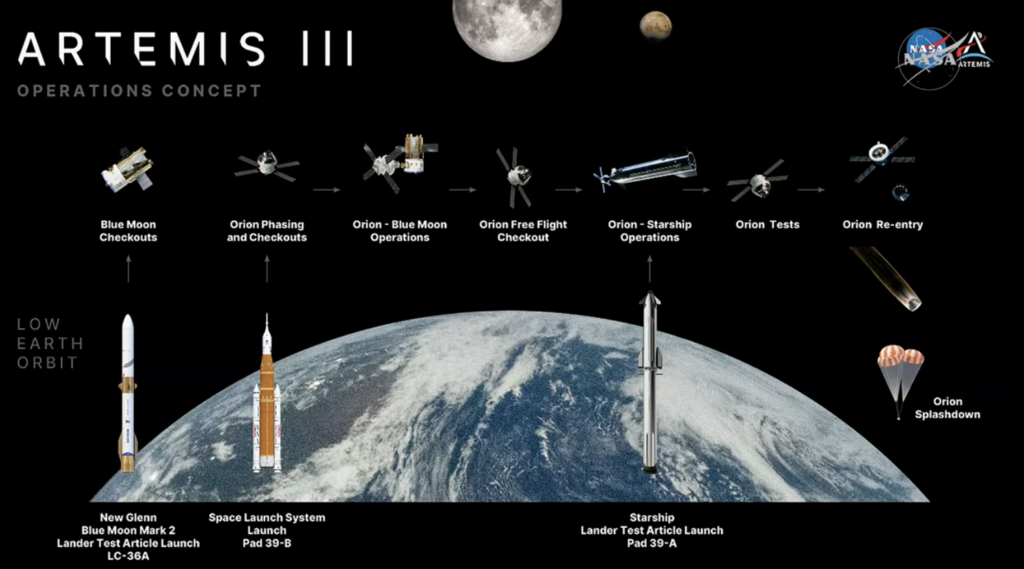
The agenda: For Artemis III, NASA is planning to fly a 14- to 17-day mission in LEO, testing three launch vehicles, one lunar lander, and the Orion crew capsule:
- The mission will begin with an uncrewed launch of Blue Origin’s New Glenn rocket, carrying the company’s Blue Moon test lander.
- NASA’s SLS rocket will launch the Artemis III crew and the Orion spacecraft to orbit “as soon as we can thereafter,” according to NASA Artemis Program Manager Jeremy Parsons.
- On Day 3, or once both spacecraft are in orbit, Orion and the Blue Moon test lander will attempt to rendezvous and dock.
- On Days 4 and 5, the crew will enter Blue Moon to validate the lander’s subsystems—including tests of environmental controls, life-support systems, and emergency scenarios.
- On Day 6, SpaceX’s Starship will launch to orbit.
- On Day 8, Starship will attempt to rendezvous and dock with the crewed Orion vehicle. The Artemis III crew won’t transfer from Orion to Starship during this two-hour test, but officials didn’t share why.
- Following the Starship docking demo, the Artemis III crew will use the remaining days of the mission to complete additional tests on Orion, including tests of the new survival suit.
Above and beyond: For Artemis IV, NASA officials laid out two different mission plans—one using SpaceX’s Starship launcher and human landing system (HLS), and the other using Blue Origin’s New Glenn rocket and Mark 2 lander.
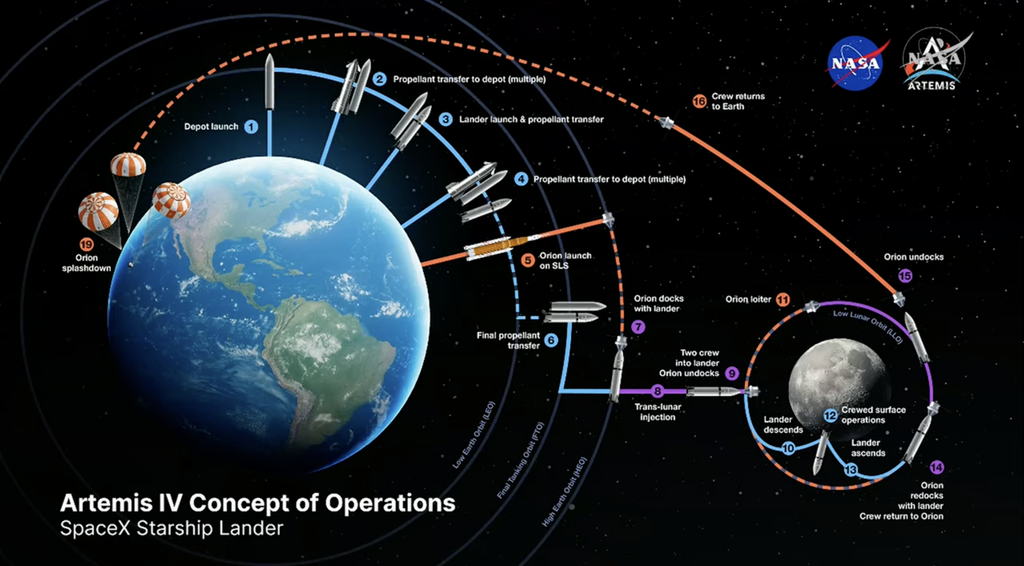
While officials didn’t confirm which company would be selected for the historic lunar landing attempt, they said that both companies are making progress, and either or both could be ready in time for NASA’s end-of-2028 goal.
There’s still a long road ahead for both companies, as Blue Origin has yet to return New Glenn to flight following its on-the-pad explosion in May, and SpaceX just notched its first uncrewed orbital flight with Starship in September.
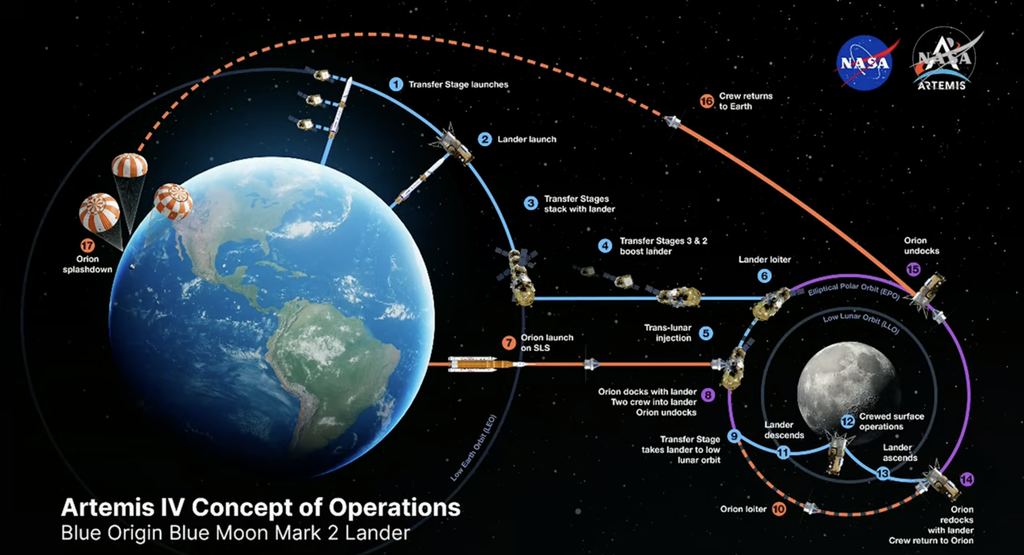
Even still, officials remained confident that both companies will have more than enough launches under their belt before the Artemis IV planning team gets antsy.
“You will have multiple launches of Starship before we go conduct Artemis III, and you will have multiple launches of the Blue Origin New Glenn vehicle from the rebuilt pad before we go launch Artemis III, and so that’s going to give us a lot of confidence,” Parsons said.
Officials also confirmed that SpaceX will attempt to demonstrate its ability to transfer propulsion in orbit in early 2027, a key capability in the company’s plans to get its HLS to the lunar surface.
Zoom out: As he did at Payload’s Off World event last month, NASA Administrator Jared Isaacman spent the bulk of his time at the lectern explaining why NASA wants to reach the Moon in two years: Once again, it’s all about beating China.
Earlier this year, Isaacman predicted China would send a crewed mission around the moon in 2027, and that NASA ‘dodged a bullet’ when the uncrewed Chang’e-6 lander targeting the Moon’s south pole (near water resources both the China and US want) was delayed from this year. As such, he maintained the US should not relax its pace to reach the Moon.
“Here we are today, very much in a new space race, and despite decades of accumulated knowledge and extraordinary advancements in technology, this race will be much closer than it ever needed to be,” Isaacman said at the Friday update. “We will never launch until we are ready, but we will not accept that great achievements simply require more time and more money, nor will NASA sit idly by and watch one of the most consequential moments of this new century pass [to] our overseas competitors.”
Isaacman was upfront about the agency’s efforts to keep to its self-imposed timeline, and recently told the NASA workforce that Artemis III is, on paper, about 90 days behind schedule—but not for a lack of effort.
Throughout the press conference, NASA officials gave countless examples of how the agency is working with vendors to accelerate supply chains, stretch hardware capabilities to do more (specifically, updates to create a “stretch” Vulcan rocket for Artemis III), and shrink requirements (i.e. on the Axiom spacesuit) to meet tighter deadlines for Artemis IV.
“Every time we run into a supplier issue, a priority issue across the industry, Administrator Isaacman [and Associate Administrator] Amit [Kshatriya] are immediately on the phone. They’re immediately putting pressure. We’re immediately going out and helping to make things happen,” Parsons said.

National Academies Rank Nonpolar Moon Sites
A new report from the National Academies ranks the top four non-polar sites for future crewed lunar missions.
Hewlett Packard Enterprise to Send AI Compute Module to the Moon
Hewlett Packard Enterprise ($HPE) is taking remote working to a whole new level.

UKSA Taps ClearSpace for Country’s First Debris Removal Mission
The UK Space Agency is dressing up as a waste-management company for Halloween.
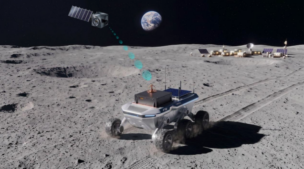
JAXA Taps ArkEdge for Two Lunar Navigation Demos
Today’s Moon explorers won’t have the luxury of GPS-like tech for navigation. But JAXA is trying to change that for future lunar visitors.


For decades, the Lockheed C-130 Hercules aircraft and variants have hauled cargo, flown as gunships, and refueled military jets midair. Now, Orbital Operations wants to do the same in space.
The Long Beach, CA, startup has won up to $35M from the DoD under a prototype Other Transaction Agreement to fly a full-scale, in-orbit demo of Astraeus—its cryogenic-maneuvering vehicle.
The company also closed a $7M seed extension led by DTX Ventures, bringing its total raised to ~$16M. GoAhead Ventures and Solaris Ventures also participated alongside follow-on investment from Initialized Capital, Harpoon Ventures, TRAC VC, and others.
Keep reading