


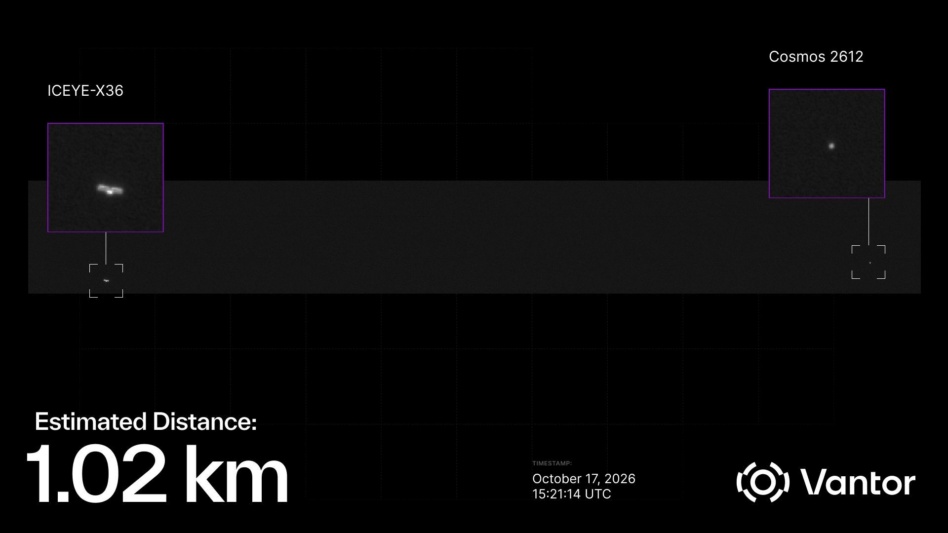
Unless you were living under a (space) rock, you will have heard that in the last month a Russian military satellite, Kosmos 2612, closed to within a few hundred meters of ICEYE-X36—an ICEYE radar satellite that’s been sharing data with Ukraine since the war began in 2022. For the better part of a day, Kosmos 2612 conducted what appears to be a sophisticated characterization mission before withdrawing. The US has since called the approach consistent with an on-orbit weapons operation, as the satellite was operating “dangerously close” to X36, according to US undersecretary of state Thomas DiNanno.
Most commenters focused on whether the operation was dangerous and irresponsible, which frankly states the blindingly obvious. They paid little attention to the more crucial matter: Why would Russia use five satellites for a mission that took five months and hundreds of m/s of propellant to perform?
While Russia’s satellite operation could be read as a capability demonstration, Moscow’s ability to do these types of missions has never been in doubt by any serious military analyst. Furthermore, an approach of this kind is not consistent with Russia’s standard provocation doctrine, which favours low-cost, high-payoff attacks such as hacking over overt action. By contrast, this RPO mission required that Russia commit to a significant—and visible—investment in staffing, satellite lifetime, and intelligence analysis. The question, then, is why they bothered approaching X36 at all?
Battlefield advantage via space
Russia’s current, overriding operational aim is to achieve a battlefield advantage in Ukraine, a country whose targeting infrastructure has become heavily dependent on space-based intelligence, surveillance and reconnaissance. Denial of such space-based services would hand Russia a significant tactical advantage.
However, it is not practical to develop a single, general-purpose jammer able to deny every synthetic aperture radar (SAR) satellite that passes over Ukraine. To do so, each radar would need its own detailed characterization. Also, no one jammer can cover every frequency used by a growing number of SAR providers. The cheapest practical route is a jammer tuned to the dominant SAR provider, ICEYE, by degrading the imagery the company collects before its satellites reach Ukraine.
A SAR forms its image by transmitting pulses at the Earth, and recording the faint echoes that bounce off the terrain similar to echolocation. The SAR is not invulnerable, however, to jamming; the echoes produced by the SAR are weak enough that the right jammer can bury them. Russia almost certainly has created a crude jammer, with this capability.
- This is how a crude jammer works: Because the satellite floods the area it is imaging with those pulses, anyone with a receiver on the ground beneath the satellite can intercept the pulses directly, and read off the radar’s frequency and timing. .
- That said, a crude jammer is a blunt instrument that has to broadcast within the main beam’s path. The jammer must therefore sit within (or close to) the imaged area, where it is easy to find and target —and in a location where ICEYE’s own defenses can largely reject that jammer.
Building a better jammer
So how would Russia field a better jammer? A jammer built to defeat the specific radar—and used by ICEYE, the dominant SAR provider—would need an accurate characterization of its antenna, because the parameters a jammer must replicate to beat the radar’s defenses cannot be reliably recovered from intercepted signals alone. Only a precise up-close image of ICEYE’s antennas would allow Russia to build a jammer to work around ICEYE’s remediation techniques. That data can be reached in only two ways: by gathering data at the source through a traditional intelligence operation inside ICEYE, or by looking at the satellite in space. The second is the route Russia appears to have taken.
This observation strategy is all too familiar in other domains, where we call it a close-target reconnaissance (CTR.) The technique involves pushing right up to a position to collect what cannot be seen from further off. Indeed, this operation would likely be best characterized as a Space CTR.
The close approach that Russia conducted enabled them to collect the data they need to build such a jammer.
- With the antenna fully characterized, a jammer can be built that can work through the freshly characterized sidelobes, meaning the weak off-axis paths generated by the ICEYE radar.
- The Russian jammer would operate from Russian-held ground well outside the imaged area in Ukraine—and at far less power than a traditional jammer, because it targets the weaker sidelobes. The jammer would also be tuned to beat the radar’s own countermeasures, rather than be shrugged off by them.
- Beyond simply jamming, the detail collected from the Space CTR will likely enable Russia to field a spoofer to inject false images into those sidelobes, to deceive Ukraine’s targeting infrastructure.
As such, the close approach of X36 has given Russia what it needs to build a jammer, or a spoofer, that can degrade or falsify ICEYE’s imagery of Ukraine, significantly weakening the country’s (and allies’) capability to perform ISTAR—or intelligence, surveillance, target acquisition, and reconnaissance. Russia will most likely use the data collected during this mission to build and field such a capability within the next 12 months.
The payoff from the Space CTR goes beyond one satellite. Because ICEYE flies 70+ near-identical radars, a sophisticated countermeasure built against one satellite will likely work against much of the constellation. The prize for this operation is ultimately on Ukrainian territory. Fielded at scale, jammers and spoofers tuned to ICEYE could blind or falsify the radar imagery that feeds Ukrainian targeting across the theater. A blank or wrong intelligence picture would break the sensor-to-command-to-fires chain, and that is likely the advantage Russia has spent five satellites and five months to achieve. It’s now likely Russia will leverage its improved technical countermeasures to help Iran, North Korea, and China against western SAR constellations in future conflicts as well
Dr Daniel Molland is Chief Technology Officer of Shield Space, a UK company developing sovereign orbital warfare capabilities.

Op-ed: The Technologies That Could Define the Future of Space
Daniel Biedermann, a partner at NewSpace Capital, gives his insights on what technologies are driving the future of space tech.
Op-ed: Aging Weather Satellites Are Raising Risks for America. It’s Time for a Hybrid Solution.
When we lose our visibility, we lose our edge. The military needs more, higher-quality weather data, not less.

Op-ed: Up to a Trillion Dollars is About to Chase Space. What Kind of Economy Will Be Built?
The largest IPO in history is here, and capital is expected to flow into the space industry at record volume. Whether that capital builds an economy that fully operates—or one that just accumulates hardware—is a choice we are about to make.
Opinion: Commercial Space Is Generating Signals Decision-Makers Cannot Hear
Launch cadences, debris accumulation rates, reusing hardware, conjunction events—the commercial sector is generating more operational signals than any previous era of space activity. However, the mechanism that decides whether a signal reaches a decision-maker or disappears into the background noise is broken.

Last week, we covered Europe’s newfound efforts to fund greater defensive—and offensive—capabilities in orbit. This week, we’re starting to get a sense of when those capabilities might be ready to fly. Spoiler alert: It’s sooner than you probably think.
On Wednesday, Swiss propulsion startup PAVE Space announced its plans to launch a demo mission of its IBEX spacecraft—designed as a highly maneuverable platform to host commercial and defense payloads—as early as February 2028.
The mission will pave the way (pun intended) for future missions to conduct on-orbit “reconnaissance, co-orbital denial—acting like a bodyguard—jamming, and capture or neutralization of a hostile spacecraft,” according to the announcement.
Keep reading