


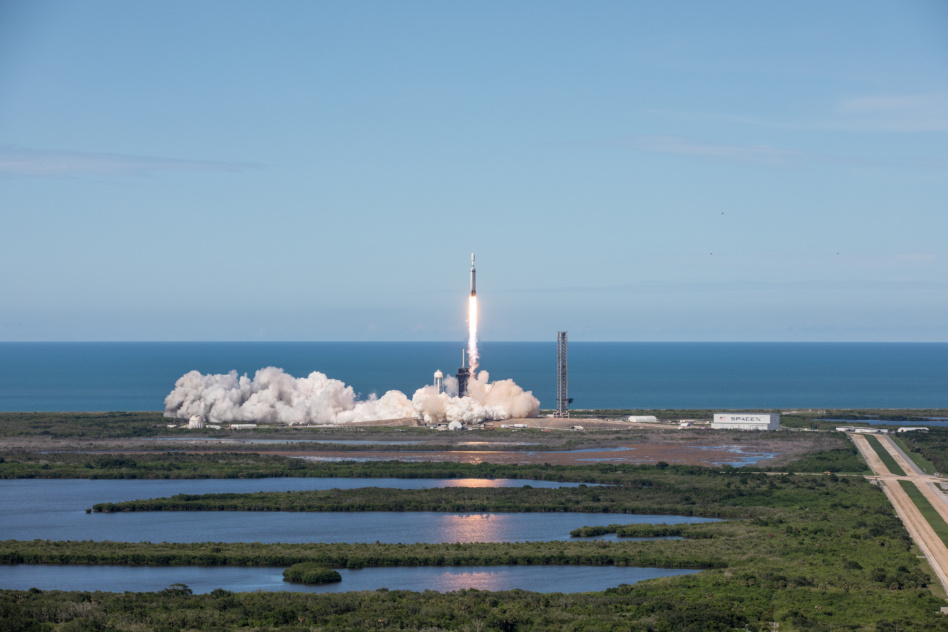
NASA may have selected SpaceX Falcon Heavy on Thursday to launch a rover to Mars, but the launch is far from a sure thing.
SpaceX is tasked to fly the ESA Rosalind Franklin rover as soon as late 2028, for a reported $175.7M. But the White House’s FY2027 budget request also suggests canceling NASA’s participation in the Mars mission. What comes next is anyone’s guess.
Science vs. schedules: ExoMars Rosalind Franklin is one of ~50 NASA science missions on the chopping block, the Planetary Society says, after the administration proposed a ~23% budget cut to $18.8B.
The Planetary Society and several members of Congress say they want the cuts reversed. Meanwhile, NASA—which always has a backup plan—likely went ahead with a launch reservation just in case the mission survives the next budget season.
This is actually NASA’s second attempt at an ExoMars ESA partnership.
- The US canceled previous ExoMars obligations during a tough budget year in 2012.
- ESA next tried partnering with Russia, but that fell apart after the Ukraine war.
- The newer NASA agreement from 2024 would see the US provide a launcher, an instrument, a descent braking engine, and components such as electronics.
SpaceX’s interplanetary era: Rosalind Franklin is a rare but notable deep-space mission for SpaceX’s Falcon Heavy. Some other examples include:
- The rocket’s debut launch in 2018 propelled a Tesla Roadster and astronaut mannequin to a heliocentric orbit. (SpaceX CEO Elon Musk also leads Tesla.)
- Europa Clipper, which made a 2024 launch to the Jupiter moon.
- The Nancy Grace Roman Space Telescope, expected to launch in October.
Few missions aside from the military or deep-space destinations, however, need this much rocket juice.
- Falcon Heavy hasn’t launched since 2024.
- SpaceX’s 165 launches in 2025 were all Falcon 9s, or test missions of Starship.
- Falcon Heavy’s manifest this year includes ViaSat-3 to GEO, and Astrobotic Technologies’ Griffin-1 to the Moon.

Exclusive: Kapta Space Raises $24M Series A to Build Moving Target Radar Payload
Seattle-based Kapta Space announced a $24M Series A to build next-gen radar payloads designed to track moving targets.
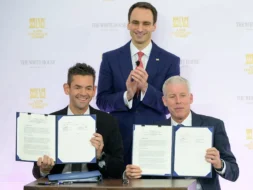
NASA Signs Space Nuclear Pact, Says Moon Base Is Ahead of Schedule
Isaacman gave updates at the White House’s “Science: A New Golden Age Summit.”

Europe’s Earth Observation Providers Set Their Sights on Satcom
Open Cosmos recently laid out plans for a 192-satellite comms constellation, and ICEYE announced a partnership with Nokia for its own comms satellite network.
The post Europe’s Earth Observation Providers Set Their Sights on Satcoms appeared first on Payload Pro.
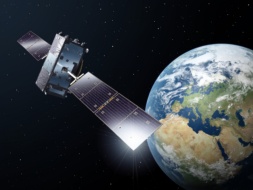
Europe’s Space Defenses Fall Just Shy of Weaponization
Europe doesn’t have any weapons in space—but that doesn’t mean the region is comfortable flying around in orbit defenseless.

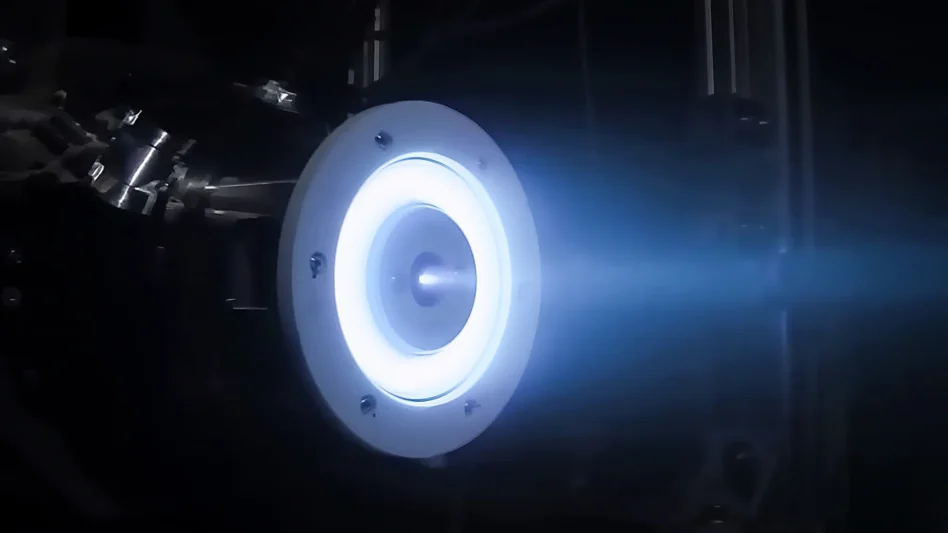
Rocket Lab continued this week to expand its business offerings beyond launch, with the introduction of a new spacecraft thruster—Gauss.
The electric thruster is intended to both support Rocket Lab’s own spacecraft programs, and to fill a gap in the industry. Thrusters are in high demand these days as commercial and government customers look to send more sats aloft, with the ability to maneuver in-orbit.
“Early technology development can be done at these small mom and pop shops, but when it really comes prime time to make things at scale, people like ourselves who are procurers of that, if they don’t vertically integrate, they get very nervous that they won’t have access to capital and expertise to scale production,” Rocket Lab CFO Adam Spice told Payload. “It’s all about derisking our ability to deliver on our commitments.”
Keep reading