


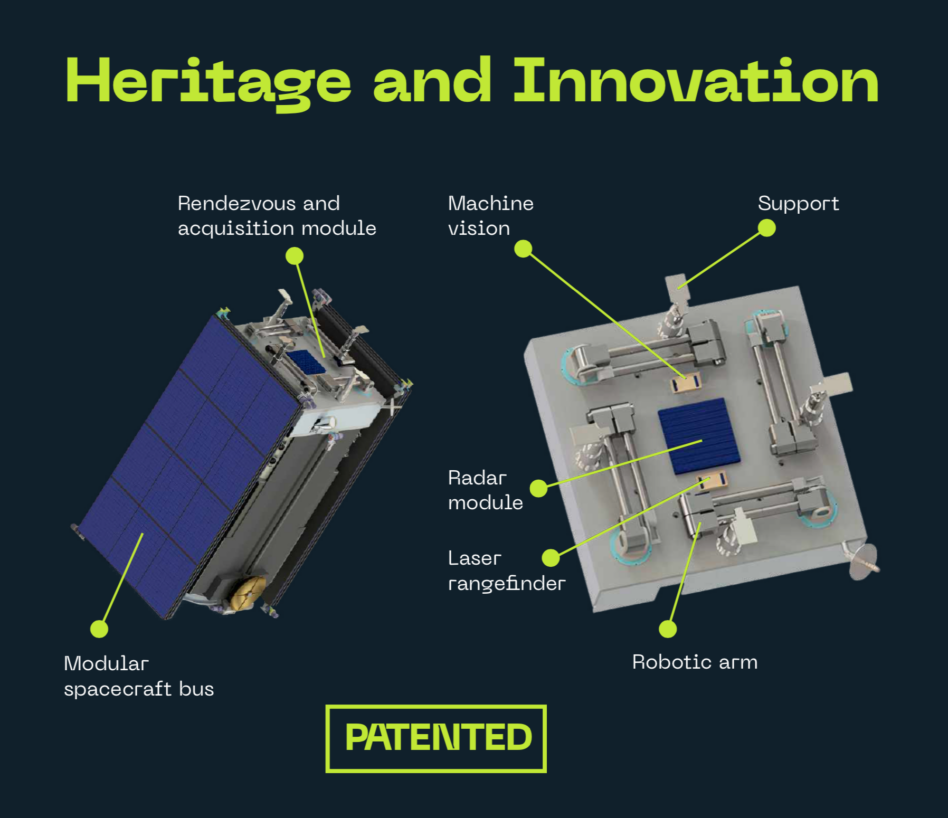
Ukrainian start-up Kurs Orbital has raised €3.7M($4M) to build and fly a prototype docking port for in-space servicing and debris removal missions.
How we got here: The company is a spin off from the Soviet-era Kiev Radio Factory, which used to build the autonomous Kurs docking system for Russia’s Soyuz and Progress spacecraft.
The collaboration with Russia ended after the annexation of Crimea in 2014, prompting engineers in Kiev to begin looking at opportunities to build a new range of products for western customers based on the Kurs legacy.
Funding details: The new funding comes from OTB Ventures, a leading European deep tech venture capital fund; Italian space-fund Galaxia; and In-Q-Tel, a US venture capital firm affiliated with the intelligence community.
Kurs Orbital will use the money to build a prototype and flight model of their docking port that will be ready to fly by the end of 2025, cofounder and CEO Volodymyr Usov told Payload.
“Our rendezvous and docking module is a standalone product that can be integrated with different types of spacecraft buses,” he said. “It uses a combination of different sensors including radar and laser range-finding that allows fully autonomous operations.”
Kurs Orbital 101: The company partially relocated to Turin, Italy, after Russia invaded Ukraine, though it maintains an R&D center in Kiev. The company, which was established in 2021, is part of the European Space Agency’s Business Incubation Center based in the
north-Italian city.
Kurs Orbital is a member of the DARPA-led Consortium for Execution of Rendezvous and Servicing Operations (CONFERS) and collaborates with several companies working on novel in-space capabilities, including Switzerland-based ClearSpace and US-based Orbit Fab.
“Our architecture is standardized so it can be almost mass produced rather than having to be custom-made for every single mission,” Usov said. “It can be scaled down for smaller satellites of about 100 kg or scaled up and fitted with more powerful radar systems for larger satellites in geostationary orbit.”
What’s next: Usov said he hasn’t yet decided what satellite will host the company’s demo mission. The firm, however, doesn’t expect to seek more funding until after that test flight.
Exclusive: Reflect Orbital Responds to its Critics
The space community is divided over whether Reflect Orbital’s sunlight-reflecting satellites are a bright idea.
Exclusive: Space Kinetic Awarded $50M for Space Maneuverability
Space Kinetic announced a $50M OTA award from the Space Force to develop Whirlwind—its space maneuverability and deployment system.
Astrolight, ATMOS Partner on Laser Comms Reentry Demo
Astrolight will fly a laser comms terminal onboard ATMOS’ PHOENIX 2 reentry vehicle during a 2027 demo mission.
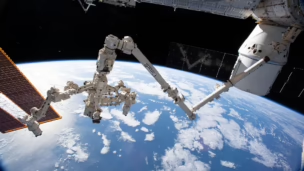
MDA Space Will ‘Repurpose’ Canadarm3 For Lunar Surface
MDA Space will “repurpose” its microgravity robot-arm tech for lunar surface operations after the US space agency put the Gateway plans on hold.

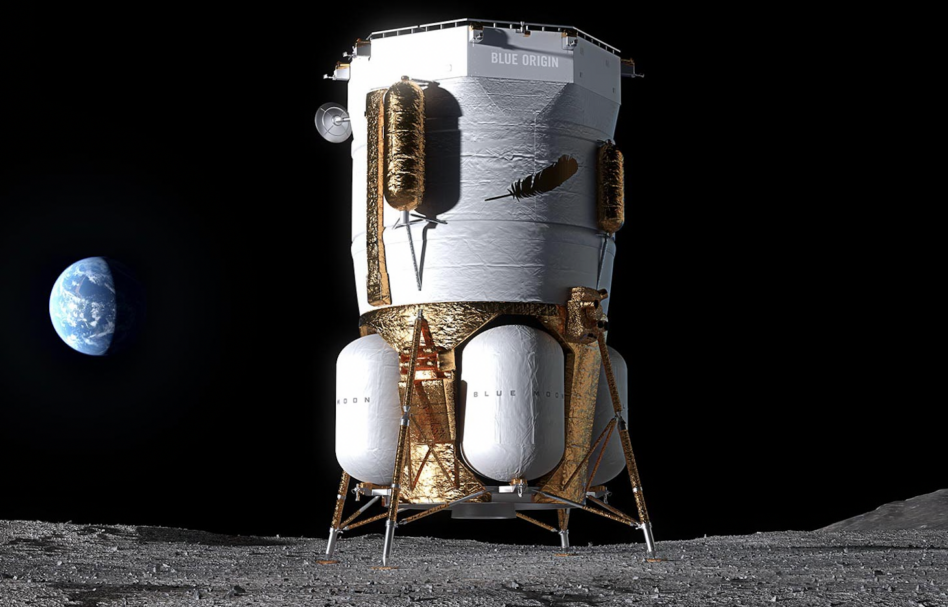
Blue Origin aims to land its Blue Moon Mark 1 cargo vehicle on the Moon next year, setting an aggressive timeline as it seeks to chart a new course of decisive action and big swings after not reaching orbit in its first two decades of operations.
“We are expecting to land on the Moon in 12-16 months from today,” Blue’s SVP of lunar permanence John Couluris told 60 Minutes last weekend.
The cargo lander can transport 3,000 kg to the lunar surface—30 times the capacity of most CLPS landers but smaller than Blue Origin’s crewed lander that will be used for Artemis V.
Keep reading