


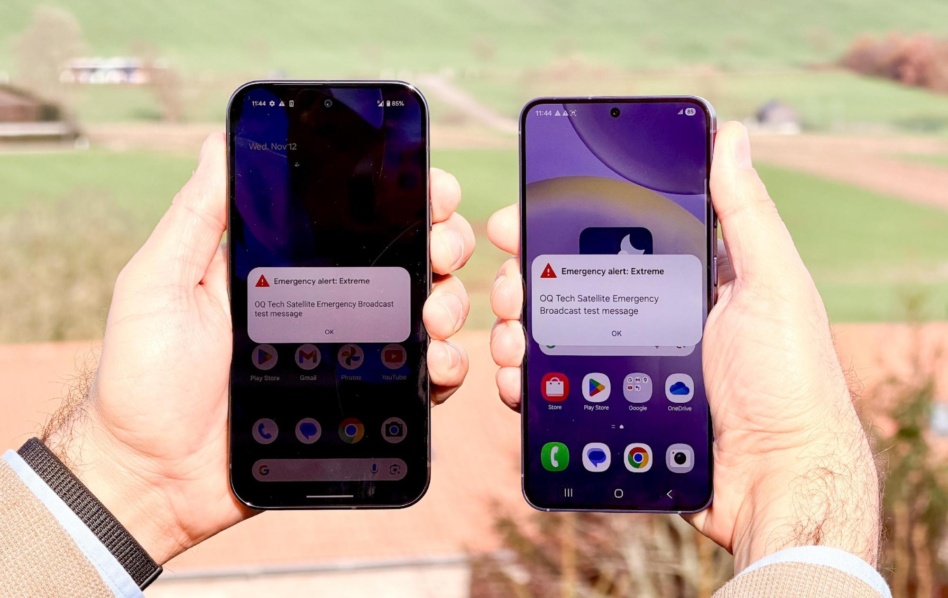
Luxembourg-based satcom startup OQ Technology sent a test emergency broadcast message from its satellites in LEO to mobile phones on Earth, marking the first time a European satellite operator has connected directly with cellular devices on the ground.
It’s not an industry first—satcom firms including Viasat, SpaceX’s Starlink, AST SpaceMobile and others have achieved direct-to-device (D2D) connections before. But OQ’s milestone opens the door for Europe to build its own sovereign D2D capabilities.
Emerging market: OQ, which operates 10 satellites in LEO, plans to offer emergency-messaging capabilities to governments and private enterprises in the short term, before rolling out a more capable network to consumers, governments, and industrial organizations in the years to come.
“D2D is very important. It’s a very big market with a lot of opportunities,” OQ CEO Omar Qaise told Payload. “We can offer this [emergency] service to any mobile operator that has a roaming agreement with us…followed then by the capability to send text messages between phones through OQ satellites, and then eventually also voice.”
OQ’s achievement comes at a time when Europe is boosting investment more broadly in sovereign communications capabilities. In August, OQ secured a €2.5M ($2.9M) grant from the European Innovation Council to test secure D2D messaging.
And it’s not the only company benefiting. Across Europe, governments have funded projects to make D2D a reality—including CNES’ U DESERVE 5G, ESA and the UK Space Agency’s SkyPhi mission, and, of course, IRIS2, which has a D2D component.
License to grow: For its part, OQ has spent years positioning itself as a viable partner to drive the commercial adoption of the new innovation. OQ owns a license to 60 MHz of MSS S-band spectrum, which is the same band that’s become the standard in 5G non-terrestrial networks.
OQ has used this license to form partnerships with Dutch telco KPN, Germany’s O2 Telefónica,and others to expand access to satellite based IoT networks across the continent. OQ also partnered with Aramco to strengthen the oil giant’s IoT connectivity in remote areas.
What’s next: OQ expects to grow its satellite constellation by an order of magnitude in the coming years. Qaise told Payload the company aims to launch 30 more satellites in the next two years, and field a 100-sat strong constellation further down the line.


Fenix Space Flies Tow-Launch Prototype
Fenix Space is one step closer to leaving the world behind.

SatVu Positions Thermal Imaging as the Missing EO Layer
SatVu is officially back in business.

Scout Space Closes $18M Series A
Plans for expansion include building a new satellite sensor factory outside DC, and nearly doubling Scout’s headcount in the next 18 months.

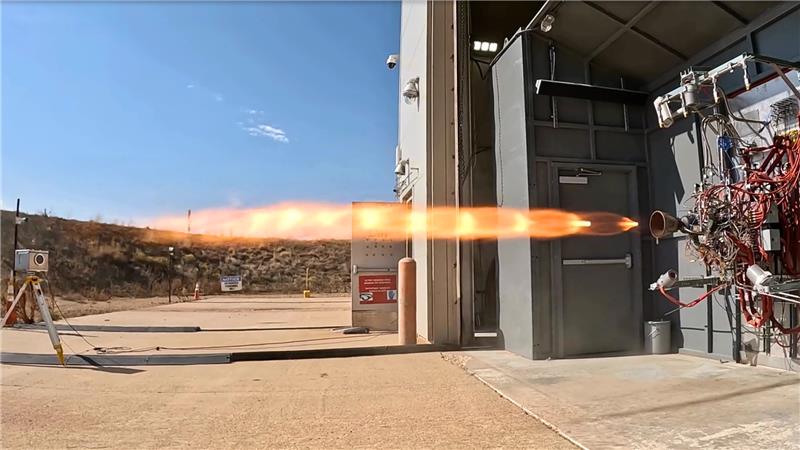
Ursa Major announced on Tuesday that it had closed a $100M Series E, which will allow the propulsion company to scale its manufacturing capabilities for its hypersonic, in-space propulsion, as well as its solid-rocket-motor tech.
Eclipse led the round, which also included participation from Woodline Partners, Principia Growth, XN, Alsop Louie Partners, and others.
“Ursa Major is doing what few others in defense have achieved—scaling manufacturing and supply chains to deliver hypersonic systems and advanced propulsion at industrial scale,” Lior Susan, a founding partner at Eclipse, said in a statement.
Keep reading