


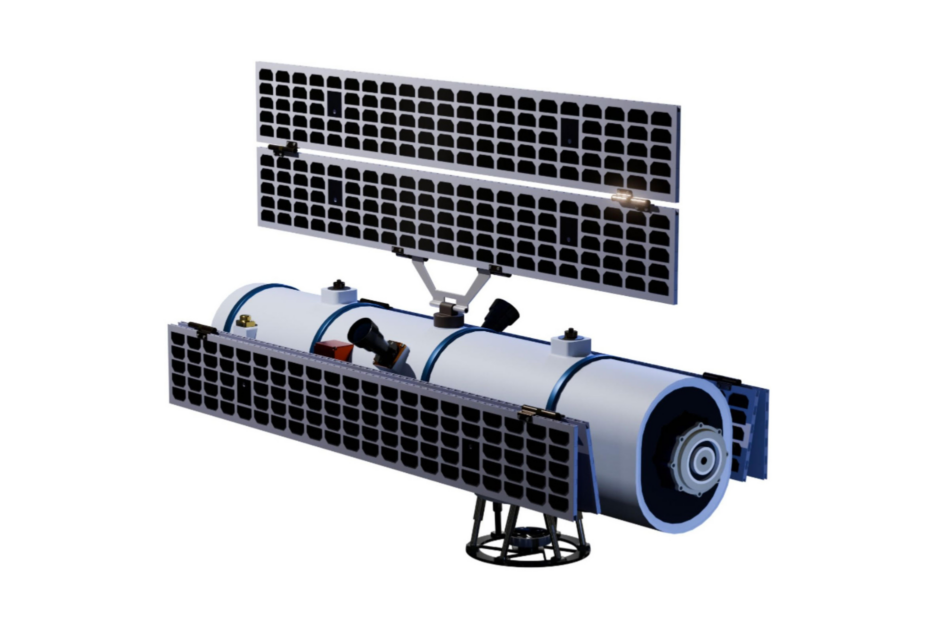
Bellatrix Aerospace is teaming up with Korean optical payload manufacturer TelePIX on a new VLEO demo satellite, launching NET 2028.
The satellite will combine new tech from both companies.
- Bellatrix will provide the satellite bus, the air breathing electric propulsion (ABEP) system, and systems for power, thermal and attitude control.
- The sat will be built around TelePIX’s high-resolution, wide-swath optical payload—called Chouette— which captures images more than twice the width of comparable sats, according to TelePIX.
Expansion planning: The deal is the latest international agreement for India-based Bellatrix, which has been steadily increasing its international footprint during the past few years—and raised $20M in March for in-space propulsion tech.
- In April 2025, Bellatrix opened up a US subsidiary, and announced plans to open a US satellite-production facility.
- Bellatrix has also signed agreements with Astroscale Japan and NewSpace India Limited (ISRO’s commercial arm).
But expansion isn’t only coming in the form of international contracts.
- Bellatrix’s long-term vision includes more satellites and propulsion systems—including ultra-LEO platforms designed to fly below 200 km, as well as orbital transfer vehicles—and multiple propulsion modes fit for various mission sizes.
- For TelePIX, which supplies optical payloads to LEO sats, the mission is the first step for a new campaign to carve out international market share in the growing VLEO space.
The satellite is expected to fly at an altitude of 180 km to 230 km to enable significantly higher-resolution imaging capabilities, compared with flights in LEO. The mission’s goal is to validate future constellation-scale deployments in VLEO—potentially driven by larger, more capable satellite platforms.
“We see this as the beginning of a much larger opportunity,” Bellatrix cofounder and COO Yashas Karanam told Payload via email. “There is growing demand for technologies that can enable sustained operations in the 180–250 km altitude range, and we expect this to translate into additional partnerships and missions in the years ahead.”
Getting warmer: The mission will give Bellatrix a chance to continue its development of more capable VLEO-ready satellite technologies. Bellatrix’s first full satellite, called Harbinger, launched to orbit on SpaceX’s Transporter-16 in March, where Bellatrix demoed multiple in-house designed components for the first time including its attitude-determination-and-control system.
“Bellatrix is among the very few companies globally working on [ABEP] technology,” Karanam said. “We believe that truly unlocking the long-term potential of VLEO requires a propulsion-first approach, and that is where Bellatrix has made its deepest investments and achieved some of its most significant technological milestones.”
ArbaLabs Launches AI Verification Demo On South Korea’s Nuri Rocket
“In short, tons of companies are looking at the latest and greatest physical AI deployments,” ArbaLabs CEO Ashley Reeves told Payload. “Nobody is really thinking about putting some checks and balances on what these AI models are doing.”
HawkEye 360 Turns its RF-Sensors to Orbital Targets
The DoD wants to better understand what’s going on in orbit. HawkEye 360 ($HAWK) has the inside scoop.

Turkey Uses IAC Stage to Pitch Peace & Homegrown Hardware
During the 2026 IAC in Antalya, representatives from Turkey are leveraging the opportunity to showcase the country’s prgoress in space.

Nebex Partners with Thrusters Unlimited to Unlock $700M for Mexico’s Space Ecosystem
The capital will fund EO, telecoms and other strategic capabilities, according to Nebex.


Parts of the space industry are generating huge amounts of data—but that data isn’t reaching decision-makers for the future space economy.
Open eyes: Launch cadences, debris accumulation rates, reusing hardware, conjunction events—the commercial sector is generating more operational signals than any previous era of space activity. However, the mechanism that decides whether a signal reaches a decision-maker or disappears into the background noise is broken.
I have been sitting in the rooms where this economy is being designed—including in The Consortium for Execution of Rendezvous and Servicing Operations’ (CONFERS) Circular Space Economy Special Interest Group. We have seen the space industry building toward reuse, resource loops, and sustainable orbital operations. But I have also watched decision-makers miss the signals that mattered most.
Keep reading