


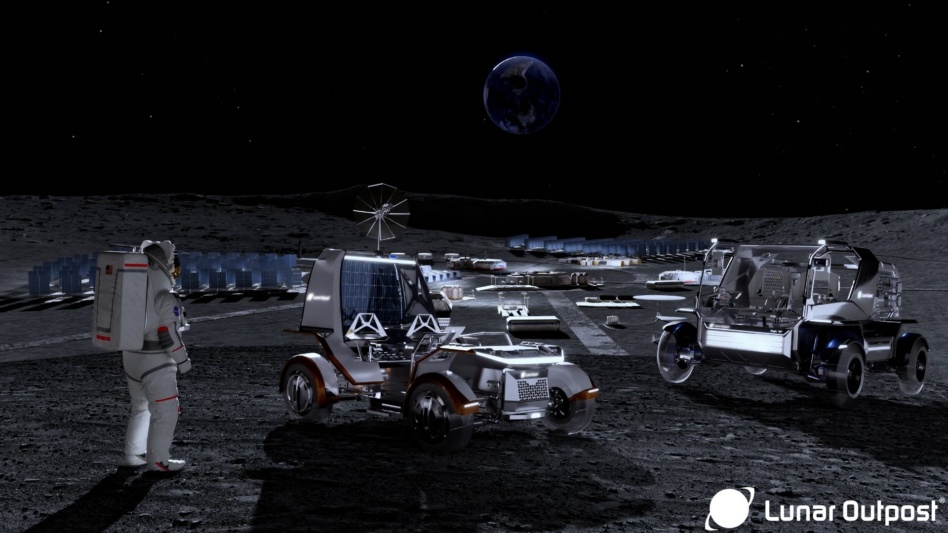
The chip race and the race back to the Moon race have just crossed paths.
Lunar Outpost, the CO-based lunar rover startup, announced plans yesterday to fly NVIDIA chips on its upcoming lunar missions.
- Lunar Outpost will carry an NVIDIA Jetson AI chip on its MAPP rover for the company’s Lunar Voyage 2 mission, which is planning to launch this year.
- Lunar Outpost will also leverage NVIDIA’s upgraded Space-1 Vera Rubin module on Lunar Voyages 3 and 5, both expected to fly before the end of the decade.
Smart car: Lunar Outpost intends to use the AI chips to help its rovers operate autonomously on the lunar surface, and ease the communications pipeline between Earth and our nocturnal neighbor.
If space is hard, operating on the Moon is next to impossible. The distance between lunar vehicles and terrestrial control centers creates a lot of latency in the flow of information, which makes remotely operating a lunar vehicle or downlinking large quantities of data especially challenging.
To get around this bottleneck, Lunar Outpost is relying on NVIDIA chips to give more autonomy to its rovers, and greater onboard processing power to compress and send large data files.
- On Lunar Voyage 2, the company’s MAPP rover will use the NVIDIA chip to control the rover’s lidar system, and handle processing of sensor data to ease the communications pipeline between Earth and the Moon.
- On later missions, the upgraded Space-1 module will be able to ingest and analyze larger quantities of sensor data, helping future Lunar Outpost rovers create real-time Moon maps, plan autonomous pathways to traverse, and operate without humans in the loop.
NVIDIA’s Space-1 processor will also be able support real-time video streaming, offering new high-res views of the lunar surface.
Bag of chips: Beyond the first demo, the partnership has potential to boost both companies. Lunar Outpost has 10 missions to the Moon and cislunar space planned to fly before the end of the decade, and if all goes well, the company will later deploy a fleet of rovers to help the US set up a permanent Moon base.
While many iterations of Lunar Outpost’s rovers come equipped with seats for astronauts, the company’s aim is to have its rovers operate with or without bums in seats. When equipped with NVIDIA chips, these rovers are designed to help NASA set up its permanent Moon base outside of crewed missions.
Satellogic Expands DoD Work As it Preps for Next Launch
Satellogic is gearing up to launch its latest batch of satellites next month, potentially including the company’s first Merlin sat, which is designed to gather constant 1-m-resolution EO imagery.
Tomorrow.io Unveils Next-Gen Weather Forecasting Instruments
Tomorrow.io announced the five instruments that will fly aboard DeepSky—its next-gen constellation built for real-time global atmospheric monitoring.

Space Weather Losses to Double by 2035, Report Finds
A new report from Mission Space estimates that solar storms will cost $20.65B in 2026, rocketing to $44.27B by 2035.
Exclusive: City Labs Plans Second Nuclear Demo
Following the success of City Labs’ first nuclear-powered betavoltaic demo, City Labs is planning a demo of its radioisotope heating unit.


This content is restricted to subscribers
The post A Deep Dive into the Bluetooth Satellite Connectivity Market Following the FCC’s Proposal appeared first on Payload Pro.
Keep reading