


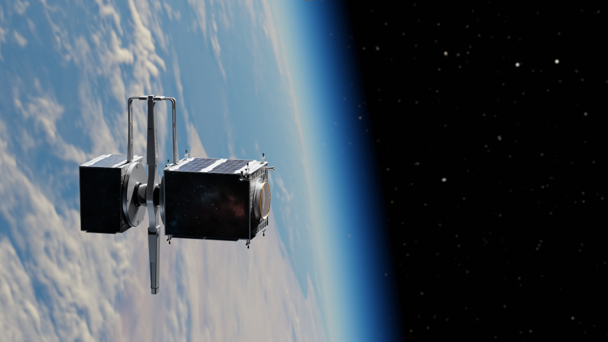
Cheap, swarming, and potentially disposable—all words used in drone economics and now one startup wants to apply them to space.
On Thursday, Space Kinetic announced a $50M OTA award from the Space Force to develop Whirlwind—its space maneuverability and deployment system. It’s the largest award yet for the company, which raised a $12M seed round in 2025.
“Our specific thesis is that the third space age demands better maneuverability, scalability, and marginal economics,” Space Kinetic cofounder and CEO Ryan Sullivan told Payload. “Space Kinetic is building an architecture where one space vehicle can enable a lot of different missions and allow for capabilities to be distributed where and when they’re needed.”
Slingshot physics: Whirlwind flings small, ruggedized microsatellites from a host spacecraft at high velocities—without firing a thruster. The microsatellites carry their own propulsion and comms, but Whirlwind provides the majority of the initial Delta-V electromechanically, sidestepping the rocket equation.
“I like to call it the space-based David sling,” Sullivan said. “We’re using centrifugal acceleration, and that’s something that as a species we’ve been doing for a couple millennia.”
Sullivan said the company has spent years working with government partners to confirm the physics before maturing the hardware.
Drone math: Bringing drone economics to orbit means payloads need to be cheap, responsive, and attritable. By decoupling the payload from the space vehicle, Space Kinetic aims to shift the burden of maneuver from the payloads to the host—minimizing mass, cost, and complexity.
“We think of traditional satellites as assets that largely are going to have multi-year useful lives,” Sullivan said. “We’re saying, if it’s going to be cheap enough, what if the useful life is 30 minutes? What could you do with that?”
Payload agnostic: Whirlwind is both regime- and payload-agnostic.
The company envisions dual-use missions including:
- Sensor payloads for SDA or EO,
- Science probes,
- Rapid-response comms nodes,
- Debris characterization.
In November, Space Kinetic received a multi-million dollar DARPA contract to accelerate its architecture for asymmetric space-based missile defense and was selected for the SpaceWERX Adaptive and Intelligent Space Challenge in July.
Scaling up: The company has yet to announce a timeline for testing Whirlwind on orbit, focusing instead on maturing the tech and integration talks with partners.
It’s also hiring hard with an already 50-person team, building out an El Segundo presence while maintaining New Mexico roots, including an Albuquerque prototyping lab and a multi-year Los Alamos National Laboratory partnership.
“We’re spending a lot of time growing the team and thinking about how to continue to hire folks who have institutional knowledge and know how to build space programs,” Sullivan said. “But also have a degree of flexibility, creativity, and curiosity that is a prerequisite when you’re trying to build something fundamentally new.”
Exclusive: In Orbit Aerospace Pivots From Re-entry Vehicles to Spacecraft Autonomy
In Orbit has won new government contracts for its onboard AI system, which the company says can run a spacecraft’s operations without waiting on ground control.
Reflect Orbital Buys Two Skyroot Aerospace Launches
Reflect Orbital announced the purchase of two launches today from Indian launcher Skyroot Aerospace.

Fortastra Raises $30M Series A to Fund its Next Security Spacecraft
The US military has weapons in space, and—with the orbital arsenal expanding—security is becoming a top priority.
Exclusive: Xona Ramps Up Production Ahead of Pulsar Launch
With FCC approval in hand and six sats ready for the pad, Xona is turning to its next challenge: building the next 250.


This content is restricted to subscribers
The post How to Pitch the Space Force: Green and Red Flags appeared first on Payload Pro.
Keep reading