


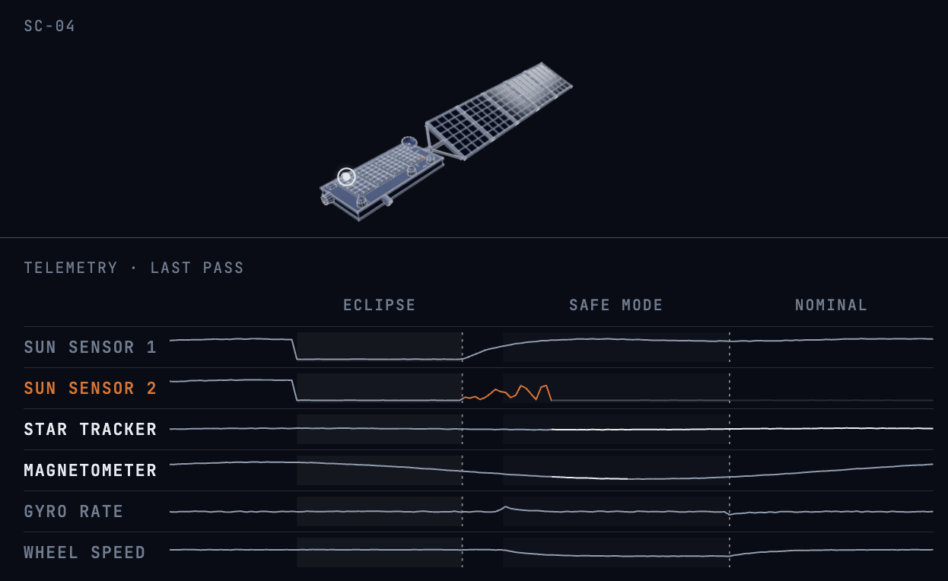
In Orbit Aerospace has swapped reentry vehicles for autonomy software, and NASA and the Space Force are funding the shift.
The Torrance, CA-based startup has won new government contracts for its onboard AI system, which the company says can run a spacecraft’s operations without waiting on ground control.
“We’re scaling to the point where you simply can’t have one, or even more, ground operators monitoring the satellite,” In Orbit CTO and cofounder Ishaan Patel told Payload. “When the problem scales that far, I think we need to have an increased sense of autonomy for the vehicle.”
Ground control: In Orbit was founded in 2020 as an in-space logistics company building reentry vehicles. However, with a handful of companies already working building the return route from space, the team felt that the market just wasn’t ready for another player.
“We were just slightly too late,” In Orbit CEO and cofounder Ryan Elliott told Payload.
The team pivoted to tackling a different reentry problem. Plasma around a returning vehicle can cut off GPS and comms, so if something goes wrong mid-descent—such as one side of the vehicle overheating—no one on the ground can see it or react in time.
In Orbit’s proposed fix is onboard autonomy software and ground interface for operators—dubbed INTELLACT.
- The software-only system is designed to manage spacecraft health, execute maneuvers, and respond to anomalies onboard, using a vehicle’s existing hardware.
- On the ground, INTELLACT feeds operators context, and recommends next steps instead of raw telemetry.
- INTELLACT is slated to debut in Q1 2027 on the AFRL/NASA HyperSTEP mission, running in shadow mode.
Patel said the aim is to move humans from “in the loop” to “on the loop,” where “the ground operator is the architect of the mission.”
The company is also building StratoDrop—an autonomous paraglider that deploys from high-altitude balloons to deliver cargo. In Orbit had raised ~$2M in venture funding prior to the autonomy pivot and could raise again within six months, Elliott said.
Money moves: In Orbit’s latest awards include a NASA Phase I SBIR for spacecraft swarms, and a SpaceWERX Phase I STTR focused on LEO constellations.
The latter came through the Space Force’s Adaptive and Intelligent Space (AIS) Challenge—which funds early research into satellites that can operate autonomously in degraded or contested environments. In Orbit’s proposal was one of ~29 selected from 300+ submissions this summer.
Both awards build on a $1.8M Phase II STTR that funded INTELLACT’s development for reentry and hypersonic vehicles. Next up are commercial pilots. “We’re at the point now where we can go to commercial companies,” Patel said.
Crowded skies: Satellite autonomy is suddenly a busy lane.
- Shield AI and Sedaro tested Shield AI’s Hivemind AI pilot on a NOVI satellite in August.
- Orca Aerospace, a Y Combinator-backed startup, says it’s building AI that controls satellites through deterministic tooling.
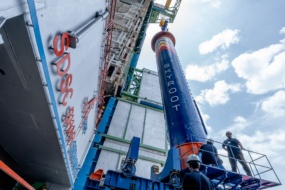
Reflect Orbital Buys Two Skyroot Aerospace Launches
Reflect Orbital announced the purchase of two launches today from Indian launcher Skyroot Aerospace.

Fortastra Raises $30M Series A to Fund its Next Security Spacecraft
The US military has weapons in space, and—with the orbital arsenal expanding—security is becoming a top priority.
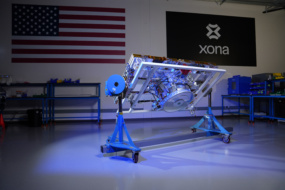
Exclusive: Xona Ramps Up Production Ahead of Pulsar Launch
With FCC approval in hand and six sats ready for the pad, Xona is turning to its next challenge: building the next 250.
ArbaLabs Launches AI Verification Demo On South Korea’s Nuri Rocket
“In short, tons of companies are looking at the latest and greatest physical AI deployments,” ArbaLabs CEO Ashley Reeves told Payload. “Nobody is really thinking about putting some checks and balances on what these AI models are doing.”


Reflect Orbital, the startup attempting to offer sunlight on-demand with in-space mirrors, announced the purchase of two launches today from Indian launcher Skyroot Aerospace.
The deal includes:
Reflect Orbital did not disclose the cost of each launch, or when the missions would fly.
Keep reading