


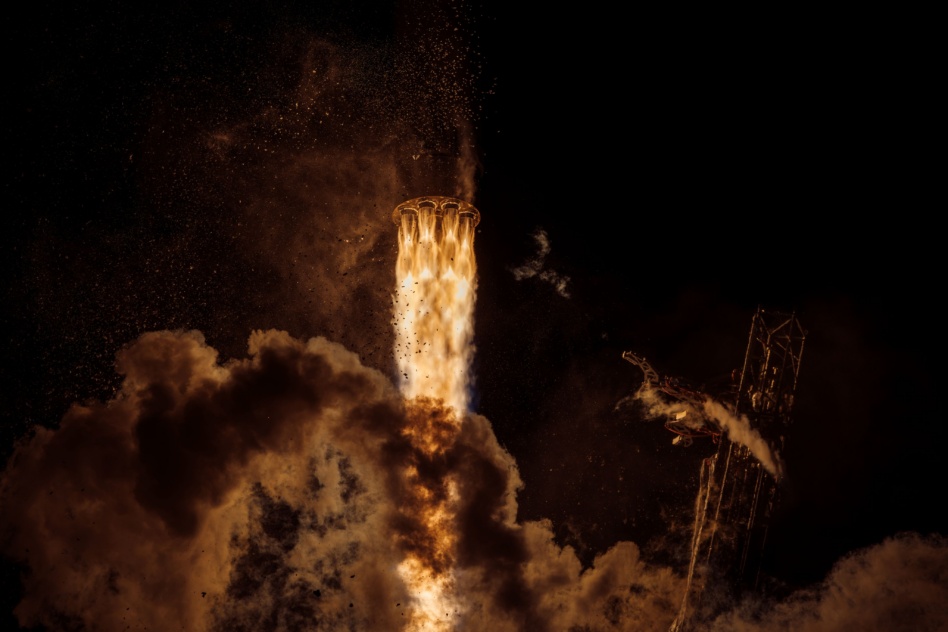
PARIS, FRANCE—Isar Aerospace became the first European launch startup to reach orbit less than two weeks ago, and already the market is demanding more.
Launch integrator SEOPS announced a multiple launch service agreement with Isar yesterday covering five dedicated Spectrum launches between 2028 and 2030. The launches will fly from Isar’s launch site at Andøya Space Center in Norway, as well as its launch pad in Nova Scotia, Canada, which is still under development with the help of partner Maritime Launch Services.
The launches will be part of SEOPS’ growing Waymaker program, which is intended to provide more rideshare availability to the market as SpaceX ramps down its Transporter missions.
Building the manifest: SEOPS purchased its first dedicated launch on Spectrum in November 2025, and SEOPS President Evan Hoyt told Payload that the five-launch contract was signed the day before Isar’s first orbital flight. Hoyt said SEOPS has had the “utmost confidence” in the Isar team for years, but that, ultimately, Isar is just one piece of its increasingly diverse portfolio of launch options.
“It’s quite evident that there’s a sunset period…on the horizon [for Transporter],” Hoyt said at a press conference. “Whatever happens with Falcon 9 is not changing our business model in the future…We really believe that resiliency has to be a global solution—it has to be a portfolio of rockets available to customers.”
And while other launch integrators have announced deals this week purporting to increase the availability of rideshare slots—including Exolaunch and Maverick Space Systems—SEOPS’ deal might represent the largest increase in supply, as announcements from other integrators have often come with anchor customers having secured most of the available space.
What’s next: Isar has entered into scale up mode following its first successful orbital flight to meet the launch timeline of the SEOPS deal.
The company is planning to fly its first fully commercial mission next year, as part of a total manifest of four flights in 2027. From there, the company plans to double its launch cadence in 2028, and is commissioning a new production facility near Munich, Germany, which will be capable of churning out as many as 40 launch vehicles annually.
The scale-up couldn’t come soon enough for the industry, which has found itself in “panic mode,” following the news that SpaceX has paused bookings for its Transporter rideshare missions beginning in late 2028 or early 2029, according to Isar’s Chief Commercial Officer Stella Guillen. Unfortunately, there’s so much demand for launch that no one company can satisfy it all.
“If we were to meet our demand right now, we would need close to 200 vehicles in 2028,” Guillen said at a press conference yesterday. “What we’re trying to do is scale up as much as we can and bring them to launch as quickly as we can.”
Correction: This article was updated to correct Evan Hoyt’s title. He is the President of SEOPS.
Maverick Books 10 Kepler Sats to Fill Excess Capacity On Portal’s Dedicated Launch
Everybody’s looking for launch capacity these days, and for those who have it, the phones are ringing off the hook.

Kuva Space Spots Illegal Poppy Farms from Orbit
Kuva Space released data today from a pilot program that demonstrated its ability to monitor illegal crop farming from space.

International Space Summit Highlights the Strength of Europe’s Space Ecosystem
Efforts by the US government to rain on Europe’s parade this week backfired.
Eutelsat Taps Infinite Orbits for GEO Life Extension Mission
Eutelsat announced an agreement today tasking the Infinite Orbits with increasing the life span of at least one of its GEO sats.


What’s cheaper than building your own constellation? Splitting one.
On Monday, Space42 and Viasat agreed to formally establish Equatys, a shared satellite-and-ground-infrastructure company for D2D connectivity and advanced mobile satellite services.
The cofounders plan to commit up to $1B in equity, $800M of it once the company is formed.
Keep reading