


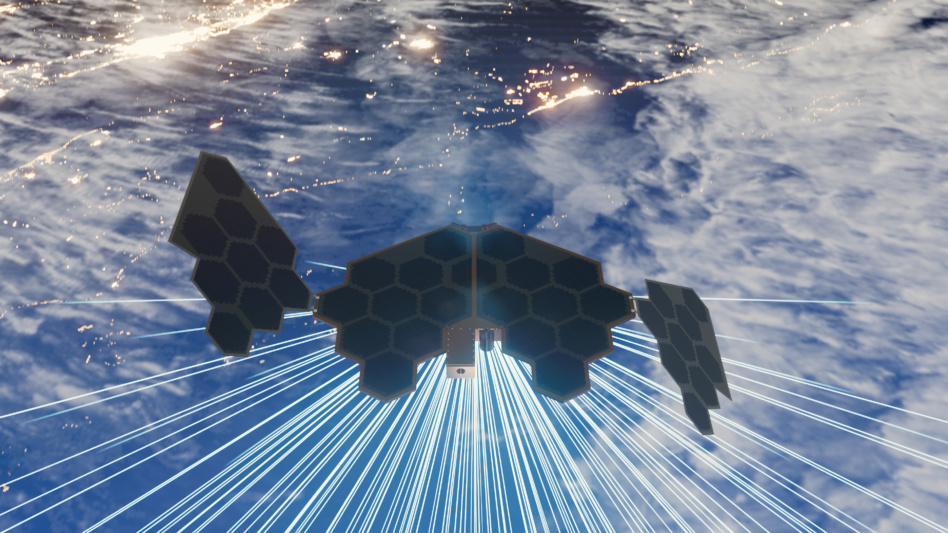
SpinLaunch, the CA-based startup best known for its development of a kinetic launch system, has been working on satcom technology since 2020—under a unit later called Meridian Space.
As of today, those business lines are going their separate ways.
“SpinLaunch and Meridian Space are separating into two independent companies,” Meridian Space CEO Massimiliano Ladovaz told Payload. “Meridian will carry forward the satcom infrastructure business…SpinLaunch will continue to build on its vision for a lower-cost approach to launch, with further applications in hypersonics to support the Golden Dome program and in the lunar economy.”
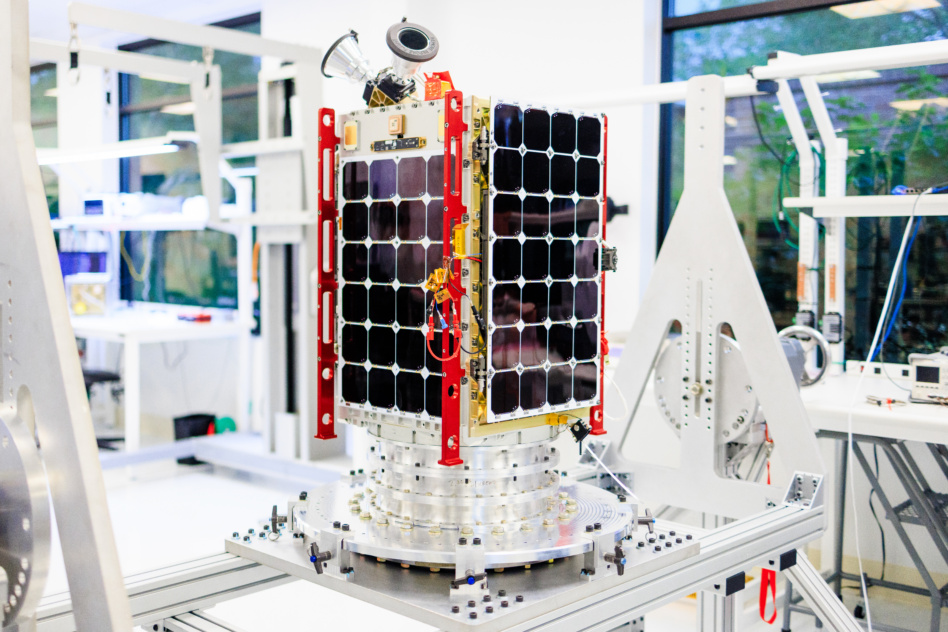
Call me maybe: The split comes just weeks before Meridian’s first in-space demo, which is expected to launch on SpaceX’s Transporter-18 rideshare NET Oct. 1.
The sat aims to demonstrate the first customer link of Meridian’s in-house-developed reflect-array technology, which company officials say uses less power than existing satcom payloads. With less power and space needed to operate and house the antenna, Meridian officials believe the company can fly satellites that are lighter and smaller than other satcom sats in the market—and pass those savings onto customers.
“Power is the thing that you want to preserve in space,” Ladovaz told Payload. “[If] you can deliver very high capacity, very flexibly, at a fraction of the power…then the satellites can be very small, and therefore, you can launch them in fewer launches.”
Meridian’s long-term goal is to fly its reflect-array antenna on flat satellite buses, making the deployment of a full 250+-sat-constellation possible on just one dedicated launch. In the shorter term, however, Meridian is offering customers the ability to fly the payload on traditional cubesat buses—under a program called Meridian Express, which could be ready to launch next year.
Go fast, go alone: Meridian is actively working on signing its first customers, according to Ladovaz. The company is targeting sovereign governments, regional operators, and telecom companies who want to own and operate a satcom network independently.
At a time when those wanting to own their own satcom networks are forced to either sign on to global networks like SpaceX Starlink or Amazon Leo, or spend potentially billions to build their own, Meridian aims to offer customers a third path. Meridian’s technology is designed to be built easily by partners. So while Meridian has signed a deal to build its first batch of sats on NanoAvionics buses, the tech opens the door for sovereign-satcom systems to be built in any country a future customer might want.
“This is about ownership, control, and the fact that we sell custom-made systems to customers,” Ladovaz told Payload. “We can build a system for less than a billion dollars. That includes the space segment, launch, and ground.”
To the Moon: SpinLaunch will share more details about its “leadership, vision, and plans in the near future,” according to Ladovaz. However, the company was awarded a patent last year—covering a kinetic launcher “anchored on to a planetary body with a rarified atmosphere…”—suggesting SpinLaunch’s future may lie off-world, sending payloads from the Moon back to Earth, or further into deep space.

Starship Reaches Orbit on 14th Test Flight
After reaching orbit, Starship deployed 26 V3 Starlink sats over about 30 minutes using its ‘Pez dispenser’ system.
Rocket Lab CFO Adam Spice Predicts More M&A Deals on the Horizon
Iridium shareholders voted overwhelmingly to approve the company’s acquisition by Rocket Lab. According to Rocket Lab CFO Adam Spice, there’s more M&A on the horizon.
TRL11 Will Build Imaging Tech for SR-1 Freedom
TRL11 has received a NASA contract to provide imaging systems for the Space Reactor-1 (SR-1) Freedom mission to Mars.
InnerPlant’s Glowing Soy Demos Hyperspectral Use Case
InnerPlant, which was founded in 2018, has enabled plants to let humans know when they’re under stress.

Last fall, Star Catcher beamed power down a runway in Florida. Now, the company wants to try the same thing between two spacecraft moving at roughly 27,000 km/h.
The company announced today that its prototype power node—dubbed Protostar—is prepped for SpaceX’s Transporter-18 launch, launching NET Oct. 1.
Protostar will attempt to beam power between two untethered spacecraft for the first time—a critical step to scale Star Catcher’s orbital energy-infrastructure ambitions. The team aims to get an operational grid in orbit by the end of the decade.
Keep reading