


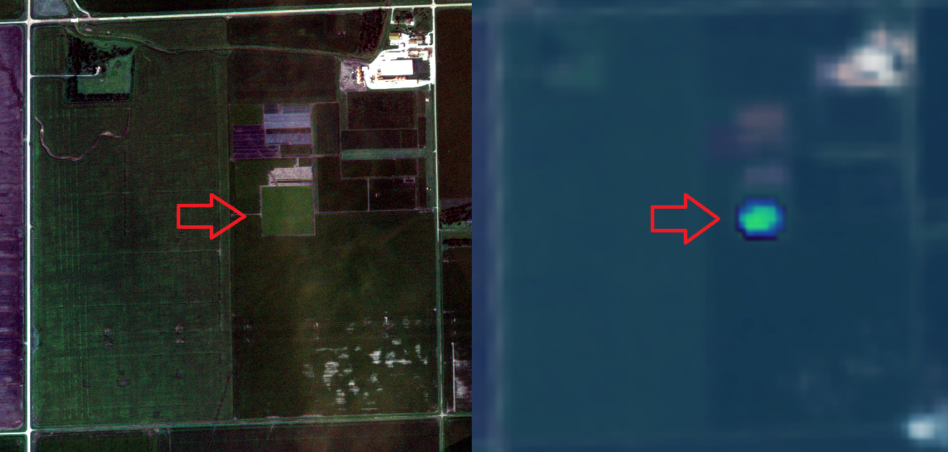
To the human eye, a soybean field could look perfectly healthy. To a hyperspectral satellite, however, the plants could be emitting a glowing warning signal that they’re in trouble.
Let it glow: InnerPlant, which was founded in 2018, has enabled plants to let humans know when they’re under stress. The company’s first product is genetically engineered soybeans that glow when they’re facing stress—specifically in this case, a fungal infection.
While the fluorescence can be picked up with ground-based sensors, the company is designed to use space assets to spot problems faster, and survey large areas of crops for potential issues.
“The idea of space was always baked in,” Sean Yokomizo, InnerPlant’s VP of comms, told Payload. “There are technologies where you can just put a clip on a leaf, and get the same readings. But doing that in a field of a thousand acres, with hundreds of millions of soybean plants in there, it’s restricted…That’s why we first started looking at space very early.”
We know you’re wondering: Let’s just get two big questions out of the way before we get into the details.
- Spotting the fluorescence takes specialized equipment, and won’t be visible to the human eye.
- The engineered plants are safe to eat. InnerPlant relies on a fluorescent protein that’s been known about and used for a long time, and the company already has USDA approval.
Keeping tabs: InnerPlant’s data is already being used by farmers today, though they’re not actually planting the seeds that will produce glowing plants yet.
- InnerPlant has planted plots of soybeans engineered to glow during fungal infection.
- Each plot has a ground-based detector that can spot the plant’s SOS signal.
- If InnerPlant detects an active mold outbreak in any of its plots, it sends a notice to farmers growing nearby, since diseases tend to follow geography, Yokomizo said.
- Each plot is designed to mimic the nearby farms, including soil type, topography, and row spacing.
Around 50 farmers used the service in summer 2026, which grew to 160 to 180 customers in summer 2026, Yokomizo said. InnerPlant provides farmers actionable data—not raw images—to keep the process as simple as possible.
“Recent history is replete with the tombstones of startup ag-tech companies that tried to give too much data to farmers,” Yokomizo said. “We’re not giving them reams and reams of data. We’re telling them, ‘Hey, this area over here is hot for this disease.’”
Helping hands: InnerPlant officials initially thought they needed to build their own satellites, Yokomizo said. But Brandon Rasmussen, head of detection science at InnerPlant, joined the team after a stint working on the Tanager hyperspectral program at Planet Labs. He showed that there were already the necessary assets in space, which allowed InnerPlant to focus on the plant problem.
InnerPlant conducted its first demo in Argentina between December 2023 and March 2024. That demo relied on tasking DLR’s Environmental Mapping and Analysis Program (EnMAP) hyperspectral satellite, and the DLR Earth Sensing Imaging Spectrometer (DESIS) aboard the ISS. All the hardware was able to spot 10 acres of “calibrator plants” that have been engineered to glow constantly. That demo proved that the company could spot its stressed plants among fields of commercial soybeans, Rasmussen said.
InnerPlant conducted a similar demo in summer 2024—but made their job harder. The company planted its fluorescent soy in fields in North Dakota, Missouri, and Iowa. In this demo, InnerPlant-engineered plants were mixed among commercial soy, proving the company could detect problems even at the pixel level, Rasmussen said.
“A big part of my work here is figuring out all of the different ways that we can do detection,” Rasmussen said. “The reason hyperspectral is interesting—this is a great use case for it—is the resulting power and specificity that it brings. But ultimately we want scalable and differentiable detection at all scales.”
What’s next: The company is working through the process of deregulating with the FDA, which they expect to be done by 2030. After that, farmers will be able to plant acres and acres of soybeans that can glow under stress. That’s the point at which satellites will become required to keep tabs on such large areas.
Nebex Partners with Thrusters Unlimited to Unlock $700M for Mexico’s Space Ecosystem
The capital will fund EO, telecoms and other strategic capabilities, according to Nebex.
Exclusive: Meridian Space Spins Out from SpinLaunch
“Meridian will carry forward the satcom infrastructure business… SpinLaunch will continue to build on its vision for a lower-cost approach to launch, with further applications in hypersonics to support the Golden Dome program and in the lunar economy,” Meridian Space CEO Massimiliano Ladovaz told Payload.
Rocket Lab CFO Adam Spice Predicts More M&A Deals on the Horizon
Iridium shareholders voted overwhelmingly to approve the company’s acquisition by Rocket Lab. According to Rocket Lab CFO Adam Spice, there’s more M&A on the horizon.

HEO Raises $25M Series B to Fuel GEO Expansion
HEO, the Australian non-Earth-imaging startup, announced Monday it closed a $25M Series B to expand its imaging network to GEO.

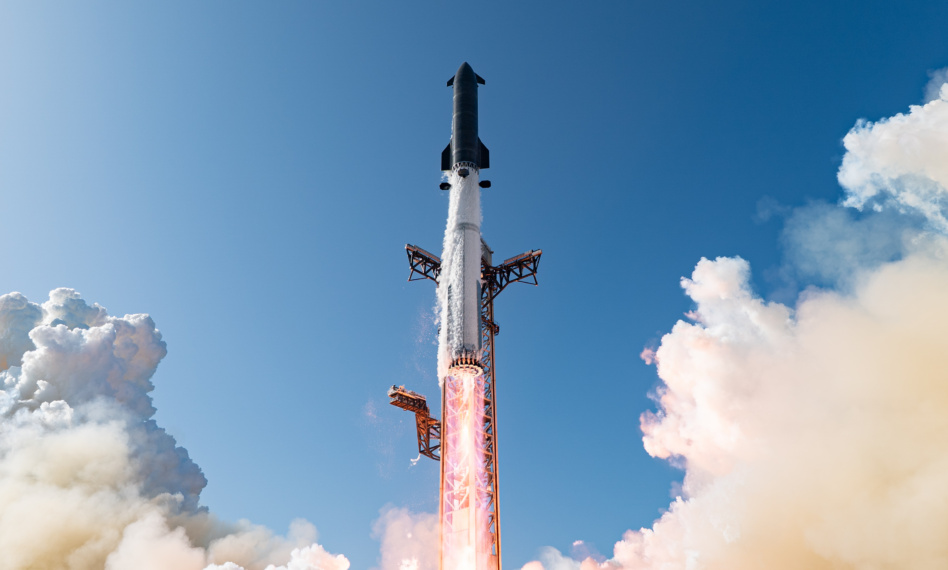
German launch integrator Exolaunch signed an agreement to support customer payloads on a SpaceX Starfall reentry mission scheduled to launch on a Starship NET 2029, the company announced today.
The deal marks Exolaunch’s first time supporting payloads on an Earth-return mission, as well as the company’s first commitment to Starship.
What goes up: Under the agreement, Exolaunch will serve as the payload integrator, filling the vehicle with customer payloads spanning biotech, pharmaceutical, and in-space manufacturing applications.
Keep reading