


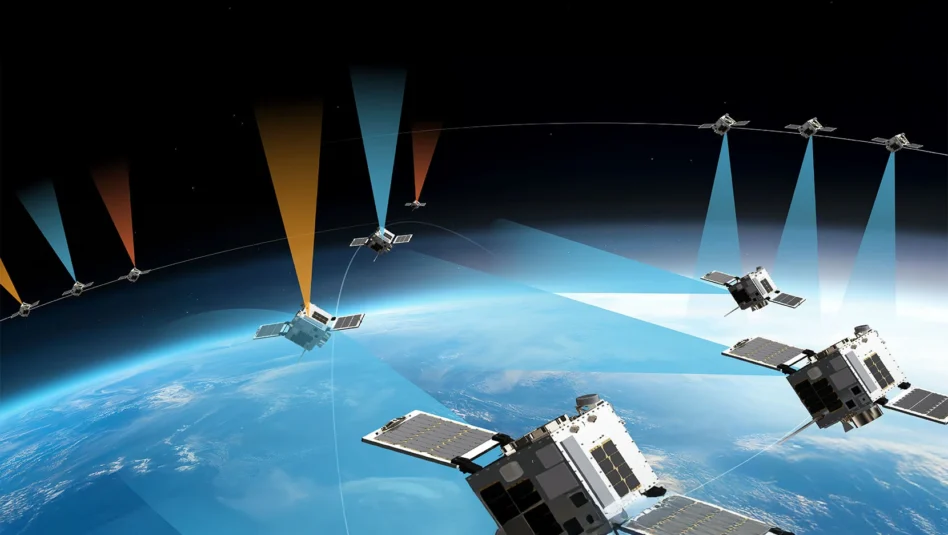
The DoD wants to better understand what’s going on in orbit. HawkEye 360 ($HAWK) has the inside scoop.
As part of a ~$1.2M AFRL Phase II SBIR awarded in 2024, HawkEye conducted a demo to see if its RF-sensing satellites—traditionally trained on terrestrial targets—could be used to spy on other satellites in orbit. Today, HawkEye released the results in a whitepaper, where the company outlined its work to detect, identify, and characterize RF signals emitting from satellites across LEO, MEO, and GEO.
“Some satellite emissions may be difficult or impossible to observe from the ground because of antenna directionality or atmospheric effects,” COO Todd Probert told Payload via email. “A space-based RF sensor can access signals and geometries that a terrestrial sensor may not.”
Eye spy: The DoD and commercial sector have gotten quite good at detecting satellites in orbit, thanks to an ever-growing network of ground-based telescopes and increasingly capable in-orbit sensors. But knowing a spacecraft’s orbital position is only half the battle.
The contract tasked HawkEye 360 with demonstrating whether its commercial RF-sensors could give the DoD more information regarding a spacecraft’s behavior—whether the satellite is transmitting, if its communicating with a particular ground station, and whether it’s altering its usual behaviors.
For the first step of this problem, HawkEye had to demonstrate whether its sensors could pick up signals from satellites in a range of orbits, each of which offered unique challenges.
- For sats flying in GEO and MEO, HawkEye was able to modify its pointing techniques to validate its ability to capture RF-signals from the target sats operating overhead.
- For sats flying in LEO, HawkEye developed new conops to enable RF-detections, despite the high relative speed and short windows for collection from the target sats.
The next step: turning this data into insights the DoD could act on.
Located in translation: HawkEye 360 developed unique processing techniques and algorithms to ensure its RF detections were matched to the right satellites, which had the added benefit of reducing false positives—and enabling automated RF-detection-missions against specified targets.
HawkEye 360 then fed all of that data into an automated-processing pipeline to enable SDA missions with limited human-in-the-loop requirements.
Altogether, the advancements HawkEye made throughout the project point to the possibility of a more robust, commercially-supplemented SDA capability within the DoD and NASA.
“This is no longer simply a question of whether commercial space-based RF can contribute to SDA. We demonstrated that it can,” Probert said. “The work now is about continuing to mature the capability and identifying where it can provide the greatest operational value across defense, civil and commercial space missions.”
US Army Welcomes First 600 Enlisted Space Soldiers
On Oct. 1, 600+ soldiers swapped their old jobs for the new 40D Tactical Space Operations Specialist military occupational specialty (MOS).
Transporter-18 Tests the Building Blocks of Orbital Data Centers
Few rideshares come with a theme, but SpaceX’s Transporter-18 had one: getting power to compute in orbit.
Star Catcher’s Orbital Power-Beaming Demo is Ready for Launch
Star Catcher announced today that its prototype power node is prepped and ready for launch NET Oct. 1.
Hubble Network Raises $200M Series C at $1.6B Valuation
The round follows a $70M Series B in September 2025, and brings Hubble’s total financing to $300M to date.


Turkey is not letting its moment in the space spotlight go to waste.
The international space community gathered in Antalya this week for the 2026 International Astronautical Congress, and representatives from Turkey are leveraging the opportunity to showcase the country’s space prowess, from arranging peace declarations to signing satellite launch deals.
During the opening ceremonies, President Recep Tayyip Erdoğan took the stage to reflect on progress made since Turkey established its National Space Program in 2021—pointing to milestones such as the country’s first ISS astronaut and the homegrown Türksat 6A satellite.
Keep reading